
The Biggest Mistake People Make with Hair Loss
You have done everything you were supposed to do.
You switched to a gentler shampoo. You started taking biotin, then tried another supplement you found online. Maybe you even changed your diet or cut back on heat styling. And still, every morning, you see more hair on the pillow, more in the drain, more in the brush than you want to.
It is frustrating. And after a while, it can start to feel personal, like your body is just not responding the way other people's do.
Here is what I want you to hear directly: it is not that hair loss is untreatable. It is that most treatments are incomplete.
I'm Jennifer Gaudet, a Nurse Practitioner at Everyday Wellness Wichita. I work with patients every day who come in after trying everything they could find on their own, and the pattern is almost always the same. They tried one thing. When that did not work, they tried another one. And when nothing seemed to stick, they started to wonder if anything ever would.
But here is the truth: most of those treatments were not wrong. They were just not enough on their own.
Hair loss is almost never caused by just one thing. It is a layered problem with multiple contributing factors, and when you only address one of them, the others keep working against you. That is why you keep trying things that feel like they should work and not seeing the results you are hoping for.
Understanding this is the foundation of how we approach hair restoration at Everyday Wellness. And once you see it clearly, the path forward starts to make a lot more sense.
Key Takeaways
Hair loss is rarely caused by a single factor.
Trying one treatment at a time is the most common reason people do not see results.
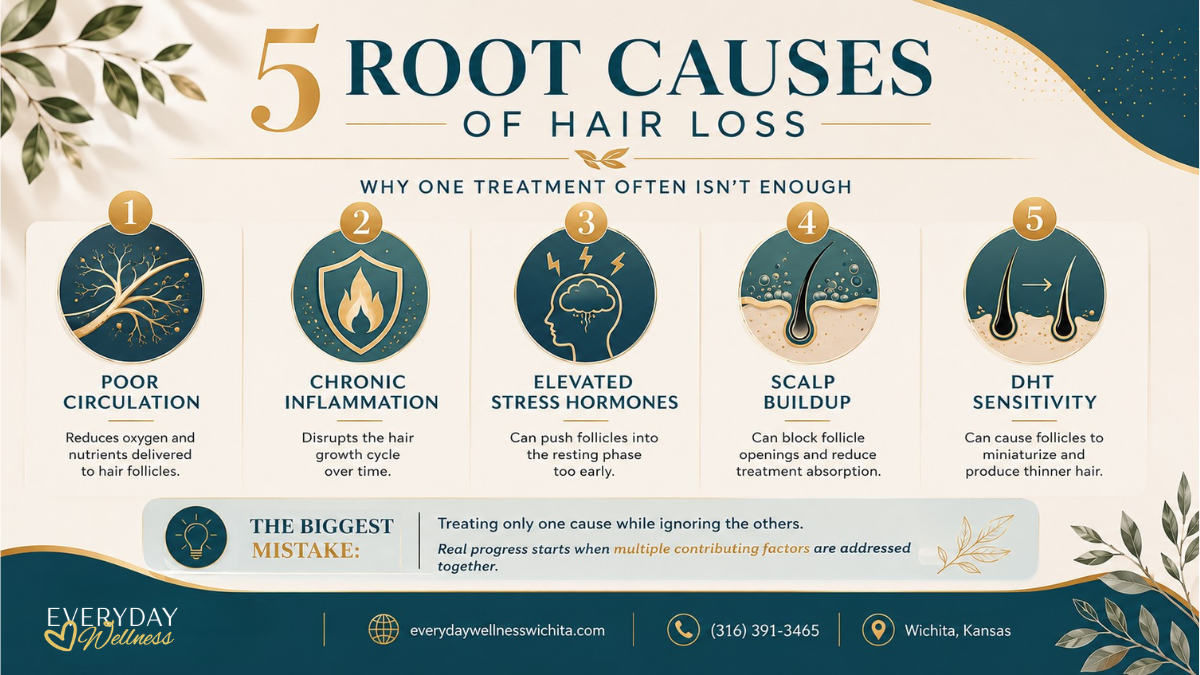
Root causes can include poor circulation, inflammation, elevated stress hormones, scalp buildup, and DHT sensitivity.
A stacked approach that addresses multiple causes at once is more effective than any single treatment.
A consultation helps identify what is actually driving your hair loss so you can build a plan that fits.
Why One Treatment Is Never Enough
Here is what most shampoo labels, supplement ads, and online articles do not tell you: they are each designed to target one specific part of the hair loss equation. And that is a problem, because hair loss does not have just one part.
Your hair follicles depend on a complex, interconnected system to function properly. When that system is disrupted, thinning and shedding can follow. But what disrupts the system is not always the same from person to person, and even within one person, there are usually several disruptions happening at the same time.
Here are the most common contributing factors we see:
Reduced circulation. Your hair follicles need a steady supply of blood, oxygen, and nutrients to stay healthy and active. When blood flow to the scalp is reduced, follicles begin to receive less of what they need. Over time, this can show up as finer, weaker strands and eventually as noticeable thinning.
Chronic inflammation. Inflammation at the scalp level can disrupt the hair growth cycle, pushing follicles out of the growth phase earlier than they should be. If inflammation is ongoing, repeated interruptions to the cycle can compound over time. Scalp irritation, redness, and sensitivity are sometimes signs that inflammation may be a contributing factor.
Elevated stress hormones. Cortisol, the body's primary stress hormone, has a well-documented relationship with hair loss. When cortisol remains elevated for extended periods, it can push hair follicles into a resting phase prematurely. This is why many people notice significant shedding in the months following prolonged stress, illness, surgery, or major life changes, sometimes long after the stressor itself has passed.
Scalp buildup. Product residue, excess sebum, and environmental debris can accumulate on the scalp and block follicle openings over time. This is often underestimated as a contributing factor. It does not feel like a medical problem, but a congested scalp is not an ideal environment for healthy hair growth. It can also reduce how effectively other treatments are absorbed and delivered where they need to go.
DHT sensitivity. Dihydrotestosterone (DHT) is a hormone derived from testosterone. Some hair follicles are genetically sensitive to DHT, which can cause them to shrink over time and eventually stop producing hair. This is one of the primary drivers of pattern hair loss in both men and women and is particularly relevant for people on testosterone therapy, who may experience increased DHT production as part of their treatment.
Most patients dealing with noticeable hair thinning or loss are experiencing two, three, or more of these factors simultaneously. That is why trying one supplement or swapping one product rarely produces the results people are hoping for. You are not doing anything wrong. You are treating a fraction of the picture.
What "Stacking" Really Means
The term "stacking" describes a straightforward concept: instead of treating one root cause at a time and waiting to see what happens, we build a plan that addresses all of the contributing factors at once.
Each treatment in a stacked protocol has a specific job. One supports blood flow. Another targets scalp health. A third addresses what is happening internally, including inflammation and stress hormone response. Another supports cellular repair at the follicle level. Together, they create conditions that are genuinely favorable to hair growth, rather than nudging one variable while the others remain unchanged.
I use this analogy with my patients: imagine your hair loss has four contributing factors. If you treat one of them, you have handled 25% of the problem. Your hair might improve slightly, but the other 75% is still working against you. Now imagine treating all four at the same time. Every layer of the problem is being addressed simultaneously, and the effects build on each other.
That is what stacking looks like in practice. And it is not about doing more for the sake of doing more. It is about being strategic: understanding which factors are driving your specific situation and selecting treatments that directly target each one.
This also changes how we interpret results. When a single supplement does not produce dramatic change in 30 days, it can feel like a failure. But when that supplement is one piece of a coordinated, multi-layer plan, its contribution becomes part of a larger, more meaningful shift. Each treatment supports the others. The effects compound. That is why this approach works when nothing else has.
The Treatments We Use at Everyday Wellness

Our hair restoration protocol draws from a carefully selected set of treatments. The combination we build for each patient depends on their individual picture, but here is what we use and why each piece matters.
Alma TED. The Alma TED uses ultrasound technology to improve blood flow to the scalp and deliver growth factors directly into the scalp tissue. It is completely non-invasive and pain-free. In fact, most of my clients fall asleep during treatment, which is one of the things I appreciate most about it. The results are real, and the experience is genuinely comfortable. I will be releasing a full video on the Alma TED next week with a deeper look at how the technology works, what to expect during a treatment session, and the results I have seen with patients.
Bloom & Grow shampoo. This is a locally made, essential-oil-based shampoo developed specifically for Everyday Wellness patients by Tiffany Hoosier, a master herbalist who owns Hoosier Health in Burton, Kansas. She created it because many of our clients going through weight loss or hormone therapy experience increased hair shedding as part of that process. It is applied directly to the scalp and used as part of a scalp health protocol to help reduce shedding and support the scalp environment. For some patients, this shampoo alone can make a meaningful difference.
Nutrafol. Nutrafol is an internal supplement formulated to support the body's response to the factors that most commonly contribute to hair loss, including elevated stress hormones, systemic inflammation, and nutritional gaps. We offer it in the clinic as a three-month supply, which is typically the minimum time needed to evaluate how a patient's body is responding. For patients on testosterone therapy who are experiencing significant shedding, we also carry the Nutrafol DHT blocker, which directly addresses DHT sensitivity.
Exosomes. For patients who may benefit from deeper cellular support, we layer in exosomes. Exosomes are growth signal messengers that support cellular repair and regeneration at the follicle level. We use the ProXO line, which includes a nightly at-home formula applied directly to the scalp before bed. We also have a version designed for use during Alma TED treatments, which can be used during the procedure for enhanced delivery. Exosomes can be used on their own or layered with the rest of the protocol, depending on where a patient is in their hair restoration journey.
Each of these treatments targets a different root cause. Alma TED addresses circulation. Bloom & Grow addresses scalp health. Nutrafol addresses internal stress and inflammation. Exosomes address cellular repair. When we use them together, we are covering every major contributing factor at once. That is what gives this approach its effectiveness.
Building Your Personal Plan
One of the questions I hear most often is: "Where do I even start?"
The honest answer is that it depends on you: on your health history, on how long the shedding has been happening, and on what else is going on in your body.
Some patients come in with mild, early-stage thinning. For them, we might start simply and see how they respond. The shampoo alone can be a meaningful first step for some people, and starting there gives us useful information.
Others come in with more significant or long-standing loss. For those patients, we typically move toward a fuller stacking protocol sooner, because they have been dealing with the problem for a while and it makes sense to address multiple contributing factors at once rather than taking a slow, sequential approach.
Then there are patients who are already receiving care at Everyday Wellness for something else, whether that is hormone therapy or a weight loss program, and who have started to notice their hair changing as part of that process. For them, we often already have important context about what is going on internally, and we can build a hair restoration plan that works alongside their existing care.
The most consistently effective plan I see is one where we stack the treatments together: internal support with Nutrafol, scalp health with Bloom & Grow, nightly cellular support with exosomes, and the Alma TED series. That is the full-picture approach, and that is where we see the strongest and most lasting results.
But we get there together. Your first appointment is a consultation where we look at your scalp, talk through your health history, and figure out what is actually contributing to your hair loss. From there, we build something specific to you. Not a generic protocol, but a real plan that makes sense for your body and your goals.
Is This Approach Right for You?
Hair thinning and loss can happen for many reasons and can feel different for different people. You might be a good candidate for a hair restoration consultation if:
You have noticed more shedding than usual in the shower, on your pillow, or when you brush your hair. Your part looks wider, or your hair feels less dense than it used to. You have tried supplements, topical products, or other treatments without seeing meaningful results. You are on testosterone therapy and have noticed changes in your hair since starting. You have been through a significant weight loss, illness, surgery, or a prolonged period of high stress. You are simply not sure what is happening with your hair and you want a professional to help you figure it out.
Hair thinning is not inevitable. It is not something you have to accept because of your age or your genes. When we approach it the right way, with a clear understanding of what is actually driving it, there is a great deal we can do.
Frequently Asked Questions
1. How do I know which treatments are right for me?
That is exactly what the consultation is designed to answer. We look at your scalp, talk through your health history and any relevant medications or treatments you are on, and identify the most likely contributing factors. You do not have to come in with a plan already in mind. You just have to come in.
2. Can I start with just one treatment and add more later?
Yes, absolutely. Some patients start with the shampoo or Nutrafol and build from there as they see how their body responds. Others prefer to begin with the full stacking protocol right away because they have been dealing with loss for a long time and want to address everything at once. We will talk through the options at your consultation and make a recommendation based on your situation.
3. How long before I see results?
This varies by patient and by the treatments involved. The Alma TED series is five treatments spaced four weeks apart, which means a five-month program for the full series. Nutrafol typically requires at least three months of consistent use before we evaluate the response. Hair growth is inherently a slow process, and meaningful change takes time. We set honest, realistic expectations from the start and check in with you throughout.
4. Is this approach only for women?
No. We work with both men and women. Hair loss patterns and root causes can differ by sex, but the stacking approach applies across the board. Men on testosterone therapy, in particular, often benefit from the DHT blocker as part of their protocol.
5. I am already a patient at Everyday Wellness for hormones or weight loss. Can I add hair restoration to my care plan?
Yes, and this is one of the most natural additions for existing patients. Many people going through hormone rebalancing or a significant weight loss program experience hair shedding as part of that process, something we can address directly. If this is something you have been noticing, mention it at your next visit or book a consultation specifically for hair restoration.
6. What makes Everyday Wellness different from other clinics that offer hair restoration?
The short answer: we look at the whole person. Our background in hormone health and metabolic wellness means we understand the internal contributors to hair loss at a level that a salon or spa setting typically does not. We are not just treating the scalp. We are treating the person, with full context about what is going on inside their body.
Ready to feel like yourself again? Let's talk.
Book your hair restoration consultation with Jen:
https://everydaywellnesswichita.com/contact
Call us: (316) 391-3465
Services: Bio-Identical Hormone Replacement Therapy (BHRT), Medical Weight Loss, Hair Restoration, Allergy Management, Esthetics
Location: 5112 E Central Ave, Wichita, KS 67208
If you want to dive in deeper, please take a look at our previous videos in this series:
Healthy Skin Starts on the Inside (Episode 1):
https://everydaywellnesswichita.com/post/healthy-skin-starts-inside-out
Meet Kenzie (Episode 2):
https://everydaywellnesswichita.com/post/what-does-acne-placement-actually-mean
Why Facials Are More Than Relaxation (Episode 3):
https://everydaywellnesswichita.com/post/facials-more-than-relaxation-root-cause-skin-wichita
The Skincare Mistakes You're Making (Episode 4):
https://everydaywellnesswichita.com/post/skincare-mistakes-hurting-your-skin
This content is for educational purposes only and is not medical advice. Treatment decisions should be made with a qualified healthcare provider who understands your symptoms, history, labs, and goals.