Trex vs. TimberTech: What 30 Years of Building Decks in Utah Taught Us
TREX VS TIMBERTECH: What 30 Years of Building Decks in Utah Taught Us
By the Warrior Built Team · Updated May 2026
After 30 years and over 3,000 completed deck projects across Utah, we have installed both Trex and TimberTech in every condition this state throws at outdoor materials — 100-degree summer days in the valley, 50-inch snowpacks in Park City, hard freeze-thaw cycles in Heber, and relentless UV at elevations above 7,000 feet.
This is not a spec-sheet comparison written by someone who has never picked up a board. This is what we have actually seen perform — and fail — in Utah's climate over three decades of installation.
In This Article:
Trex vs. TimberTech
TREX VS TIMBERTECH: What 30 Years of Building Decks in Utah Taught Us
Where They Differ - The Details That Matter in Utah
Why No Wood Fiber Matters at Elevation
Our Recommendation by Project Type
Pool Surrounds and Hot Tub Decks
High-Traffic Decks with Pets or Heavy Family Use
Which lasts longer in Utah - Trex or TimberTech?
Is TimberTech Worth the Extra Cost in Utah?
Does Composite Decking Hold up to Utah Snow?
What is the Best Decking Material for a Park City Mountain Cabin?
The Short Answer
Choose Trex if you want proven composite performance, strong scratch resistance, and a lower entry price for a Wasatch Front home with moderate sun exposure.
Choose TimberTech Advanced PVC if your deck will face heavy snow, sits above 5,000 feet, gets intense afternoon sun, or you plan to stay in the home long enough to benefit from a 50-year warranty.
Both are excellent products. Neither is the right answer for every project. Here is how we break it down for our clients.
What They Have in Common
Before getting into the differences, it is worth stating what Trex and TimberTech share. Both are composite decking systems that require no sanding, staining, or sealing. Both dramatically outlast pressure-treated wood in Utah's climate. Both carry multi-decade warranties and are installed with hidden fastener systems that produce a clean, splinter-free surface. Neither will rot, warp, or splinter the way wood does after a few Utah winters.
For homeowners replacing an old wood deck, either brand represents a significant upgrade in durability and maintenance reduction.
Where They Differ - The Details That Matter in Utah
Material Composition
TREX uses a wood-plastic composite core — recycled wood fiber and plastic bonded together, wrapped in a protective polymer cap. Trex is made from approximately 95% recycled content, which gives it strong environmental credentials and makes it one of the most widely available composite boards in the country.
TimberTech offers two distinct product types. Their composite lines (Prime, Premier) use a similar wood-fiber-and-plastic construction with a four-sided polymer cap. Their Advanced PVC lines (AZEK Vintage, Landmark, Harvest) contain no wood fiber at all — they are 100% polymer through and through. That distinction is the most important technical difference between the two brands, and it matters enormously in Utah.
Why No Wood Fiber Matters at Elevation
Wood fiber absorbs moisture. In Utah's mountain zones, decks are exposed to weeks of snow sitting on the surface, ice forming in the board gaps, and spring melt cycles that push moisture into every seam. Composite boards with wood-fiber cores — regardless of brand — are more susceptible to long-term moisture infiltration than fully capped polymer boards.
In 30 years of installations, we have seen composite boards in mountain-zone projects show edge swelling, surface micro-cracking, and cap separation at a higher rate than PVC boards in the same conditions. TimberTech's Advanced PVC eliminates this risk category entirely because there is no wood to absorb moisture in the first place.
For Wasatch Front projects at lower elevation with moderate snow exposure, the wood-fiber core in both Trex and TimberTech composite is not a significant concern. For Park City, Heber, Midway, Sundance, or any site above 6,000 feet, we recommend PVC over composite as a default.
Warranty Coverage
Trex carries a 25-year fade and stain warranty on its capped composite lines. Some premium Trex lines now offer extended coverage — always confirm the specific warranty for the collection being quoted, as it varies by product tier.
TimberTech's capped composite lines carry a 30-year fade and stain warranty. Their Advanced PVC lines carry a 50-year fade and stain warranty plus a lifetime structural warranty — the longest coverage available in the composite decking category.
For a deck built today on a Utah home, a 50-year warranty means the material is covered until 2076. That is not a marketing claim. That is TimberTech putting decades of confidence behind the performance of their PVC boards in exactly the kind of harsh-climate conditions Utah produces.
See how TimberTech and Trex compare across all product tiers on our decking materials page.
Heat Performance
All synthetic decking gets warm in direct afternoon sun. This is a real consideration in Utah where south-facing decks at altitude get intense UV exposure from late spring through early fall.
TimberTech's Advanced PVC boards are engineered to stay up to 30 degrees cooler than standard composite boards in full sun. UV radiation also increases approximately 4% per 1,000 feet of elevation. At 7,000 feet — common for Park City and mountain cabin projects — deck surfaces face roughly 28% more UV exposure than at sea level. The difference in surface temperature between a TimberTech AZEK board and a standard composite board on a south-facing Park City deck on a July afternoon is noticeable underfoot.
Trex has introduced heat-mitigating technology in select lines. For valley locations with moderate sun, this performs well. For full-sun, high-elevation installations, TimberTech's PVC remains the stronger performer in our experience.
Scratch Resistance
This is where Trex holds a meaningful advantage. Trex's premium lines — particularly Transcend — offer superior scratch resistance compared to most TimberTech composite options. For high-traffic decks, homes with dogs, or families with kids, Trex's surface durability is a genuine differentiator.
TimberTech's Advanced PVC is highly durable but slightly more susceptible to surface scratching than Trex Transcend in our observation. For a deck that will see heavy use and physical wear, factor this in.
Price
Trex is typically the more affordable entry point. Entry-level composite options such as Trex Select or TimberTech Prime generally run $60 to $75 per square foot installed. Mid-range composite lines like Trex Transcend or TimberTech Legacy fall between $75 and $95 per square foot. Premium PVC and full outdoor living builds using TimberTech AZEK or custom design features typically start at $95 and run $120 or more per square foot.
That said, price-per-board is only part of the equation. A TimberTech AZEK deck with a 50-year warranty will likely outlast two Trex composite decks in a mountain-zone environment. The long-term cost-per-year calculation often favors the higher upfront investment in PVC for high-elevation Utah builds.
Color Selection
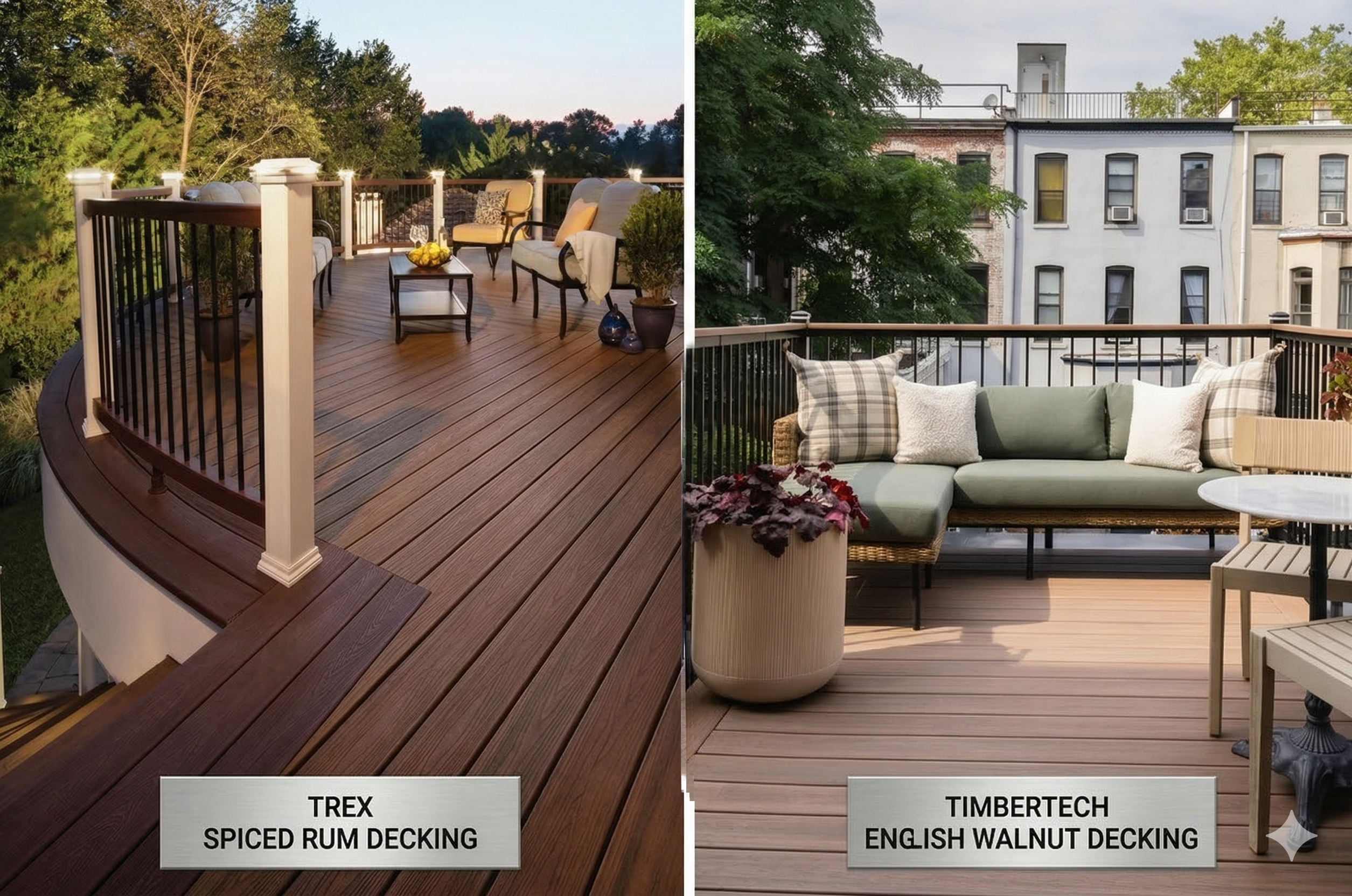
TimberTech offers approximately 40 color options across their full product lineup — more variety than any competitor. Their Advanced PVC lines in particular offer some of the most realistic wood-grain appearances available in synthetic decking. For homeowners who want the look of exotic hardwood without the maintenance, TimberTech's Vintage PVC collection is difficult to beat.
Trex offers a strong but narrower color selection, with rich natural tones and vibrant options that photograph exceptionally well and hold their appearance over time.
Our Recommendation by Project Type
Wasatch Front: Salt Lake City, Sandy, Murray, Draper, Lehi, Provo Orem
For homes below 5,000 feet with standard sun exposure and a budget-conscious scope, Trex composite is a proven performer. It installs reliably, carries strong brand recognition with buyers at resale, and delivers excellent value per square foot.
Mountain and High-Elevation - Park City, Heber, Midway, Sundance, Deer Valley
For any site above 5,500 feet, we recommend TimberTech Advanced PVC as our default specification. The wood-free core, 50-year warranty, superior UV resistance, and cooler surface performance justify the price difference when a deck will face Utah's most demanding mountain conditions.
Pool Surrounds and Hot Tub Decks
For any application with consistent moisture exposure at any elevation, TimberTech AZEK is the right material. Its fully impervious PVC construction handles constant moisture contact better than any composite board on the market.
High-Traffic Decks with Pets or Heavy Family Use
For Wasatch Front locations where surface durability matters more than UV performance, Trex Transcend is our recommendation. The scratch resistance is genuinely superior and the lower cost makes it the smarter value play for active households.
A Note on Installation
The best material in the world performs poorly if it is installed incorrectly. Both Trex and TimberTech require proper joist spacing, appropriate fastener selection, and correct gap spacing for thermal expansion — which varies at Utah elevations because boards contract more in cold temperatures than manufacturer guidelines written for moderate climates suggest.
We have re-decked projects installed by less experienced contractors where boards were gapping at two to three times the correct width in winter because expansion gaps were set for sea-level temperatures. We have also seen boards buckling in summer because gaps were set too tight. In Utah's temperature range — which can swing 80 degrees between a January night and a July afternoon — getting expansion gaps right requires local installation experience, not just manufacturer instructions.
Warrior Built has been installing composite and PVC decks in Utah since the 1990s. We know how these materials move in this climate across all four seasons. That knowledge does not come from a spec sheet.
Frequently Asked Questions
Which lasts longer in Utah - Trex or TimberTech?
TimberTech Advanced PVC carries the longer warranty at 50 years for fade and stain plus a lifetime structural warranty. For mountain and high-elevation Utah builds, TimberTech PVC's wood-free composition makes it the longer-performing choice in our installation experience. For Wasatch Front builds at lower elevation, both brands deliver comparable long-term performance.
Is TimberTech Worth the Extra Cost in Utah?
For projects above 5,000 feet or with heavy snow exposure, yes. The wood-free PVC core, 50-year warranty, and superior UV and heat performance make the price premium a sound long-term investment. For standard valley builds with moderate sun, Trex composite delivers excellent value and the price difference may not be justified.
Does Composite Decking Hold up to Utah Snow?
Both Trex and TimberTech composite hold up well under snow load when installed correctly with proper structural framing. The key is the substructure — joists, footings, and post sizing must be engineered for local snow loads, which in Utah mountain zones can reach 50 to 100 pounds per square foot. Material choice matters, but structural engineering matters more for snow performance.
What is the Best Decking Material for a Park City Mountain Cabin?
TimberTech Advanced PVC — specifically the AZEK Vintage or Landmark collections — is our standard recommendation for Park City, Heber, and Midway builds. The combination of wood-free construction, 50-year fade warranty, and superior cold-weather performance makes it the right material for Utah's most demanding mountain climate conditions.
How Much Does a Trex or TimberTech Deck Cost in Utah?
Entry-level Trex composite decks installed by Warrior Built typically start around $60 to $75 per square foot. Mid-range TimberTech composite runs $75 to $95 per square foot. Premium TimberTech AZEK PVC builds start at $95 and run $120 or more per square foot depending on scope, site access, and design complexity. Most of our completed projects fall between $25,000 and $65,000 total.
Most of our completed projects fall between $25,000 and $65,000 total. Read more abotu what affects deck costs in Utah on our homepate.
Ready to Choose?
After 30 years and 3,000+ Utah deck projects, our honest advice is this: the right material depends on your site, your elevation, your budget, and how long you plan to stay in the home. We will tell you exactly which system makes sense for your specific project — not the most expensive option, and not a generic recommendation.
Call us at 385-275-5771 or request a free consultation online.
Warrior Built Company — Utah's Premier Deck Builder. Serving Salt Lake City, Park City, Heber, Midway, Provo, and surrounding Utah communities since 1995.
