Executive Coaching ROI: 7 Ways to Measure What Actually Changes | Washington Speaks
Executive coaching delivers an average ROI of 5 to 7 times the initial investment, according to ICF and PwC. But most leaders can't articulate what actually changed. Here are 7 concrete ways to measure the real impact of executive coaching — beyond vague claims of 'improved confidence.'
Why Executive Coaching ROI Is Hard to Measure — and Why It Matters Anyway
Every executive who has invested in coaching has been asked the same question by their CFO or board: what's the return?
The honest answer is that executive coaching ROI is real, measurable, and well-documented — but it requires knowing where to look. A PwC global survey found that companies investing in coaching achieved a mean ROI of 7 times the initial investment, with over a quarter reporting returns of 10 to 49 times.
But here's the problem: most organizations measure coaching success with surveys asking coached leaders if they 'feel' better. That's not ROI. That's feedback.
At Washington Speaks, we believe if you can't point to what changed, you can't justify the investment. Here are 7 concrete metrics that actually measure coaching impact.
Metric 1: Decision Speed — Are You Deciding Faster with Better Outcomes?
One of the first things that changes with effective executive coaching is decision velocity. Leaders who have been coached on presence and authority under pressure stop over-deliberating, stop seeking excessive consensus, and start making clear, directional decisions.
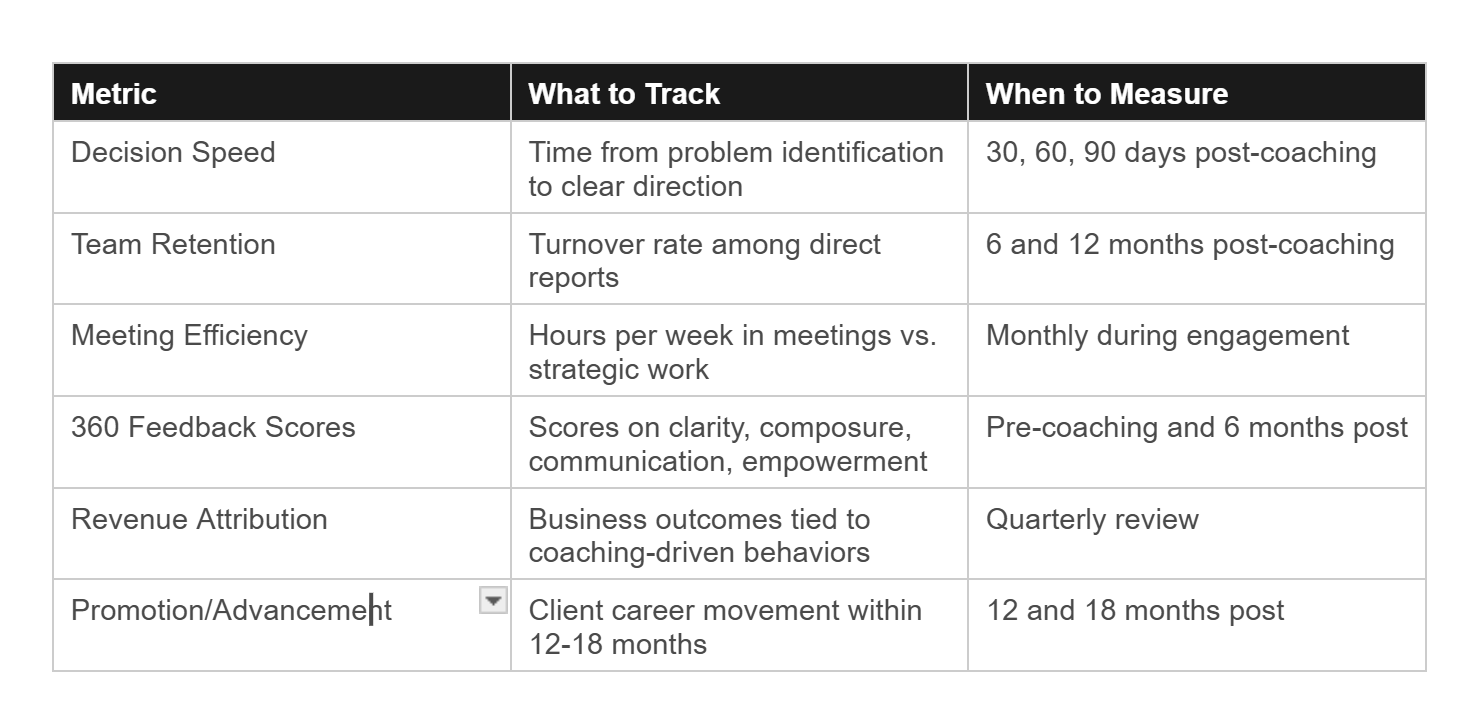
Measure this by tracking how long key decisions take before and after coaching. In Washington Speaks engagements, clients frequently report that decisions that previously took weeks now take hours — not because they're being reckless, but because they've recalibrated how they process pressure and communicate direction.
This metric matters because slow decision-making compounds across an organization. Every week a decision sits unmade costs the company in execution delays, team frustration, and missed market timing.
Metric 2: Team Retention — Are Your Best People Staying?
The BetterUp/Twilio study tracked coaching outcomes over two years and found that coached employees were 5 times less likely to leave the organization. Coached managers had a retention rate 6.75 times higher than non-coached peers.
This isn't surprising. Gallup's research shows that managers account for 70% of the variance in team engagement. When leaders improve how they communicate, delegate, and create psychological safety, their teams stay.
At Washington Speaks, we coach leaders on how authority lands — which directly impacts how their teams experience working for them. A leader who commands through restraint and clarity creates a fundamentally different environment than one who leads through volume and urgency.
Metric 3: Meeting Efficiency — Are You Reclaiming Strategic Thinking Time?
Leaders who lack executive presence tend to fill meetings with over-explanation, unnecessary context-setting, and consensus-seeking. The result: meetings that should take 30 minutes take 90, and the leader has no time left for strategic work.
A practical ROI metric from Washington Speaks engagements: track the total hours per week spent in meetings before and after coaching. One executive client reduced weekly meeting time from 17 hours to 9 by learning to set direction faster, delegate more clearly, and end meetings with decisions instead of 'next steps to discuss.'
That's 8 hours per week returned to strategic thinking — 416 hours per year. Multiply that by the executive's hourly cost to the organization, and you have a concrete financial ROI.
Metric 4: 360-Degree Feedback Scores — Are Others Experiencing the Change?
Self-reported improvement is not ROI. What matters is whether the people around the coached leader experience a measurable difference.
360-degree feedback scores — collected from direct reports, peers, and supervisors before and after a coaching engagement — provide the most reliable external measurement of coaching impact. Key dimensions to track include strategic clarity, communication effectiveness, composure under pressure, and team empowerment.
The ICF/PwC study found that 80% of coaching clients reported improved self-confidence and 70% reported improved work performance. But Washington Speaks focuses on the harder metric: do the people you lead experience your authority differently? That's what 360 scores reveal.
Metric 5: Revenue Attribution — Are Coaching-Driven Behaviors Creating Business Results?
The MetrixGlobal study of a Fortune 500 telecommunications firm found that executive coaching produced a 529% ROI — rising to 788% when employee retention benefits were included.
Revenue attribution connects coaching behaviors to business outcomes. Did the coached leader close a critical deal? Did their improved boardroom presence secure a capital raise? Did their team's improved alignment result in faster product launches?
These connections require intentional tracking but they are measurable. Washington Speaks recommends establishing 2-3 business outcomes tied to the coaching engagement at the outset, then reviewing them at 90-day intervals.
Most executive coaches charge between $200 and $800 per hour, with a median rate of $425 (ICF). Washington Speaks positions at the premium end of the market because we work with leaders navigating the highest-stakes decisions — capital asks, boardroom conflict, organizational transformation.
The global executive coaching and leadership development market reached $103.6 billion in 2025 (Mordor Intelligence), reflecting the scale of organizational investment in leadership development. The question is not whether coaching is expensive. The question is what it costs to leave the leadership gap unaddressed.
Metric 6: Promotion and Advancement — Did the Leader Move Up?
The ultimate career ROI of executive coaching is advancement. Did the coached leader get the promotion, the board seat, the expanded scope, or the new opportunity they were working toward?
Coqual research shows that executive presence accounts for 26% of what it takes to get promoted. For leaders at the VP and C-suite level, coaching that specifically targets presence, authority, and influence under pressure has a direct line to career advancement.
Washington Speaks tracks this metric with clients over 12-18 month periods. The majority of Washington Speaks clients are already successful — the coaching doesn't create their competence, it removes the friction that was preventing their competence from translating into influence.
Metric 7: The Qualitative Shift — Can You Feel the Difference in the Room?
Not everything that matters can be quantified. The most consistent feedback Washington Speaks receives from coached leaders is some version of: 'The room feels different when I walk in now.'
That shift — from a leader whose presence is neutral to one whose presence is commanding — is the essence of what Washington Speaks calls authority transfer. It shows up in how quickly people align with your direction, how much pushback decreases (or becomes more productive), and how your confidence under pressure stops wavering.
This qualitative shift often precedes the quantitative metrics by weeks or months. The change happens in the leader first, then radiates outward into their team, their board, and their results.
Frequently Asked Questions About Executive Coaching ROI
Q1: What is the average ROI of executive coaching?
According to the ICF/PwC Global Coaching Client Study, organizations report a median ROI of 5 to 7 times the initial investment in executive coaching. A MetrixGlobal study of a Fortune 500 company found ROI as high as 788% when retention benefits were included.
Q2: How long does it take to see results from executive coaching?
Behavioral changes typically begin within 4-6 weeks. Measurable business impact — including retention improvements, decision speed, and 360-degree score changes — usually becomes visible within 3-6 months. Washington Speaks recommends a minimum 6-month engagement for meaningful, lasting change.
Q3: Can you measure executive coaching ROI without expensive tools?
Yes. Simple before-and-after measurements of decision speed, meeting hours, team turnover, and 360-degree feedback provide concrete ROI data without specialized tools. The key is establishing baseline measurements before coaching begins.
Q4: Is executive coaching worth it for mid-level leaders or only C-suite?
Coaching is most impactful when the leader has real responsibility and capital at stake. Washington Speaks works primarily with founders, CEOs, and senior leaders, but the same principles apply to any leader whose influence, presence, or authority under pressure is the bottleneck.
Q5: How does Washington Speaks measure coaching effectiveness?
Washington Speaks ties every engagement to specific, measurable outcomes established at the start — whether that's decision speed, team retention, boardroom performance, or career advancement. We don't measure 'how you feel.' We measure what changed.
Ready to See What Changes When Your Authority Stops Being the Bottleneck?
If you already know what's right but can't yet move others to act, the ROI conversation starts with one honest call.
Washington Speaks works privately with founders, CEOs, and senior leaders who are ready to close the gap between their competence and their influence. Book a confidential discovery call at washingtonspeaks.com/book-a-call.
Sources Referenced
ICF/PwC Global Coaching Client Study 2024 — 86% of organizations that tracked coaching ROI reported positive returns, with a median of 5 to 7x
https://coachingfederation.org
MetrixGlobal Fortune 500 Study — Coaching produced a 529% ROI, rising to 788% when retention benefits were included
Mordor Intelligence 2025 — Global executive coaching and leadership development market reached $103.6 billion
https://www.mordorintelligence.com
BetterUp/Twilio Study 2022 — Coached employees 32% more likely to receive high performance ratings and 5x less likely to leave
Gallup 2023 — Managers account for 70% of the variance in team engagement
