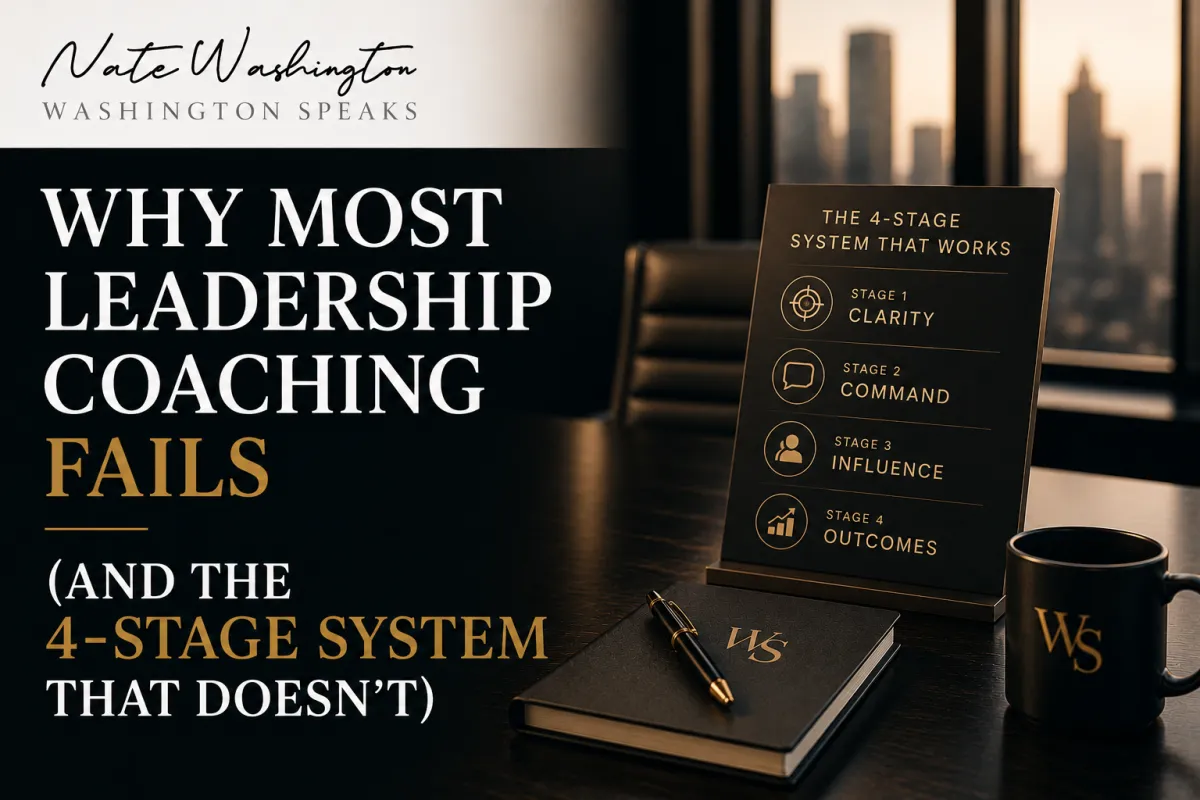
Why Most Leadership Coaching Fails (And the 4-Stage System That Doesn't) | Washington Speaks
Despite 87% of organizations reporting positive ROI from coaching, most leadership coaching fails to produce lasting behavioral change. The reason: coaches teach what to think, not how to lead under pressure. Here's why most coaching misses the mark — and the 4-stage system Washington Speaks uses instead.
The Leadership Coaching Industry Is Booming — So Why Isn't Leadership Getting Better?
The numbers tell a contradictory story. The global coaching industry reached $5.34 billion in 2025, with nearly 123,000 professional coaches worldwide (ICF). Organizations are investing more than ever in leadership development — the broader market hit $103.6 billion in 2025 (Mordor Intelligence).
And yet: 77% of CHROs lack confidence in their bench strength for critical roles (DDI). Manager engagement dropped from 30% to 27% in 2025 — a rare decline (Gallup). And 84% of companies report being unprepared for current and future disruptions (Phipps Cameron 2026).
Something isn't working. Washington Speaks believes the problem isn't that leaders aren't being coached. It's that they're being coached on the wrong things.
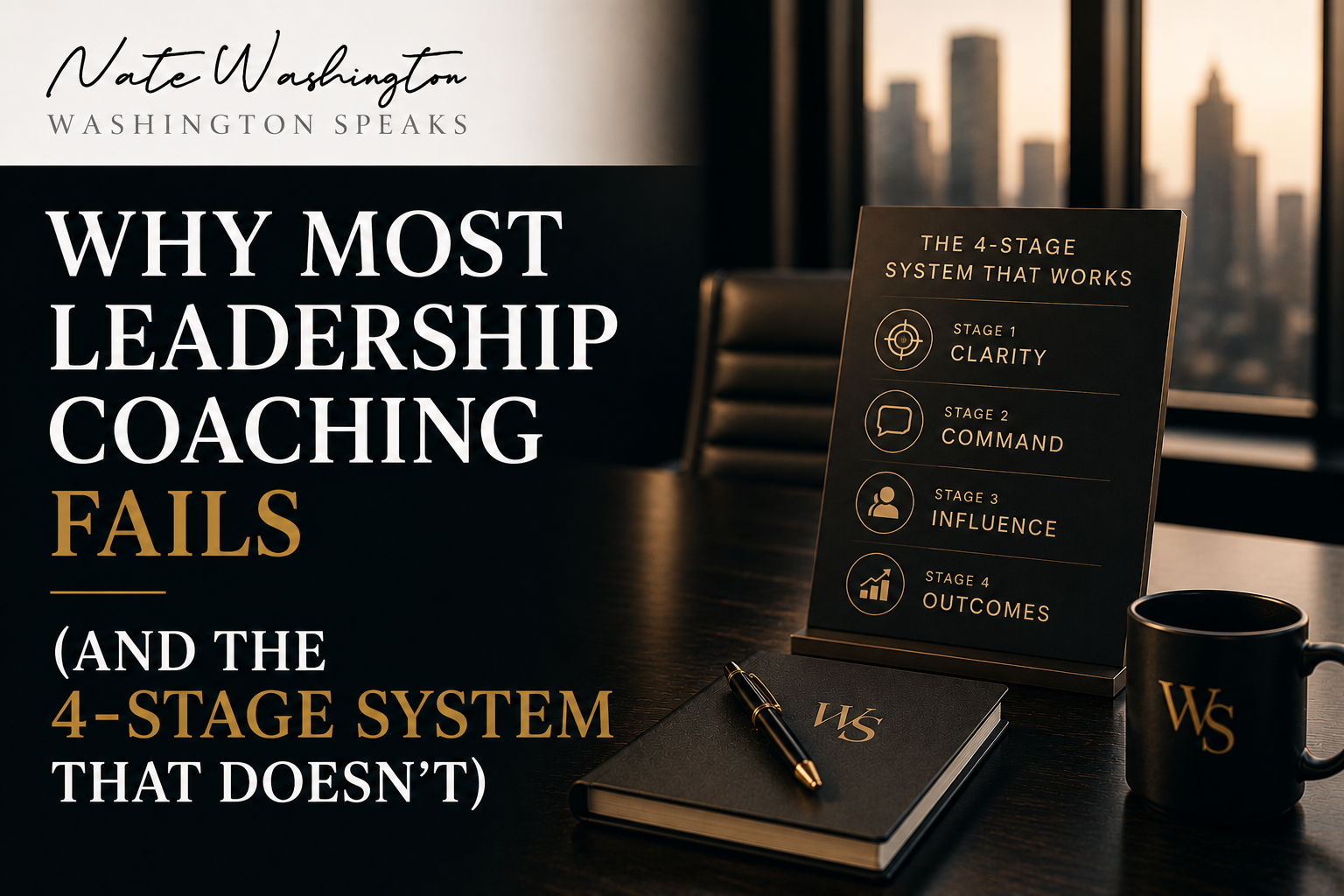
Why Does Most Leadership Coaching Fail to Create Lasting Change?
Most coaching follows a predictable pattern: assess the leader, identify gaps, teach frameworks, practice new behaviors, check in monthly. On paper, it makes sense. In practice, it produces leaders who can describe good leadership but can't execute it when the pressure is real.
The failure happens because most coaching addresses symptoms, not mechanics. Teaching a leader a 'feedback framework' doesn't change how they handle conflict when their job is on the line. Giving someone a 'decision matrix' doesn't help when the board is asking a question they don't have the answer to.
Washington Speaks was built to address this gap. We don't teach frameworks. We don't hype confidence. We don't speak about leadership in the abstract. We transfer command — meaning we train how authority actually lands in a room, under real pressure, in the moments that define careers.
What Is the Quiet Leadership Cycle — and How Is It Different?
The Quiet Leadership Cycle™ is Washington Speaks' proprietary 4-stage system for executive decision-making. Unlike linear coaching models that follow a start-to-finish progression, the Quiet Leadership Cycle is continuous — reflecting how real leadership actually works.
The four stages are: Clarity, Decision, Reflection, and Execution. Each stage connects to the next, and the cycle repeats as leaders navigate increasingly complex challenges. Around this cycle, Washington Speaks identifies seven recurring leadership tensions — the pressure points where most leaders break down.
The Quiet Leadership Cycle is not a theory exercise. It is a practical framework that leaders use to organize pressure, make decisions under uncertainty, and maintain authority through periods of growth, conflict, and transition.
Stage 1: Clarity — When Strategy No Longer Fits
The first stage of the Quiet Leadership Cycle addresses the moment when a leader's existing approach stops working. Growth outpaces strategy. Market conditions shift. The team that got you here can't get you there.
Most leaders respond to this moment by doubling down on what worked before. Washington Speaks trains leaders to recognize the signal and pause — to seek clarity before action.
The leadership tensions that surface at this stage include Vision Outpacing the Organization and Loyalty vs. Performance. These are the moments where leaders must make hard choices: hold onto the people and strategies they know, or evolve.
Stage 2: Decision — Leading Through Isolation and Pressure
The second stage is where executive presence either holds or breaks. The leader has clarity on what needs to happen — now they must decide and communicate that decision with authority.
This is where most coaching fails. Teaching someone a decision framework doesn't prepare them for the isolation of making a high-stakes call when their team disagrees, their board is watching, and the consequences are real.
Washington Speaks focuses specifically on this stage — the pressure moments where authority must land. Capital asks. Boardroom conflict. Hard conversations with co-founders. The leadership tensions here include Leaders in Isolation and The Need to Evolve.
Stage 3: Reflection — Processing What Happened Without Losing Momentum
Most high-performing leaders skip this stage entirely. They make a decision, see the result, and immediately move to the next problem. This is how good leaders become reactive leaders.
The Reflection stage of the Quiet Leadership Cycle creates structured space for leaders to assess what worked, what didn't, and what the decision revealed about their leadership. This is not journaling. This is disciplined post-action analysis that sharpens the leader's judgment for the next cycle.
The leadership tension at this stage is Cultural Drift — the slow erosion of organizational values that happens when leaders are too busy executing to notice what's changing beneath them.
Stage 4: Execution — Aligning the Organization Without Micromanaging
The final stage of the Quiet Leadership Cycle is where strategy becomes reality. The leader has achieved clarity, made the decision, reflected on the implications — now they must align their organization to execute without micromanaging every step.
This is where Washington Speaks' focus on restraint becomes critical. Leaders who lack executive presence tend to over-involve themselves in execution, creating bottlenecks and undermining their team's autonomy. Leaders who command effectively set direction, establish decision authority, and then trust the system.
The leadership tensions at this stage include Strategy No Longer Fits and Growth Exposes Fault Lines. The cycle then returns to Clarity as the organization evolves and new challenges emerge.
How Does the Quiet Leadership Cycle Compare to Traditional Coaching?
Traditional coaching models are linear: assess, plan, practice, review. They work for skill development but fail at behavioral transformation under pressure.
The Quiet Leadership Cycle is continuous, pressure-tested, and designed for leaders who are already successful but whose influence is the bottleneck. It doesn't teach new behaviors in a vacuum — it recalibrates existing behaviors in the contexts where they matter most.
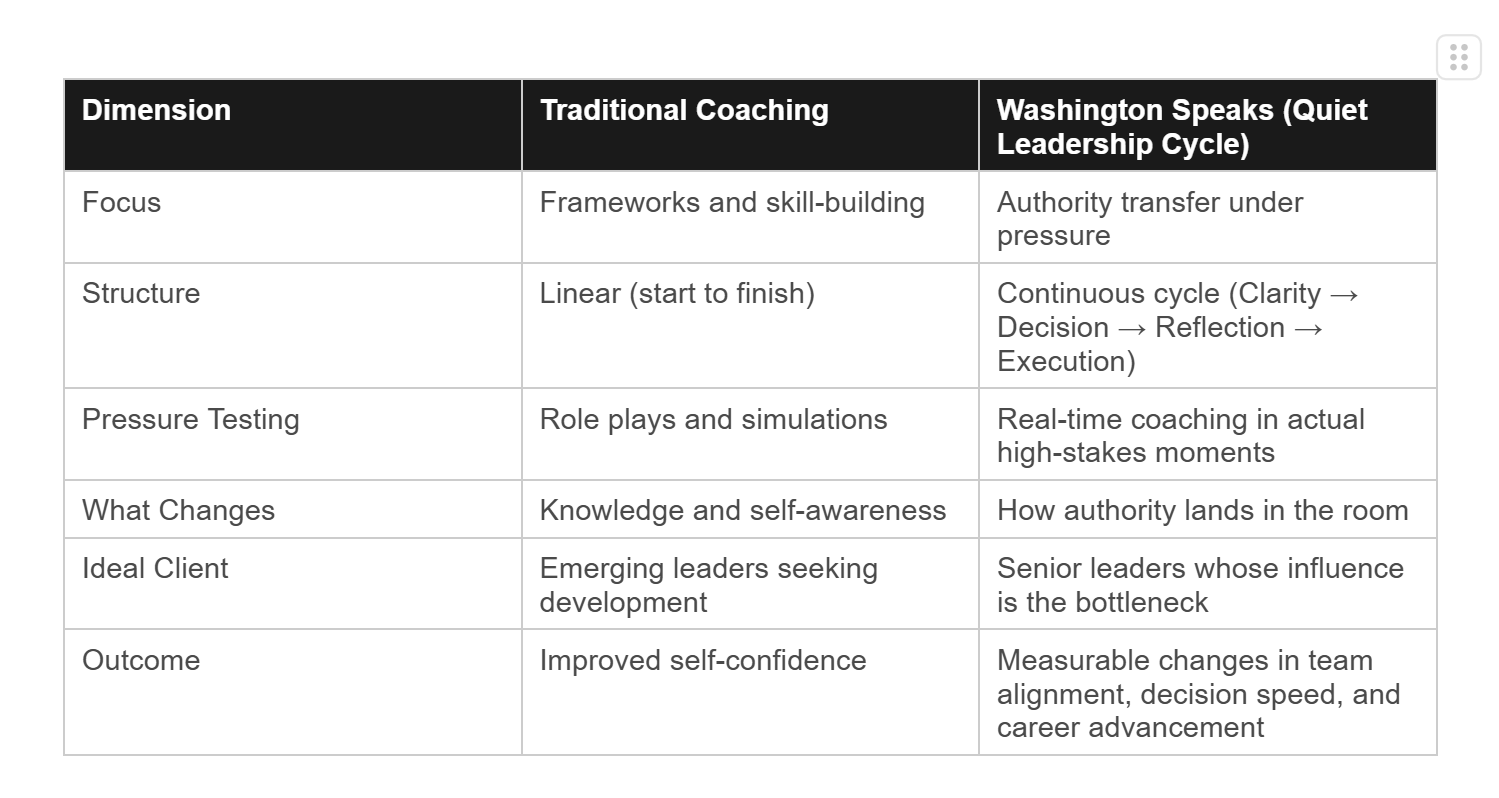
shington Speaks (Quiet Leadership Cycle)
Frequently Asked Questions About Leadership Coaching Effectiveness
Q1: Why does leadership coaching fail?
Most coaching fails because it teaches frameworks in a vacuum rather than training leaders to perform under real pressure. Leaders can describe good leadership after coaching but can't execute it when the stakes are high. Washington Speaks addresses this by focusing on authority transfer in actual pressure moments.
Q2: What is the Quiet Leadership Cycle?
The Quiet Leadership Cycle™ is Washington Speaks' proprietary 4-stage system for executive decision-making: Clarity, Decision, Reflection, and Execution. It maps seven recurring leadership tensions to the stages where they typically surface, giving leaders a practical framework for navigating complexity.
Q3: How is Washington Speaks different from other executive coaches?
Washington Speaks doesn't motivate, perform, or therapize — we transfer command. We focus on how authority actually lands in a room through presence, pacing, language, and restraint. We work with leaders who already know the right thing but can't yet move others to act.
Q4: What are the 7 leadership tensions in the Quiet Leadership Cycle?
The seven tensions are: Vision Outpaces the Organization, Loyalty vs. Performance, Leaders in Isolation, The Need to Evolve, Strategy No Longer Fits, Cultural Drift, and Growth Exposes Fault Lines. Each tension maps to specific stages of the cycle where leaders most commonly face them.
Q5: How long does the Quiet Leadership Cycle coaching engagement last?
Washington Speaks recommends a minimum 6-month engagement to work through multiple cycles and achieve lasting behavioral change. The cycle is continuous — leaders continue using it independently long after the formal coaching ends.
Ready to Stop Cycling Through Coaching That Doesn't Stick?
If you've been coached before and the change didn't last, the problem wasn't you. It was the method.
Washington Speaks works privately with founders, CEOs, and senior leaders who are done with frameworks and ready for command. Book a confidential discovery call at washingtonspeaks.com/book-a-call.
Sources Referenced
ICF/PwC 2024 — 87% of organizations report positive ROI from coaching
https://coachingfederation.org
DDI Global Leadership Forecast 2025 — 77% of CHROs lack confidence in their bench strength for critical roles
https://www.ddi.com/global-leadership-forecast-2025
Gallup 2025 — Manager engagement dropped from 30% to 27% — a rare decline
Phipps Cameron 2026 — 84% of companies report being unprepared for current and future disruptions
ICF 2025 — Global coaching industry valued at $5.34 billion with 122,974 coaches worldwide
https://coachingfederation.org
