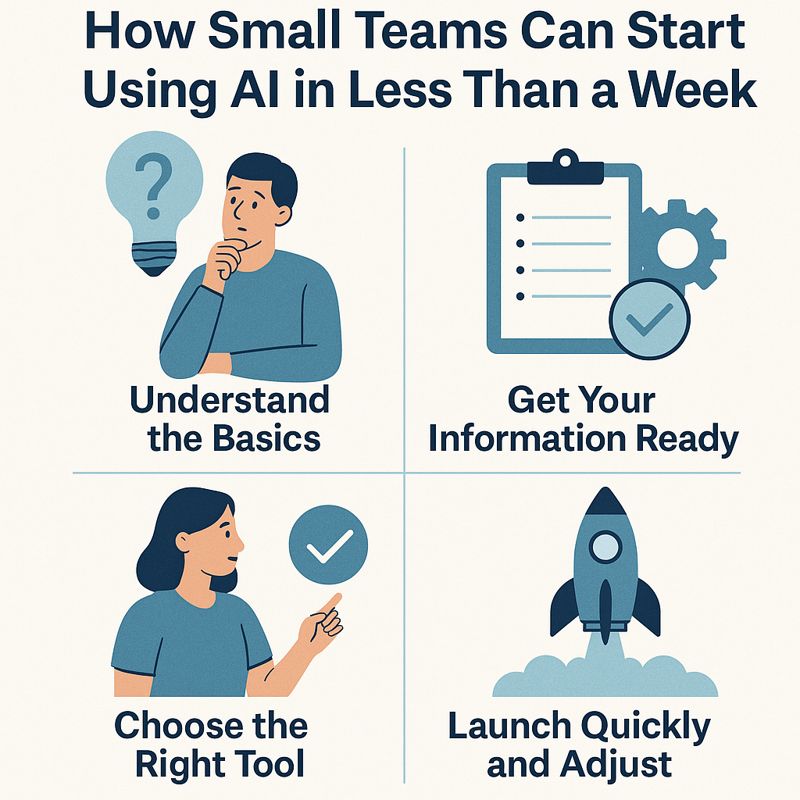
How Small Teams Can Start Using AI in Less Than a Week
How Small Teams Can Start Using AI in Less Than a Week
Customer expectations are changing faster than ever. People want quick answers, easy scheduling, and reliable communication from the businesses they reach out to. For small, locally owned service companies, this creates a challenge. The team is already busy with jobs, managing customers, and running day-to-day operations. There is rarely time to respond instantly to every call, text, email, or social media message.
This is where AI has become a powerful advantage. Not long ago, AI tools required technical knowledge and long setup times. Today, AI is built for small service teams. It is easier to implement, simpler to manage, and more affordable than hiring additional staff.
The good news is that a small business can start using AI in less than a week. With a clear plan and the right tools, even non-technical business owners can be up and running quickly. This article explains exactly how to do it and why now is the perfect time for small teams to adopt AI.
Why Small Teams Think AI Takes Too Long

Many small business owners assume AI is complicated. They picture advanced robots, coding, and expensive software that only large corporations can use. In reality, modern AI tools are built with simplicity in mind, especially for local service-based companies.
Misconceptions That Hold Businesses Back
Most business owners avoid AI because of a few common misunderstandings:
They think it requires technical skills.
In the past, automation tools were complex and required integrations or coding. This is no longer true.
They worry about breaking their current process.
Small teams operate with limited time. The idea of changing systems feels risky.
They assume training will take weeks or months.
But modern AI comes pre-trained for common situations found in service businesses.
They are unsure how AI fits into their daily workflow.
Without clarity, adoption feels overwhelming.
These concerns are reasonable, but the technology has changed. AI is now designed for everyday use and requires very little setup.
What AI Looks Like Today
AI tools today act more like team members than software. They can answer real customer questions, follow instructions, and handle basic tasks on their own. Small teams do not need to learn anything technical. They simply provide information about their services, pricing, hours, and customer process. The AI uses that information to manage communication.
AI no longer lives behind complicated dashboards. It communicates through channels customers already use like text, email, phone calls, and social messaging. Most owners are surprised by how natural it feels.
What You Need Before Getting Started
AI setup is no longer complicated. Businesses only need a few basic pieces of information.
Your Core Business Details
This includes:
The services your business offers
Pricing or typical job ranges
The locations you serve
Your hours of operation
FAQ-style answers to common customer questions
Most businesses already have this information on their website or in their notes. AI uses this to understand what customers need and how to respond.
Your Ideal Customer Flow
AI works best when it understands how you want new customers to move through the process. Small businesses simply need to clarify:
What makes a customer a “good lead”
What details they want collected up front
How appointments should be scheduled
What the next step is after qualification
This helps the AI respond in a way that matches the business’s real process.
One Central Inbox
Small teams struggle not because customers reach out, but because they reach out everywhere: text messages, social media platforms, web forms, email, and phone calls.
A central inbox pulls all conversations into one place so the team does not need to check multiple platforms. This prevents missed messages, forgotten leads, and frustration.
A Simple 5-Day Plan to Start Using AI in Less Than a Week
Here is a practical, step-by-step process any small business can follow.
Day 1: Gather Your Core Business Information
Spend 30 minutes collecting:
Services
Pricing
Service areas
Business hours
Basic FAQs
This provides the baseline for clear communication.
Day 2: Set Up Your AI Employee
You connect your communication channels such as:
Phone
SMS
Email
Web forms
Social messaging
This allows the AI to respond everywhere your customers reach out.
Day 3: Train the AI on Your Customer Journey
Show the AI:
Your qualification questions
How you schedule appointments
What information you want gathered
What makes someone a real opportunity
Training today is mostly answering simple prompts in plain language. No technical work is required.
Day 4: Test Real Conversations
Send test messages and make test calls.
Ask the AI:
Service questions
Pricing questions
Availability requests
Booking questions
This helps you fine-tune responses.
Day 5: Go Live With Real Customers
Once everything looks good, turn the AI on and let it respond to real customer inquiries.
Most businesses see improvements immediately:
Faster responses
Fewer missed calls
More booked jobs
Less manual follow up
This five-day plan works for nearly all small service teams.
How Jess Makes AI Setup Simple for Small Teams
Jess is the AI Employee built into MarketingWorks. Jess comes preconfigured with everything small businesses need to communicate with customers. This eliminates the guesswork and setup challenges owners expect.
Jess handles:
Calls
Text messages
Emails
Social media messages
Web form inquiries
Missed-call follow up
Appointment scheduling
Lead qualification
Because Jess already understands how small service businesses work, the setup takes days instead of weeks. Business owners only need to provide essential details. Jess takes care of the rest.
This makes Jess the fastest and most practical way for small teams to get started with AI.
How AI Is Evolving Around the World
AI is advancing rapidly in everyday life. People interact with AI through their phones, navigation systems, smart speakers, customer service chats, and even simple online tools.
This shift is changing expectations.
Customers no longer want to wait hours or days for responses. They expect:
Fast answers
Clear communication
Easy booking
Reliable updates
Large companies have already adopted AI to handle these expectations. They use AI to respond instantly, qualify customers, follow up, and personalize communication at scale.
Small businesses now have access to the same level of capability through tools like MarketingWorks. This levels the playing field. Businesses that adopt AI now will be aligned with where customer communication is heading.
Those who delay risk falling behind competitors who respond faster and make the process easier.
Real Examples of Small Teams Using AI Their First Week
A Local Home Service Business
A small HVAC team began using AI for after-hours calls. Instead of missed calls, every customer received an immediate response. AI booked next-day appointments automatically. The owner scheduled eight additional jobs in the first week.
A Small Contracting Business
A contractor used AI to qualify leads before doing quotes. The AI asked about project type, location, timeline, and budget. This filtered out low-value jobs and saved hours of unnecessary calls.
A Family-Owned Shop
A retail service shop used AI to manage Facebook messages, Google messages, and website inquiries all in one place. Before AI, they often missed messages because each platform required constant checking.
How AI Reduces Workload Immediately
Instant Replies to Every Inquiry
AI responds the moment someone reaches out. This prevents customers from calling competitors and dramatically increases booking rates.
Automated Follow Up
AI sends reminders, checks in with leads, and keeps conversations going until the customer is ready. Small teams often struggle to follow up consistently due to job demands. AI handles it automatically.
Scheduling and Qualification Without Back and Forth
AI can gather:
Job details
Service needs
Location
Budget
Customer preferences
It then books appointments based on your availability. This eliminates time-consuming communication loops.
Why AI Is a Smart Investment for Small Teams
AI provides value in three key ways:
Predictable Cost
An AI Employee has a simple monthly fee. There is no payroll, training, or turnover. For many businesses, it costs less than hiring additional staff.
No Training or Technical Knowledge Needed
AI tools are now built for non-technical owners. Setup is fast, and the system improves with use.
Scales Instantly
Whether five leads come in or 50 leads come in, AI responds instantly. It never gets overwhelmed.
Small teams can grow without hiring more staff and without working longer hours.
Conclusion
AI is no longer complicated or time-consuming. With the right tools, small service teams can adopt AI in less than a week. It reduces workload, improves communication, and prevents missed opportunities.
Jess from MarketingWorks makes this process simple. Jess answers calls, responds across every channel, qualifies leads, books appointments, and keeps follow up running automatically. It works like a real team member, but without the cost or complexity of hiring additional staff.
AI is evolving quickly. Businesses that start now gain a clear advantage. Those that wait risk losing customers to competitors who respond faster and communicate more consistently.
To take the next step:
Learn more at GetAnAIEmployee.com
or
Schedule your pre onboarding call with MarketingWorks
