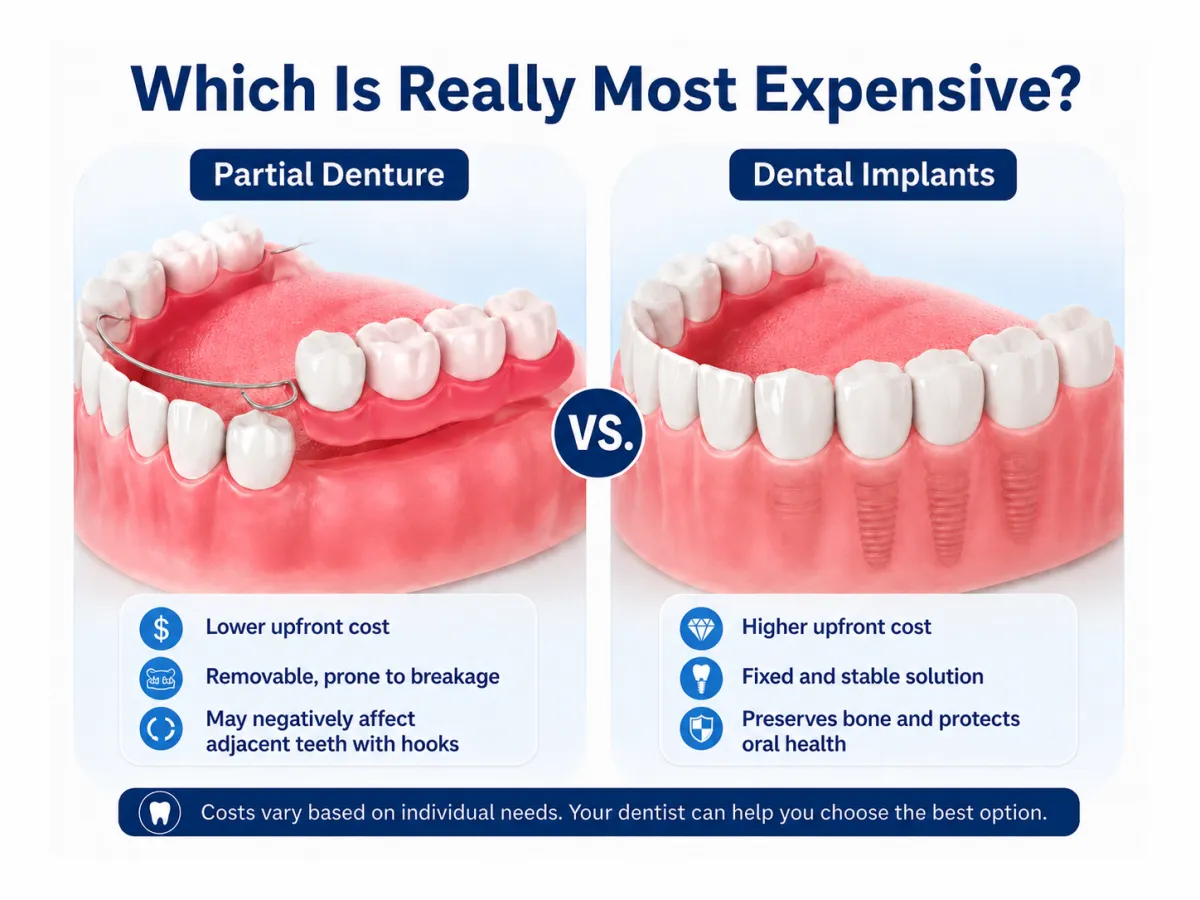
Are Removable Partial Dentures Cheaper Than Dental Implants?
Are Removable Partial Dentures Cheaper Than Dental Implants?
Dental Implant Affordability Guides
On the surface, yes. The upfront cost of a removable partial denture is considerably lower than a dental implant.
But the upfront comparison is only part of the picture — and for most patients, it’s the least important part.
The long-term cost of a partial denture, measured in replacements, repairs, damage to supporting teeth, and the clinical consequences of ongoing bone loss, tells a very different story.
Here is the complete picture before making a decision that will affect your oral health for years to come.
What Is a Removable Partial Denture?
A removable partial denture is a prosthetic device designed to replace one or more missing teeth when some natural teeth remain.
It consists of artificial teeth attached to a plastic or metal framework that clips onto the remaining natural teeth for support. The device can be removed for cleaning and is generally considered a non-surgical, lower-cost alternative to dental implants.
Flexible nylon partial dentures are among the most common type. They are lightweight, relatively comfortable initially, and made without metal clasps, which many patients find more aesthetically acceptable.
What Does a Removable Partial Denture Actually Cost?
According to the 2024 Synchrony Average Procedural Cost Study conducted by ASQ360° Market Research, the average cost of a flexible nylon partial denture in the United States is $1,761, with a range of $1,360 to $3,451.[2]
By comparison, a single dental implant typically runs between $4,000 and $6,000, depending on the practice, location, and complexity of the case.
The upfront gap is real. What matters is what happens over the following years.
What Are the Long-Term Consequences of Wearing a Partial Denture?
The challenges associated with partial dentures are not primarily about comfort in the first year. They compound over time in ways most patients don’t anticipate at the point of treatment selection.
Does a Partial Denture Stay Comfortable Over Time?
Most patients find that fit declines over time.
A partial denture cannot stimulate the jawbone the way a natural tooth root does. Without that stimulation, the bone beneath the denture gradually resorbs and changes shape. As the jawbone shrinks, the denture that once fit well begins to feel loose, creates sore spots, and requires more frequent adjustment.
This is not a fixable problem. It is the predictable result of bone loss continuing underneath a prosthetic that has no mechanism to stop it.
Can Partial Dentures Cause Bone Loss?
Partial dentures do not cause bone loss directly, but they do nothing to prevent it.
When a tooth root is absent, the jawbone receives no chewing stimulation and begins to resorb. A partial denture rests on the gum tissue above the gap. It does not replace the root. The bone loss that began at the moment of tooth loss continues regardless of whether a partial denture is in place.
Over many years, substantial bone loss can alter the shape of the jaw and the lower face, and make fitting any replacement prosthetic increasingly complex and costly.
Only a dental implant, which fuses with the jawbone and transmits chewing forces directly into the bone, can interrupt that process.
Do Partial Dentures Damage Your Natural Teeth?
This is one of the most significant and least discussed consequences of partial denture use.
Partial dentures rely on the adjacent natural teeth for support and stability. The framework clips onto those teeth, placing ongoing mechanical stress on them with every bite.
Over time, that stress — combined with the difficulty of cleaning around the clasps — increases the risk of decay and structural damage to the very teeth holding the denture in place.
Research published in the Journal of Oral Rehabilitation found that natural teeth used to stabilize removable partial dentures are disproportionately affected by cavities compared to teeth not bearing that load.[1]
When a supporting tooth develops significant decay, it can progress to periodontal disease and root infection. At that point, the patient faces a root canal, a crown, or an extraction.
If the tooth is lost, the partial denture no longer fits. A replacement must be made at full cost, and the patient now has one more missing tooth than when they started.
Can You Eat and Speak Normally With a Partial Denture?
Eating and speaking are manageable for many patients, particularly in the early period after placement.
As the fit deteriorates over time, however, chewing capacity often declines with it. Many long- term partial denture wearers gradually avoid coarse, fibrous, and nutrient-dense foods. Often the healthiest foods are the kinds that require the most biting force. That dietary restriction carries its own health cost, separate from the financial one.
Why Are Dental Implants a Better Long-Term Investment?
Dental implants address the root cause of the missing tooth problem rather than working around it.Frequently Asked Questions
Preserves Jawbone and Facial Structure
A dental implant is a titanium post painlessly placed directly into the jawbone. Once healed, the implant functions as an artificial tooth root. This transmits chewing forces into the bone and prevents the resorption that causes fit problems, facial changes, and increased complexity over time that a partial denture can lead to.
With an implant, the bone volume stays intact. The surrounding teeth are not affected. The foundation for any future restoration remains stable.
Feels and Functions Like Natural Teeth
Once placed, an implant-supported crown looks and functions like a natural tooth. There is no movement, no slipping, and no concern about the prosthetic shifting during meals or conversation.
Patients can eat coarse, fibrous, nutrient-dense foods without restriction. That is a meaningful quality-of-life difference that compounds over years of daily use.
Longevity and Durability
Research reported by the American Dental Association found that dental implants demonstrated a 95.6 percent survival rate over a 38-to-40-year follow-up period.[3]
Over that same window, a patient who started with a partial denture may have replaced it two or three times. Additionally, one or more supporting teeth may have required being treated, and potentially the loss of additional teeth is also likely to have occurred.
The implant’s primary future cost is typically a crown replacement after 15 to 20 years of wear. With routine maintenance, the underlying implant post can potentially last a lifetime.
Better Oral Health
Implants do not affect adjacent natural teeth. There are no clasps, no mechanical stress on neighboring teeth, and no elevated decay risk from hard-to-clean framework components.
Maintenance is straightforward. Brush and floss as normal. No special cleaning solutions or removal routines are required.
The Bottom Line on Partial Dentures vs. Implants
A removable partial denture costs less today. That is true.
What is equally true is that the cost doesn’t stop there. Replacements, adjustments, supporting tooth treatment, and the downstream consequences of unchecked bone loss accumulate over time. For many patients, the ten-year cost comparison is much closer than the initial estimate suggests.
Dental implants cost more upfront. They also preserve bone, protect adjacent teeth, restore full chewing function, and are designed to last decades without recurring replacement costs.
If the upfront cost of implant treatment is the barrier, that barrier is more addressable than most patients realize. Patient financing, Health Savings Accounts, personal loans, and home equity lines of credit are all tools that can structure the cost of implant treatment into manageablemonthly payments.
The Dental Implant Affordability Guides series includes dedicated guides to patient financing, Health Savings Accounts, and personal loans, covering how to make implant treatment work within a real household budget. A commonly used strategy known as ‘payment stacking’ can make most any dental implant procedure affordable.
For the complete library of affordability guides, visit MakeMyImplantsAffordable.com.
Frequently Asked Questions
References
[1] Drake CW, Beck JD. “The oral status of elderly removable partial denture wearers.” J Oral Rehabil. 1993 Jan;20(1):53–60. doi: 10.1111/j.1365-2842.1993.tb01514.x. PMID: 8429423. pubmed.ncbi.nlm.nih.gov/8429423
[2] Synchrony Financial / ASQ360° Market Research. “2024 Average Procedural Cost Study for Cosmetic, Dental, Veterinary, Vision and Other Practices Across the United States.” Cost Tables.
