Step-by-Step Guide to Preventing Choking in Babies and Toddlers
The Critical Importance of Choking Prevention
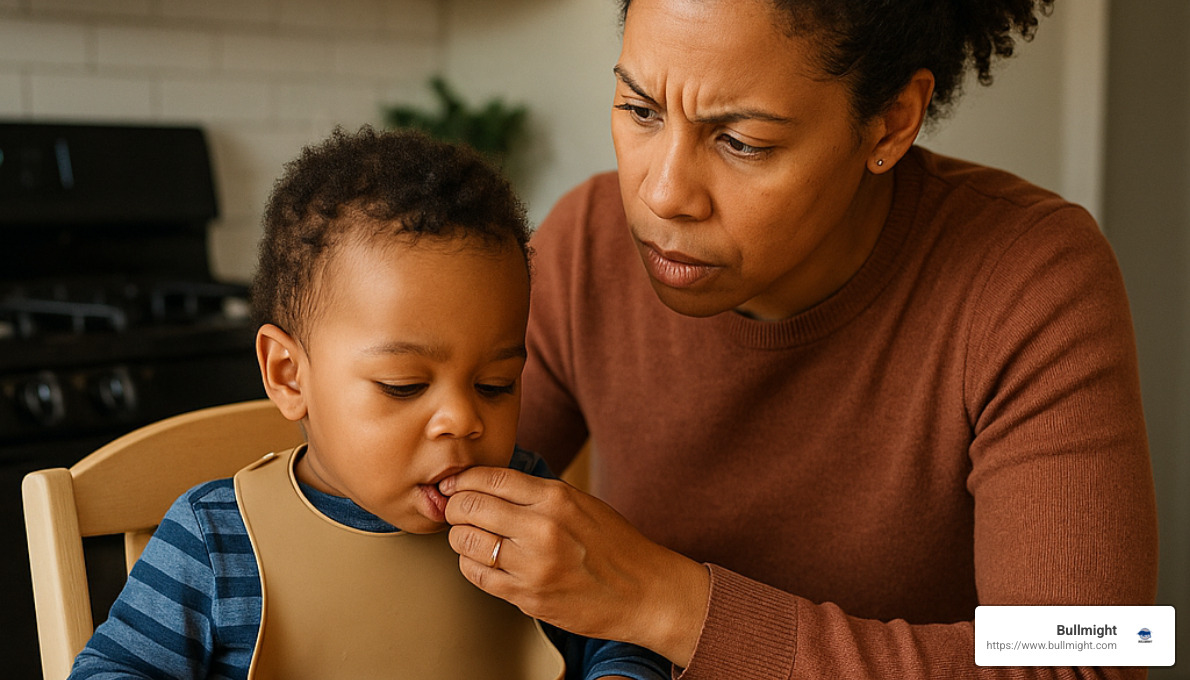
If you're searching for a Guide to Preventing Choking in Babies and Toddlers, here's what you need to know:
Key Prevention Strategies Why It Matters Supervise all mealtimes and play Choking is a leading cause of injury in children under 5Cut food into pieces smaller than 1/2 inch One child dies every five days from choking in the US Avoid high-risk foods (whole grapes, nuts, popcorn)Children under 4 are at highest risk due to developing chewing skills Keep small objects out of reach Food accounts for over 50% of choking episodes Learn infant CPR and choking first aid Quick response can prevent brain damage that begins within 4 minutes
Parents looking for complete child safety strategies can also read our guide on Building Resilience in Young Kids and The Science of Wonder in Early Learning.
Guide to Preventing Choking in Babies and Toddlers is not just important—it's essential knowledge for every parent, childcare provider, and educator. As Fred Rogers wisely said, "Anything that is human is mentionable, and anything that is mentionable can be more manageable." Choking hazards are a reality we must face head-on.
One second your child is laughing and playing; the next, they could be gasping for breath. It's a terrifying scenario, but with proper knowledge and preparation, it's largely preventable. Babies and toddlers are naturally curious and explore their world by putting things in their mouths, making them particularly vulnerable to choking incidents.
For childcare facility directors, implementing robust choking prevention protocols isn't just about safety—it's about providing peace of mind to parents and meeting regulatory requirements. Having clear guidelines protects children, reassures families, and distinguishes your facility as one that prioritizes safety above all else.
Understanding Choking in Babies and Toddlers
When we talk about choking, we're referring to something that gets stuck in a person's airway, making breathing difficult or impossible. For our little ones, this danger is magnified – their airways are tiny compared to ours, and they're still figuring out how this whole eating thing works!
Imagine for a moment how complex the act of eating actually is. For babies and toddlers who are just developing these skills, it's like learning a complicated dance between chewing, moving food around the mouth, and swallowing at just the right time. No wonder they sometimes get it wrong.
Choking can happen in two ways, and knowing the difference could save a life:
A partial blockage means your child can still make sounds – they might cough forcefully or cry. While definitely scary, this situation actually allows their natural reflexes to work on pushing out whatever's causing the problem. Your little one's body is trying to protect itself.
A complete blockage is the true emergency we all fear. When this happens, a child cannot make sounds, breathe, or cough effectively. Their face might turn blue or red as their body desperately needs oxygen. This requires immediate action – every second counts.
But why are our smallest family members so vulnerable? Several important developmental factors come into play:
Their airways are naturally smaller than adults', making blockages more likely and more dangerous. Think about trying to push a grape through a straw versus a garden hose – size matters tremendously when it comes to choking risks.
Babies and toddlers are still developing the coordination needed for eating safely. The complex dance of chewing and swallowing develops over time, not overnight. Until around age 4, children lack the molars needed to grind certain foods properly, making items like raw vegetables particularly hazardous.
Perhaps most importantly, putting objects in their mouths is a primary way babies explore their world. It's completely natural development – but also potentially dangerous. And they simply don't understand that certain objects or foods could harm them.
As pediatrician Dr. Whitney Casares explains, "Difficulty handling breast milk, formula or saliva are common causes of choking in young infants." As children grow, these risks evolve but remain significant through the toddler years.
The statistics underscore why this topic deserves our serious attention. The American Academy of Pediatrics identifies choking as the fourth leading cause of accidental death in children under age 5. This isn't meant to frighten you, but rather to emphasize why a Guide to Preventing Choking in Babies and Toddlers should be essential reading for every parent and caregiver.
According to the American Academy of Pediatrics, choking remains one of the leading causes of injury-related death in young children.
Understanding these risks is your first step toward creating a safer environment for the little ones in your care. Knowledge truly is power – especially when it comes to protecting those who depend on us most.
Strong emotional regulation and supervised routines also support safer mealtimes. Learn more in our article on Emotional Regulation for Preschoolers.
Strong emotional regulation and supervised routines also support safer mealtimes. Learn more in our article on Emotional Regulation for Preschoolers.
Common Causes of Choking in Young Children
When it comes to keeping our little ones safe, understanding what might cause choking is essential. Choking hazards typically fall into two main categories: food items and non-food objects. Being aware of these potential dangers is your first line of defense in preventing frightening choking incidents.
Did you know that in the United States, choking accounts for over 50% of choking episodes in children, with food being the most common culprit? While we often focus on food hazards, small objects found around the home can be equally dangerous to curious babies and toddlers.
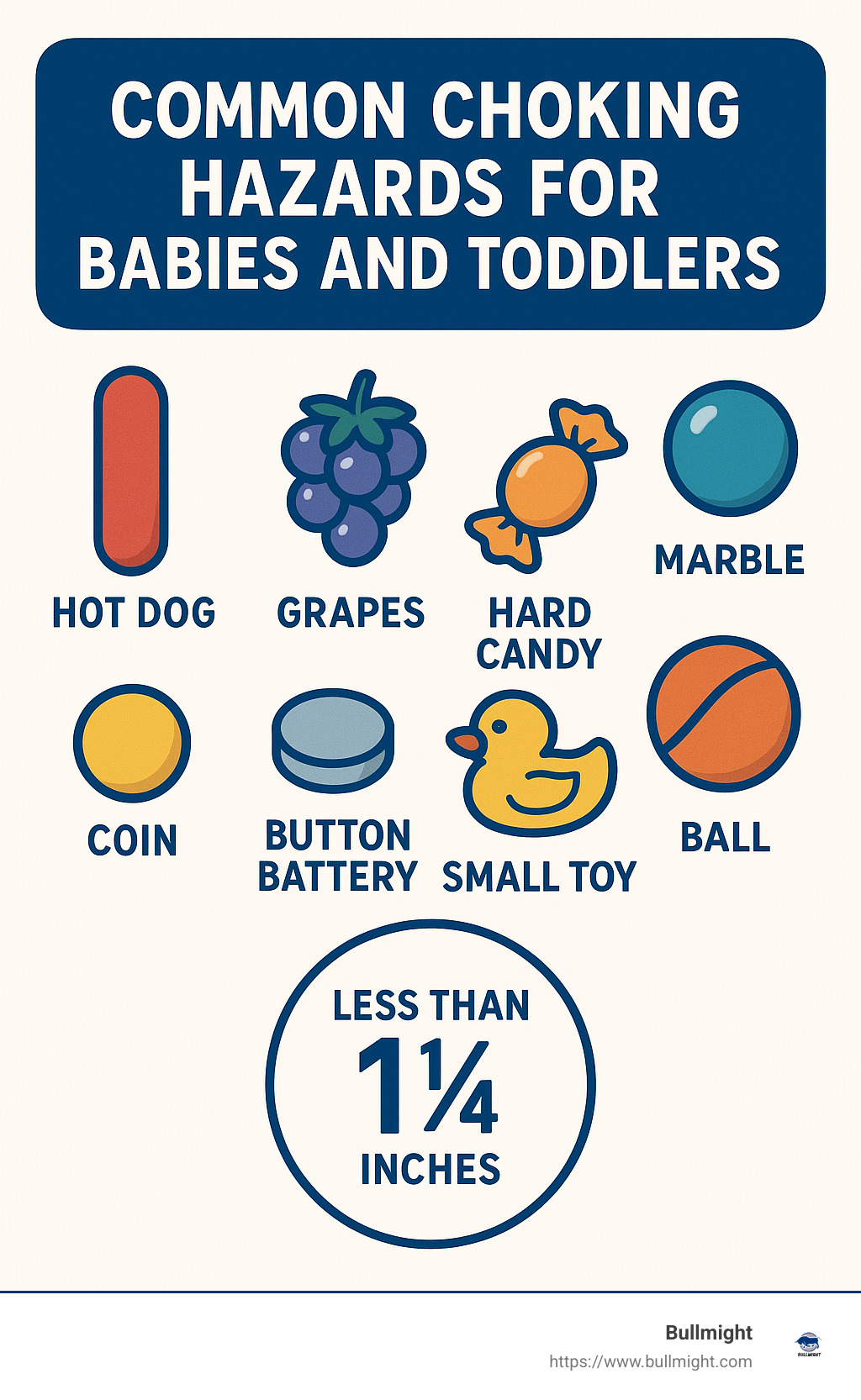
Here's a simple rule of thumb that all parents and caregivers should remember: Any object smaller than 1¼ inches in diameter or 2¼ inches in length can potentially get stuck in a child's airway. That's approximately the size of a child's throat—a sobering thought that puts into perspective how vigilant we need to be.
Food Hazards in Babies and Toddlers
The foods that pose the highest choking risks share certain characteristics that make them particularly dangerous. They're often round, hard, sticky, or just the perfect size to block an airway completely.
Hot dogs might seem like an easy food for little ones, but their cylindrical shape can perfectly block a child's airway. Always cut them lengthwise first, then into small pieces. Similarly, whole grapes and cherry tomatoes can seal a child's airway like a cork in a bottle—always quarter these round foods before serving.
Nuts and seeds have a hard texture that makes them difficult for young children to grind properly with their developing teeth. The same goes for raw vegetables like carrots, celery, and peas, which can be hard and difficult to chew thoroughly.
That movie-night favorite , popcorn, might seem harmless, but the airy kernels can be inhaled easily, while unpopped kernels are hard and dangerous. Hard candy and cough drops dissolve slowly and can easily be inhaled when a child runs or laughs.
Sticky foods present their own dangers. Peanut butter (especially in spoonfuls), caramel, marshmallows, and chewing gum can be difficult to dislodge if they get stuck. Dried fruits like raisins can be sticky and challenging for young children to manage. And chunks of meat or cheese can be too tough or large for proper chewing by little mouths.

The American Academy of Pediatrics strongly recommends that children under 4 years old should not be given hard, smooth foods that may cause choking. When introducing solid foods to babies, it's crucial to prepare them appropriately for their developmental stage—a topic covered in detail by scientific research on choking hazards for children.
Object Hazards in Babies and Toddlers
Beyond food, many everyday items in our homes pose significant choking risks. Non-food items account for a surprising number of choking incidents, and they're often things we might not immediately recognize as dangerous.
Coins top the list as among the most common non-food choking hazards for children. Their size and shininess make them irresistible to curious little hands and mouths. Even more dangerous are button batteries, which not only pose a choking risk but can cause severe chemical burns if swallowed.
Children's playtime introduces its own risks, with small toy parts that break off from toys or games not designed for young children being a common hazard. Marbles and small balls have a round shape that makes them perfect for blocking airways, while latex balloons—whether intact or, more commonly, when popped and torn into pieces—are a leading cause of choking deaths in children.
Everyday items like safety pins, paperclips, and jewelry might seem harmless but can be dangerous in tiny hands. Magnets present a unique danger because if multiple magnets are swallowed, they can attract through intestinal walls, causing serious damage beyond just choking.
Other items to watch for include pen or marker caps, whose size and shape make them particularly dangerous, small hair bows, barrettes, and rubber bands that attract babies' attention, and disc batteries which, like button batteries, can cause chemical burns and tissue damage.
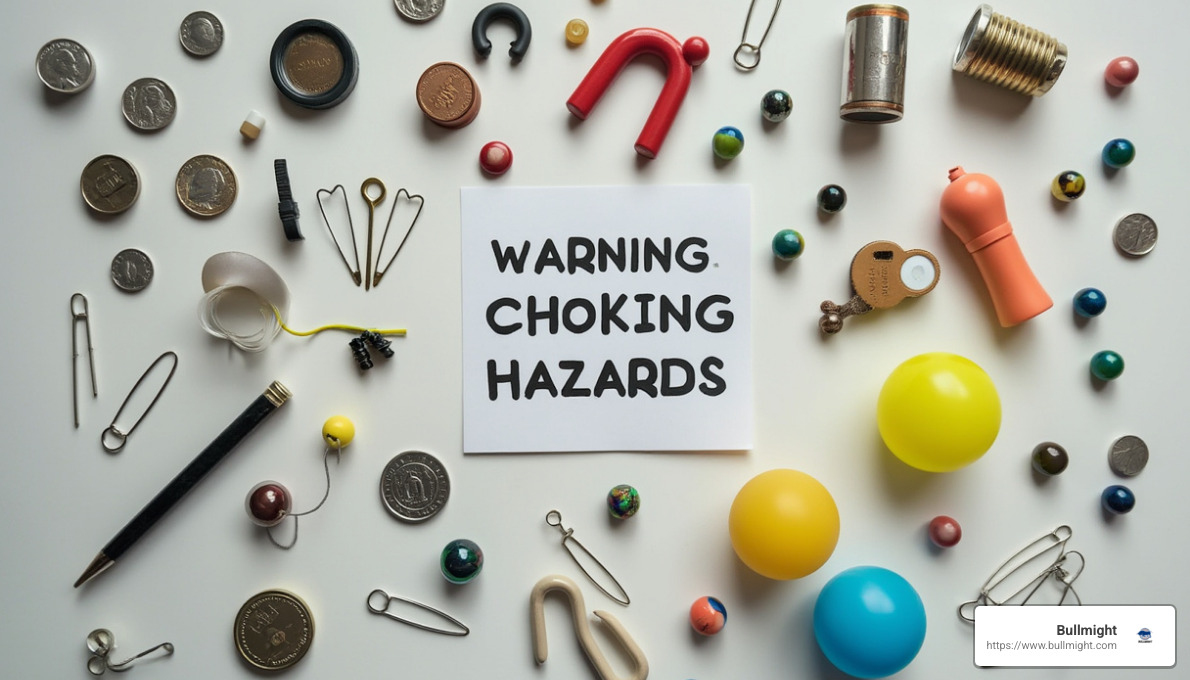
As Dr. Joan E. Shook, MD, MBA, wisely points out, "Infants have a relatively limited repertoire of things they can do for themselves." This natural limitation means adults must be vigilant about what objects are within a child's reach—a responsibility we simply cannot take lightly.
For childcare facilities, implementing rigorous safety checks throughout the day isn't just a good idea—it's essential. At Kids Haven Learning Center , we recommend that childcare centers develop comprehensive safety protocols that include regular sweeps for small objects and clear guidelines for age-appropriate toys and activities. These simple steps can make all the difference in creating a safe environment where children can thrive without unnecessary risks.
Creating a Guide to Preventing Choking in Babies and Toddlers for your facility not only protects the children in your care but also demonstrates to parents your commitment to providing the safest possible environment for their little ones.
Guide to Preventing Choking in Babies and Toddlers: Essential Safety Strategies
When it comes to our little ones, prevention is always better than reaction. Creating a safe environment for babies and toddlers requires thoughtful planning and consistent vigilance—especially when it comes to choking hazards.
As parents and caregivers, we have the power to significantly reduce choking risks through simple, everyday practices. The peace of mind that comes from knowing you've created a safer space for children is invaluable, particularly in childcare settings where multiple children need protection.
Let's explore the essential strategies that should be part of any Guide to Preventing Choking in Babies and Toddlers:
Active supervision is your first and most powerful tool. Never leave young children alone while eating or playing—not even for a moment. Those few seconds you step away could be when a curious toddler finds something fascinating to put in their mouth.
Creating safe environments means getting down to a child's eye level. What might seem perfectly safe from adult height can look very different from a baby's perspective. Regular safety sweeps of play areas can catch small objects before they become dangers.
Knowing what's developmentally appropriate is crucial. Both foods and toys should match your child's abilities—what's safe for a 4-year-old could be dangerous for an 18-month-old. Always follow age recommendations on toys and introduce foods at appropriate stages.
Food preparation deserves special attention. The way you cut, cook, and serve food can make all the difference between a nutritious meal and a potential hazard. We'll explore specific techniques shortly.
Teaching good eating habits early sets children up for lifetime safety. This includes sitting while eating, taking manageable bites, and chewing thoroughly before swallowing.
Finally, despite our best efforts, emergencies can happen. Being prepared with first aid knowledge gives you confidence to act quickly if needed.

In childcare settings, we recommend implementing what we call a "child's-eye view policy." This means staff regularly get down on their hands and knees to see the environment as children do. This simple practice reveals hazards that might otherwise go unnoticed—the forgotten bead under a table or small button that rolled behind a toy shelf.
Guide to Preventing Choking During Mealtime for Babies and Toddlers
Mealtime brings families together but also presents one of the highest-risk periods for choking incidents. Creating safer mealtimes doesn't have to be complicated or take away from the joy of eating together.
Proper food preparation is your foundation for mealtime safety. For toddlers, food should be cut into pieces no larger than ½ inch—roughly the size of a nickel. Babies need even more careful preparation with foods pureed smooth or soft enough to mash easily between your fingers. As one experienced pediatric nurse told me, "When in doubt, go smaller than you think necessary. No one ever had an emergency from food that was cut too small."
Cooking foods to appropriate softness makes them easier for little ones to manage. Hard vegetables like carrots should be steamed or boiled until they can be easily pierced with a fork. Young children don't have all their molars yet, making grinding tough foods difficult.
High-risk foods need special attention. Those perfectly round grapes that seem so convenient? They're actually shaped ideally to block a child's airway. Instead, cut them into quarters, not just halves. Hot dogs should be sliced lengthwise first, then into small pieces to change their shape from circular to irregular.
Seated eating only is a rule worth enforcing consistently. Children should always sit upright while eating—never lying down, walking, running, or playing. This position helps them focus on the mechanics of eating and reduces the risk of food going down "the wrong pipe."
"Always supervise babies and young children when they are eating," emphasizes Dr. Laura Jana, pediatrician and author. This supervision isn't passive watching—it means being fully present, engaged, and ready to respond if needed.
The Centers for Disease Control and Prevention (CDC) recommends careful food preparation for children under age 4.
For babies just starting on solid foods, follow a thoughtful progression. Begin with smooth purees, then gradually introduce mashed foods with soft lumps. As their skills develop, move to soft finger foods cut into appropriate sizes, eventually introducing more textures as their chewing abilities mature.
Guide to Preventing Choking During Playtime for Babies and Toddlers
Play environments can contain hidden dangers when it comes to choking hazards. Creating safer play spaces means thinking proactively about what could potentially cause problems.
Age-appropriate toys provide the right foundation for safe play. Manufacturers' age recommendations aren't arbitrary—they're carefully determined based on developmental stages and safety considerations, including choking hazards. Trust these guidelines, even when your child seems advanced for their age.
Regular toy inspection should become second nature. Check toys frequently for broken parts, pieces that could detach, or wear and tear that might create hazards. That favorite stuffed animal with the loose button eye? It needs repair before it goes back in the toy box.
Thoughtful toy storage matters more than you might think. Keep toys for older children completely separate from those for babies and toddlers. Many childcare centers use color-coded bins to ensure toys with small parts never mix with infant toys.
The small parts testis a practical tool anyone can use. If an object fits entirely inside a toilet paper tube (or commercial small parts tester), it's too small for children under 3. This simple test can help you make quick decisions about borderline items.
Regular floor checks catch the small objects that inevitably find their way to the ground. Get down on hands and knees to spot items from a child's perspective—you'll be surprised what you find that standing inspections miss.
Sibling awareness requires ongoing conversation. Older children need gentle reminders about keeping their small toys away from curious younger siblings. Frame it as an opportunity for them to be helpers and protectors, not as a restriction.
Certain items deserve special vigilance. Be particularly watchful about coins, batteries (especially button batteries), magnets, and balloons. These items are responsible for some of the most serious choking incidents and injuries.
For childcare facilities, implementing a documented "safety sweep" at regular intervals throughout the day provides both protection and peace of mind. This systematic check for small objects should become as routine as handwashing—a non-negotiable part of your safety protocols.

Creating a safe environment isn't a one-time effort—it's an ongoing commitment that evolves as children grow and develop new skills. By implementing these strategies consistently, you're creating layers of protection that significantly reduce choking risks for the little ones in your care.
For more information about creating comprehensive safe environments for children, visit this helpful resource.
Emergency Response: What to Do If Your Child Is Choking
Even with the most vigilant prevention efforts, choking emergencies can still happen in the blink of an eye. When seconds count, knowing exactly what to do can make all the difference. The reality is sobering: permanent brain damage can begin within just 4 minutes when oxygen is cut off.
Before you can help, you need to recognize what choking actually looks like. It's not always as dramatic as we see in movies. The signs that should trigger immediate action include:
A child who suddenly cannot cry, cough, or speak is showing the most alarming sign of a complete airway blockage. You might hear high-pitched wheezing sounds when they try to breathe in, which indicates air struggling to pass through a partially blocked airway. Their face may develop a bluish or reddish color as oxygen levels drop. Look for panic in their eyes or frantic pointing toward their throat—even very young children instinctively signal this way when choking. Weak, ineffective coughing suggests they're struggling but cannot clear the blockage themselves.
One common confusion for parents and caregivers is distinguishing between gagging and choking. Gagging is actually a protective reflex that includes retching sounds, strong coughing, or crying. When a child is gagging, they're working to protect their airway—and in most cases, you should monitor but not interfere, as intervention might accidentally push an object deeper.
True choking, however, demands immediate action.
Responding to a Choking Infant (Under 1 Year)
Babies require a different approach than older children when choking. Their tiny bodies and developing structures need gentle but firm techniques:
Position your baby face down along your forearm, using your thigh for support. Keep their head lower than their chest—this uses gravity to help dislodge the object. With the heel of your hand (not your fingers), deliver five firm back blows right between the infant's shoulder blades. These should be purposeful and robust, but not so hard that you risk causing injury.
After the back blows, carefully turn the baby over while supporting their head. Check if the object has become visible in their mouth. If you can clearly see it and safely reach it, remove it with your fingertip. Never perform blind finger sweeps—you might accidentally push the object deeper.
If the blockage remains, position the baby face-up on your forearm, maintaining the head-lower-than-chest position. Place two fingers in the center of the baby's chest just below the nipple line and give five quick chest thrusts, pressing about 1½ inches deep. These thrusts create artificial coughs that can help expel the object.
Continue alternating between five back blows and five chest thrusts until either the object comes out or the baby becomes unresponsive. If your baby loses consciousness, the situation has escalated to a critical emergency. Place them on a firm, flat surface, call 911 immediately (or have someone else call), and begin infant CPR.

Responding to a Choking Toddler (Over 1 Year)
For children older than one, the approach changes to incorporate the Heimlich maneuver (abdominal thrusts):
First, quickly assess whether they're truly choking or just coughing. Simply ask, "Are you choking?" A child who can speak, cry loudly, or cough forcefully still has a partially open airway. In this case, encourage them to keep coughing, as their body is working to clear the blockage naturally.
For a child who cannot respond, position yourself behind them, either standing or kneeling depending on their size. Wrap your arms around their waist and make a fist with one hand. The thumb side of your fist should rest against their abdomen, just above the navel but well below the ribcage—this is the sweet spot for effective thrusts.
Grasp your fist with your other hand and deliver quick, upward thrusts. These should be forceful but controlled. Continue until the object is expelled or the child loses consciousness.
If the child becomes unresponsive, the situation has escalated to a critical emergency. Carefully lower them to the ground, call 911 immediately, and begin CPR. CPR for a child differs slightly from adult CPR, using less force appropriate to their smaller body.
"The most important thing is to act quickly but calmly," says pediatric emergency physician Dr. Elizabeth Murray. "Panic can waste precious seconds. Trust your training and focus on the techniques."
Even after successfully removing a choking hazard, seek medical attention. There could be unseen injuries, remaining fragments, or damage to the throat or airway that needs professional assessment. Some complications might not be immediately apparent but could develop hours later.
The American Red Cross offers excellent resources on infant choking response and regularly updates their protocols based on the latest medical research. Consider bookmarking their page on your facility's computers for quick reference in an emergency.
Your confident response in those first critical moments can truly be the difference between life and death. This isn't meant to frighten, but to empower—knowledge saves lives.
Training and Preparation for Caregivers
When it comes to choking emergencies, knowing what to do in theory is one thing – but having the muscle memory and confidence to act quickly is something else entirely. That's why hands-on training is absolutely essential for anyone caring for young children.
I'll never forget what a pediatric emergency nurse once told me: "In a crisis, we don't rise to the occasion – we fall to the level of our training." This couldn't be more true when facing a choking child and every second counts.
For childcare centers, having properly trained staff isn't just a nice-to-have – it's often legally required. The American Academy of Pediatrics strongly recommends that licensed childcare facilities always have at least one employee with current first aid and CPR certification present at all times.
Taking a certified course should be your first priority if you care for children. Organizations like the American Red Cross and American Heart Association offer specialized training focused specifically on infant and child emergencies. These courses provide hands-on practice with mannequins, giving you the physical experience of performing the techniques correctly.
"Hands-on training is invaluable," explains Dr. Elizabeth Murray, pediatric emergency physician. "Instructions over the phone during an emergency may not be sufficient in high-stress moments when your adrenaline is pumping and a child's life is at stake."
Skills deteriorate over time without practice. Many certifications require renewal every two years, but consider refreshing your skills more frequently. Some childcare centers organize quarterly practice sessions to keep techniques fresh in everyone's mind.
Having clear emergency response plans posted where everyone can see them is another crucial preparation step. These visual guides should outline exactly what to do in a choking emergency, with simple steps that anyone can follow. Consider placing these in dining areas and classrooms where choking risks are highest.
Communication systems need to be rock-solid in childcare environments. This means ensuring phones are always charged and accessible, emergency numbers are pre-programmed, and parent contact information is up-to-date and readily available. Some centers have implemented emergency notification systems that can alert all staff simultaneously if help is needed.
Having the right emergency supplies on hand matters too. While choking rescue generally doesn't require special equipment, having a properly stocked first aid kit nearby can help with any injuries that might occur during a choking incident or its aftermath.
At Our Learning Center , we help childcare facilities develop comprehensive safety protocols that include emergency preparedness. We've found that highlighting these safety measures in marketing materials resonates deeply with parents who are evaluating childcare options. Today's parents are increasingly safety-conscious and often look specifically for facilities that prioritize staff training and emergency readiness.
For families at home, the preparation process is similar but scaled to the home environment. Taking infant/child CPR courses as a family ensures everyone from older siblings to grandparents knows what to do in an emergency. Creating a home emergency plan with clearly assigned roles can prevent confusion during a crisis. And don't forget to program emergency numbers into everyone's phones – including poison control and your pediatrician's after-hours line.
Child development experts at HealthyChildren.org provide additional guidance on age-appropriate feeding and supervision.
Some families also consider adding a choking rescue device to their home first aid kit. While these should never replace proper training, they can provide an additional tool in emergency situations.
The bottom line? In a choking emergency, a confident, well-trained responder gives a child the best chance of a positive outcome. As one childcare director put it, "The peace of mind that comes from knowing my entire staff is prepared to handle a choking emergency is immeasurable – both for me and for the parents who trust us with their children."
Frequently Asked Questions about Preventing Choking in Babies and Toddlers
What are the most effective ways to prevent choking in babies and toddlers?
When parents ask me about the most effective ways to keep their little ones safe from choking hazards, I always emphasize that prevention starts with awareness and vigilance.
Constant supervision during meals and playtime is your first line of defense. I know it's impossible to watch your child every second, but during high-risk activities like eating, your full attention can make all the difference. One mom told me she now puts her phone away completely during mealtimes after her toddler started choking while she was briefly checking an email.
Proper food preparation is absolutely crucial. This means cutting foods into pieces smaller than half an inch (smaller than a child's airway), cooking vegetables until they're soft enough to mash with a fork, and being particularly careful with round foods like grapes. I still remember how a childcare provider once showed me a grape next to a child's airway model—the size match was frighteningly perfect!
Creating a safe environment means getting down on your hands and knees regularly to spot small objects from your child's perspective. Those tiny LEGO pieces, coins, or button batteries that seem harmless to us can be deadly when placed in small mouths.
For childcare facilities, implementing these strategies isn't just good practice—it's essential protection. Having documented safety protocols provides peace of mind to parents and meets regulatory requirements. At Our Learning Center , we've seen how facilities that highlight their safety measures in their marketing materials often attract more families who recognize this commitment to child wellbeing.
Which foods pose the highest choking risks and should be avoided?
Not all foods are created equal when it comes to choking risks. Some should be completely off the menu for children under 4, while others just need special preparation.
Foods to avoid entirely include hard candies and cough drops, which account for a surprising number of emergency room visits each year. Whole nuts and seeds are particularly dangerous due to their size and hardness. Popcorn might seem like a harmless snack, but those airy kernels can be easily inhaled, while unpopped kernels are extremely hard. Chewing gum, marshmallows, and hard raw vegetables round out the "no" list.
Then there are foods that can be served with proper preparation. Hot dogs(the number one choking culprit according to many studies) should be cut lengthwise first, then into small pieces—never in coin-shaped slices. Grapes and cherry tomatoes need to be quartered, not just halved. Chunks of meat should be cut smaller than half an inch, and peanut butter should only be spread thinly, never given by the spoonful where it can form a sticky plug.
I once spoke with a pediatric ER doctor who said, "If I could eliminate just one food from children's diets to prevent choking, it would be whole grapes." That statement has stuck with me, and I always share it with parents who might not realize the dangers of certain everyday foods.
As your child grows and develops better chewing abilities, these restrictions can gradually relax—but caution is still warranted until at least age 4, when children have developed more mature eating skills.
How do I perform first aid on a choking infant or toddler?
Knowing how to respond in a choking emergency is knowledge I hope you'll never need to use—but it's absolutely essential to have. The techniques differ depending on your child's age, and nothing replaces hands-on training from a certified course.
For an infant under 1 year who's choking:
Position your baby face down along your forearm, with their head lower than their chest and supported by your hand. Using the heel of your other hand, deliver 5 firm back blows between their shoulder blades. Then turn the baby face up on your forearm or thigh and give 5 chest thrusts using two fingers placed just below the nipple line. Keep alternating between these techniques until the object is dislodged or help arrives.
For a child over 1 year:
Stand behind your child and wrap your arms around their waist. Make a fist with one hand and place it just above their navel. Grasp your fist with your other hand and give quick, upward and inward thrusts—not too hard, but with enough force to create artificial coughs. Continue until the object is expelled.
If either a baby or child becomes unresponsive during a choking episode, you'll need to begin CPR immediately and call 911.
One mother I worked with shared how she had practiced these techniques repeatedly on a doll, thinking she was being overly cautious. When her 10-month-old choked on a piece of apple that had fallen from the counter, she said her hands "just knew what to do" because of that practice. Her story reinforces why taking a certified first aid course is so valuable—these aren't skills you want to learn for the first time during an emergency.
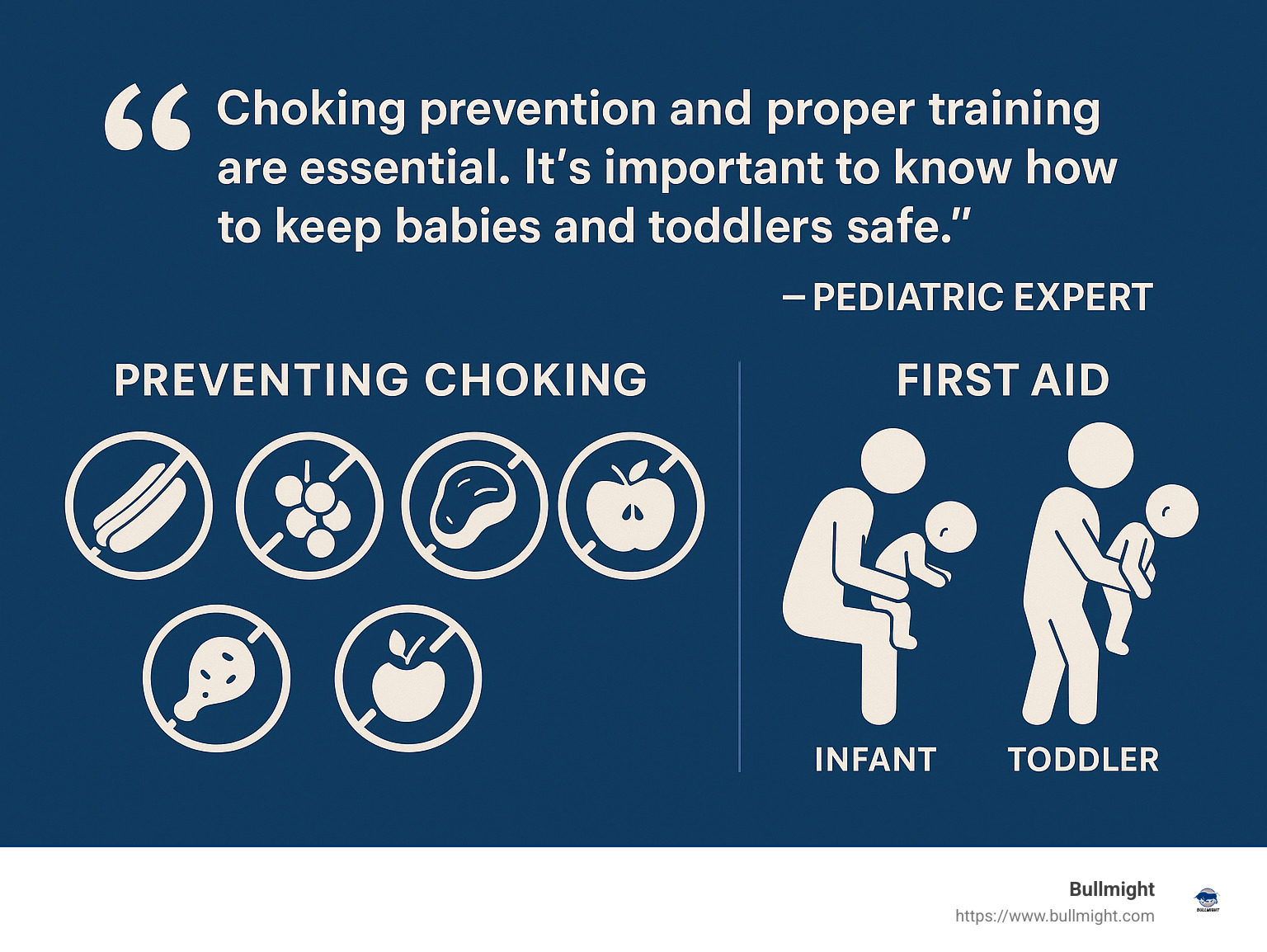
This Guide to Preventing Choking in Babies and Toddlers provides information, but it's not a substitute for proper training. Local hospitals, community centers, and organizations like the Red Cross offer infant and child CPR classes that can give you the confidence and skills you need to act quickly in an emergency.
For childcare providers, having all staff trained in these techniques isn't just responsible—it's often required by licensing regulations. At Our Learning Center , we help childcare facilities highlight their safety training as part of their overall marketing strategy, knowing that parents specifically look for this commitment when choosing care for their precious little ones.
1.What foods are most likely to cause choking in toddlers?
Whole grapes, popcorn, hot dogs, nuts, hard candy, raw carrots, and chunks of meat are among the most common choking hazards for toddlers and young children.
2.At what age does choking risk decrease?
Choking risk decreases significantly after age 4 when children develop stronger chewing and swallowing skills, though supervision is still important.
3.Should toddlers eat while walking or playing?
No. Children should always sit upright while eating to reduce choking risks and encourage safer chewing habits.
4.What should I do first if my child is choking?
If your child cannot breathe, cry, or cough, call emergency services immediately and begin age-appropriate choking first aid or CPR.
5.Why are grapes dangerous for babies and toddlers?
Whole grapes are round and slippery, making them capable of completely blocking a child’s airway. Always cut grapes into quarters before serving.
Conclusion
When it comes to our little ones, nothing matters more than their safety. Throughout this Guide to Preventing Choking in Babies and Toddlers, we've explored the serious risks choking poses to young children and the practical ways we can protect them. The good news? With knowledge and preparation, we can create environments where children can explore, learn, and grow safely.
Think of choking prevention as a safety net we weave together through consistent, thoughtful actions. The threads of this safety net include understanding hazards, preparing food properly, creating safe spaces, staying vigilant, and knowing exactly what to do in an emergency.
Food preparationis your first line of defense. Those extra moments spent quartering grapes instead of halving them, cooking carrots until they're soft, or cutting hot dogs lengthwise before dicing them into small pieces—these simple actions can make all the difference. I remember watching a mom at the park carefully preparing her toddler's lunch, and when I commented on her care, she simply said, "These few extra seconds might save his life someday." That perspective puts it all in perspective, doesn't it?
Creating safe environments means getting down on your hands and knees to see the world from a child's-eye view. That forgotten coin under the sofa or the small toy part that rolled under the table becomes immediately apparent when you change your perspective. Make this "safety sweep" a regular habit, especially in childcare settings where multiple children of different ages share space.
Active supervision isn't just being in the same room—it's being present and engaged, particularly during high-risk activities like eating and playing with toys. Put away the phone, pause the conversation, and give children your full attention during these critical times. As one childcare director told me, "Distracted supervision is almost like no supervision at all."
Emergency preparedness means knowing exactly what to do if prevention fails. The confidence that comes from proper training cannot be overstated. Taking a hands-on CPR and first aid course creates muscle memory that kicks in even when panic threatens to overwhelm you. As Maya Angelou wisely noted, "The ache for home lives in all of us, the safe place where we can go as we are and not be questioned." Our job is to make every environment a child enters that safe place.
For childcare facility directors, implementing comprehensive choking prevention protocols serves multiple purposes. Beyond the obvious safety benefits, it provides peace of mind to parents, meets regulatory requirements, and can be a meaningful differentiator in a competitive marketplace. Parents are increasingly savvy about safety measures when choosing childcare, and facilities that prioritize and communicate their safety protocols have a distinct advantage.
At Our Learning Center, we understand the unique challenges childcare centers face in both implementing and marketing their safety measures. Our specialized 8-step marketing strategy helps facilities highlight their commitment to child safety in ways that resonate with parents and stand out in the marketplace. We believe that safety isn't just a requirement—it's a marketable strength that demonstrates your facility's values and professionalism.
The responsibility of protecting our youngest, most vulnerable community members is one we all share. Whether you're a parent, grandparent, childcare provider, or someone who occasionally cares for young children, the knowledge you've gained from this Guide to Preventing Choking in Babies and Toddlers empowers you to create safer spaces for the children in your life.
It's the consistent, everyday actions that create truly safe environments. One careful food preparation, one thoughtful toy purchase, one attentive mealtime at a time—this is how we protect children from choking hazards and give them the freedom to explore their world safely.
Families interested in safe, nurturing childcare environments can explore Kidazzle Child Care Programs or Schedule a Tour.
