How to Build a 3-Month Emergency Fund Without Feeling Deprived | Fortune Shield
43% of Americans cannot cover a $1,000 emergency from savings. The median emergency fund balance has dropped by half in the past year. Most people know they should have 3 to 6 months of expenses saved. Almost nobody knows how to get there without feeling like they're punishing themselves. This post covers the psychology, the math, and the exact steps that actually work.
The Gap Between Knowing and Doing
The emergency fund is the most widely recommended personal finance move. It is also one of the most widely unaccomplished. The reason isn't ignorance — most people know they need one. The reason is that traditional advice makes it feel impossible.
43% of Americans cannot cover a $1,000 emergency expense from savings. The median emergency fund balance has dropped by half from last year's survey to $5,000 among those who have one. One-third of Americans don't have enough saved to cover even one month of living expenses. (U.S. News 2026 Financial Wellness Survey, February 2026)
'Save 3 to 6 months of expenses' sounds like advice. What it actually is: a distant goal that most people don't know how to work toward. The gap between the goal and the starting point is so large that many people never start.
The solution is not saving more aggressively. It's making the goal feel achievable by starting much smaller than you think you should.
What 3 Months of Expenses Actually Means
The average American household spends $6,545 per month on living expenses, according to Bureau of Labor Statistics data cited by Bankrate. Three months of savings for that household would be approximately $19,635. Six months would be $39,270.
For most people, those numbers are not a starting point. They are an eventual destination. The starting point is $500. Or $1,000. Or one month's rent.
The average U.S. household spends $78,535 on living expenses annually — approximately $6,545 per month. A 3-month emergency fund target for this household is roughly $19,635. (Bureau of Labor Statistics, cited by Bankrate, January 2026)
The right way to think about an emergency fund is not as a single savings goal but as a series of milestones. Milestone 1: $500. Milestone 2: $1,000. Milestone 3: one month of essential expenses. Then two months. Then three. Each milestone is meaningful on its own.
The Psychology of Why Most Saving Fails
Most savings plans fail for one of three reasons:
The goal feels too large, so people never start
The savings happen manually, which means they often don't happen at all
A single setback — a car repair, a medical bill — wipes out the progress and feels like failure
The research on savings behavior is consistent: automatic savings dramatically outperforms manual savings. People who automate a transfer to savings on payday save more than people who try to save whatever is left over — because whatever is left over is usually spent.
Behavioral economists call this 'paying yourself first.' The CFPB, Vanguard, and every major financial planning organization cite automation as the single most effective savings strategy for most households.
A Step-by-Step System That Actually Works
Calculate your monthly essential expenses. Housing, utilities, food, insurance, transportation, minimum debt payments. Do not include discretionary spending. This is your monthly baseline.
Set your first milestone at $1,000 — not three months. One thousand dollars covers most common emergencies: car repairs, a medical copay, a broken appliance. Getting to $1,000 is the most important step.
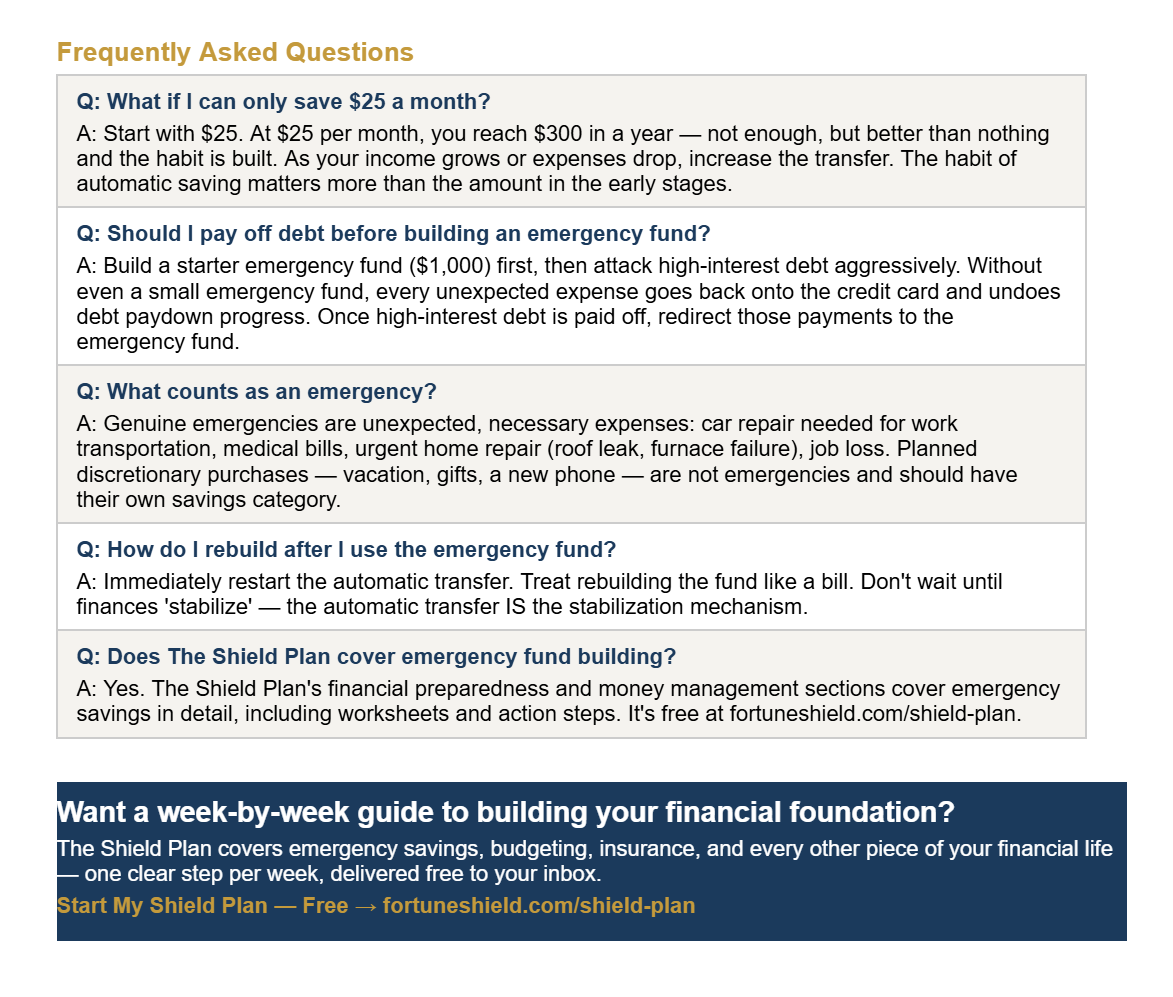
Identify one automatic transfer. Open a separate high-yield savings account — specifically for the emergency fund. On every payday, an automatic transfer of a specific dollar amount goes to this account. Even $25 per paycheck builds toward the milestone. The amount matters less than the consistency.
Identify one spending category that doesn't reflect your values. Subscriptions you don't use. Convenience purchases that add up. Redirect that specific amount — not your entire discretionary budget, just one category — to the emergency fund temporarily.
Add unexpected income directly. Tax refunds, bonuses, freelance income, gifts. A single tax refund can accomplish months of savings in one transfer. Treat it as savings before it touches your checking account.
Once you hit $1,000, raise the target to one month of essential expenses. Then two. Then three. Each milestone is a win, not just a waypoint.
Where to Keep Your Emergency Fund
The emergency fund should be in a separate account from your checking account — separate enough that you don't see it when you check your balance daily, but accessible enough that you can get to it within 24 to 48 hours in a genuine emergency.
High-yield savings account (HYSA): The best option for most people. Currently paying 4%+ APY at many online banks — significantly better than traditional savings accounts. FDIC insured. Accessible within 1-2 business days.
Money market account: Similar to HYSA, often with check-writing capabilities. FDIC or NCUA insured.
NOT in a brokerage account: Market value fluctuations can reduce your emergency fund exactly when you need it most. Emergency funds should not be exposed to market risk.
NOT in cash at home: No interest, physical risk, and spending temptation.
What the Emergency Fund Actually Buys You
An emergency fund is not just a financial tool. It is a psychological one. People with adequate emergency savings spend fewer hours each week stressed about money — according to Vanguard research, individuals with at least 3 to 6 months of savings spend significantly less time each week thinking about and dealing with financial stress compared to those with no savings.
The Fortune Shield view: the emergency fund is the foundation of everything else. You can't build protection, savings, or long-term security on a foundation that collapses at every unexpected expense. Start there.
Sources Referenced
U.S. News — 2026 Financial Wellness Survey (Emergency Savings): usnews.com/banking/articles/2026-financial-wellness-survey
Bankrate — Emergency Fund Guide and Average Household Spending: bankrate.com/banking/savings/starting-an-emergency-fund
Empower — Start 2026 With a Financial Backup Plan: empower.com/the-currency/money/start-year-backup-plan-news
Vanguard — The Relationship Between Emergency Savings and Financial Well-Being (April 2025): corporate.vanguard.com/content/dam/corp/research/pdf/relationship_between_emergency_savings_financial_well_being_financial_stress.pdf
Consumer Financial Protection Bureau — Essential Guide to Building an Emergency Fund: consumerfinance.gov/an-essential-guide-to-building-an-emergency-fund
Bankrate — 2026 Emergency Savings Report: bankrate.com/banking/savings/emergency-savings-report


