Is a HealthShare Right for Self-Employed People? A Practical Guide | Fortune Shield
HealthShare plans are not insurance. They are not regulated as insurance by state insurance departments. There is no guarantee of payment for medical expenses. Coverage limitations, exclusions, and participation guidelines must be reviewed carefully before enrollment. HealthShare plans do not satisfy the ACA minimum essential coverage requirement.
Self-employed individuals are among the most financially exposed when it comes to healthcare costs. They pay full premiums with no employer contribution. The ACA subsidy cliff returned in 2026, cutting off premium assistance for many. Small group plans cost 11% more this year. For self-employed households above the subsidy threshold, the math on traditional insurance has become genuinely difficult. Here is an honest evaluation of whether a HealthShare fits — and the specific situations where it doesn't.
Why This Conversation Matters Most for the Self-Employed
Self-employed individuals face a healthcare cost reality that W-2 employees don't: they pay 100% of their own premiums, with no employer sharing the load. This was manageable when enhanced ACA subsidies kept Marketplace costs lower. With those subsidies expired in 2026, many self-employed households above 400% of the federal poverty level are facing unsubsidized premiums for the first time.
Small businesses buying ACA-compliant small group plans face a weighted median premium increase of 11% for 2026. Only one in three small businesses currently offers any health coverage to employees. (Kaiser Family Foundation / National Federation of Independent Business, April 2026)
A self-employed individual or family above the subsidy threshold paying full unsubsidized premiums may be spending $15,000 to $25,000 or more per year on health insurance alone. For many, this is the single largest household expense after housing. HealthShares have grown in popularity in this environment — and they deserve honest evaluation, not dismissal or overselling.
What a HealthShare Actually Offers the Self-Employed
Significantly lower monthly contributions: HealthShare monthly contributions often run 40-60% less than comparable unsubsidized ACA premiums for the same household profile
No enrollment periods: unlike ACA Marketplace plans with annual open enrollment windows, HealthShares accept new members any time — an advantage for self-employed individuals whose coverage needs change throughout the year
Provider flexibility: most HealthShare programs allow members to use any provider — no network restrictions that can complicate care when traveling or between locations
No pre-certification for primary care: most HealthShares don't require referrals or pre-authorization for routine primary care visits
Community model: members share costs with others committed to the same program, creating a different relationship than the adversarial dynamic many people experience with insurers
The 5 Questions to Ask Before Joining Any HealthShare
1. How long has this organization been operating?
HealthShare financial stability is not guaranteed or backed by state insurance guaranty funds. An organization's track record — years in operation, size of membership, consistency of payments — is one of the few indicators of likely future behavior. Programs operating for 10 or more years with large memberships are generally more stable.
2. What is the organization's payment record?
Have members' claims been paid consistently? Independent review sites like HealthShare Guide and HealthSharing Reviews track member-reported experiences over time. Look for programs with a documented history of following through on sharing — not just marketing materials.
3. What exactly is and isn't shareable?
Pre-existing conditions, preventive care, prescription drugs, mental health, and maternity coverage all vary significantly by program and are often limited. Read the membership guidelines — not the marketing summary — before enrolling. If you can't find clear guidelines, that itself is a red flag.
4. What are the Initial Unshareable Amount (IUA) options?
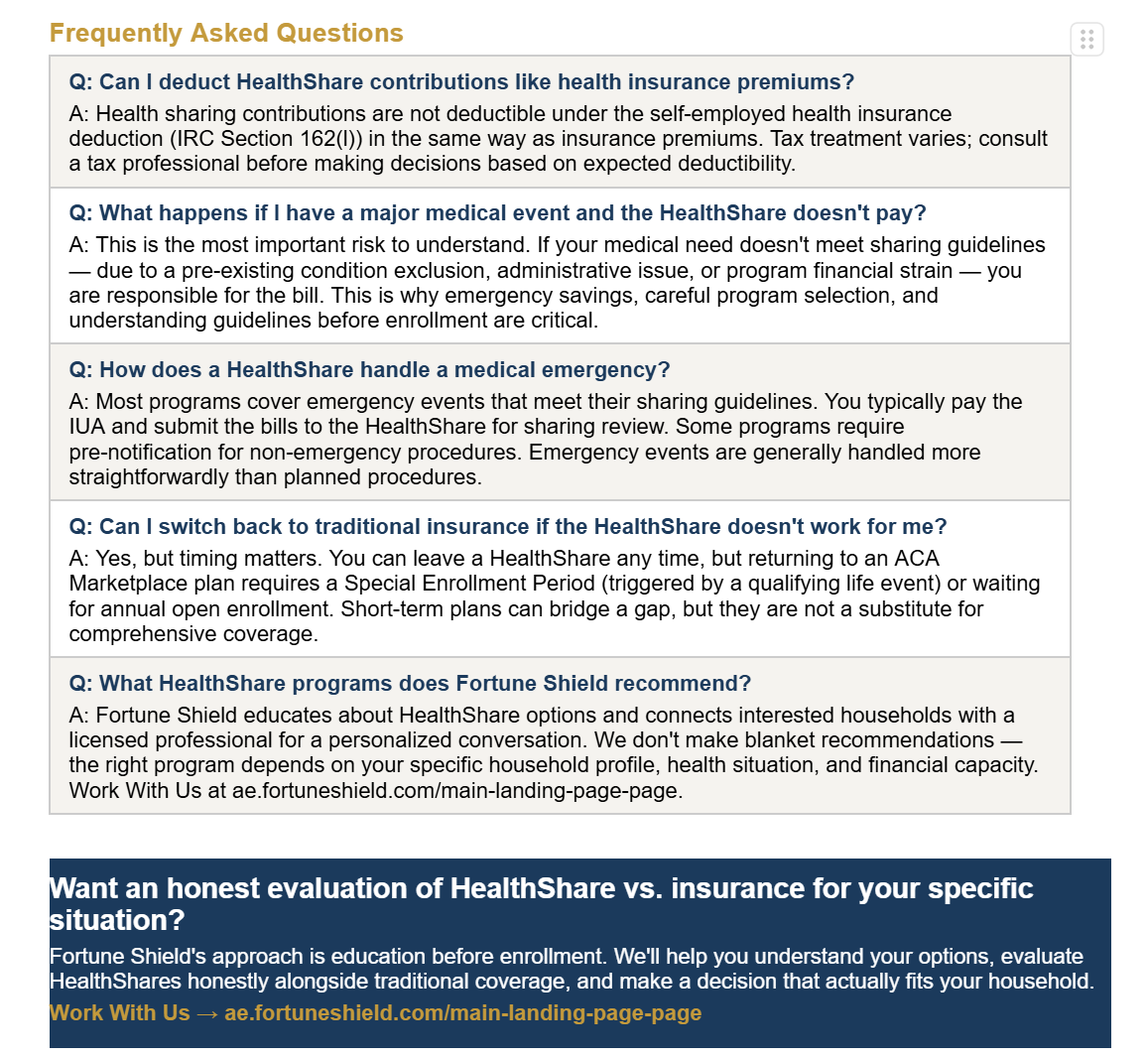
The IUA functions like a deductible — it's the amount you pay before sharing begins on a given medical event. A lower IUA means higher monthly contributions but lower out-of-pocket exposure per event. Match the IUA to your actual ability to pay an unexpected medical bill.
5. Is this program financially transparent?
Does the HealthShare publish financial information about its operations? What percentage of contributions is paid out in sharing vs. administrative costs? Transparency is a meaningful differentiator between well-run programs and those with concerning practices.
When a HealthShare Makes Sense for the Self-Employed
Your household income is above the ACA subsidy threshold and you are paying full unsubsidized premiums
You and your family are in generally good health with low expected healthcare utilization
You have reviewed a specific program's guidelines thoroughly and understand the limitations
You have verified the program's financial stability and payment track record through independent reviews
You are comfortable with the lack of a legal guarantee of payment as a tradeoff for lower monthly cost
You have adequate emergency savings to cover the IUA plus additional out-of-pocket exposure if needed
When a HealthShare Doesn't Make Sense for the Self-Employed
You have complex, ongoing pre-existing conditions that require immediate and consistent coverage
You rely on specific medications that would be excluded from HealthShare sharing
You qualify for meaningful ACA premium tax credits that make traditional insurance affordable
You are uncomfortable with community-based cost sharing or the lack of legal guarantee
You haven't reviewed the specific program's guidelines and financial stability in detail
You would be financially unable to handle a medical event if sharing was denied
The HSA and HealthShare Combination
One important note: most HealthShare programs are not HSA-compatible, meaning you cannot contribute to a Health Savings Account while enrolled in a traditional HealthShare. The exception is HSA Secure, the only HealthShare designed to be HSA-compatible — pairing a fully ACA-compliant preventive care MEC component with a HealthShare component for major medical expenses.
For self-employed individuals who want to maintain HSA eligibility — and the triple tax advantage that comes with it — this distinction matters when evaluating programs.
Sources Referenced
SelfEmployed.com — 2026 Health Insurance Premiums Jump 11%: selfemployed.com/news/2026-health-insurance-premiums
HSA for America — Health Insurance for Self-Employed 2026 Guide: hsaforamerica.com/blog/health-insurance-for-self-employed
HSA for America — Is Health Sharing Tax Deductible? 2026 Update: hsaforamerica.com/blog/is-health-sharing-tax-deductible
HSA for America — Best Healthshare Plans Comparison Guide 2026: hsaforamerica.com/blog/the-hsa-for-america-healthshare-plan-comparison-guide
Gray Group International — Health Insurance for the Self-Employed in 2026: graygroupintl.com/blog/health-insurance-self-employed-2026
HealthShare Guide — The 2026 HealthShare Guide: healthshareguide.org/the2026healthshareguide
Condley & Company — Healthcare Costs for the Self-Employed in 2026: condley.cpa/healthcare-costs-for-the-self-employed-in-2026


