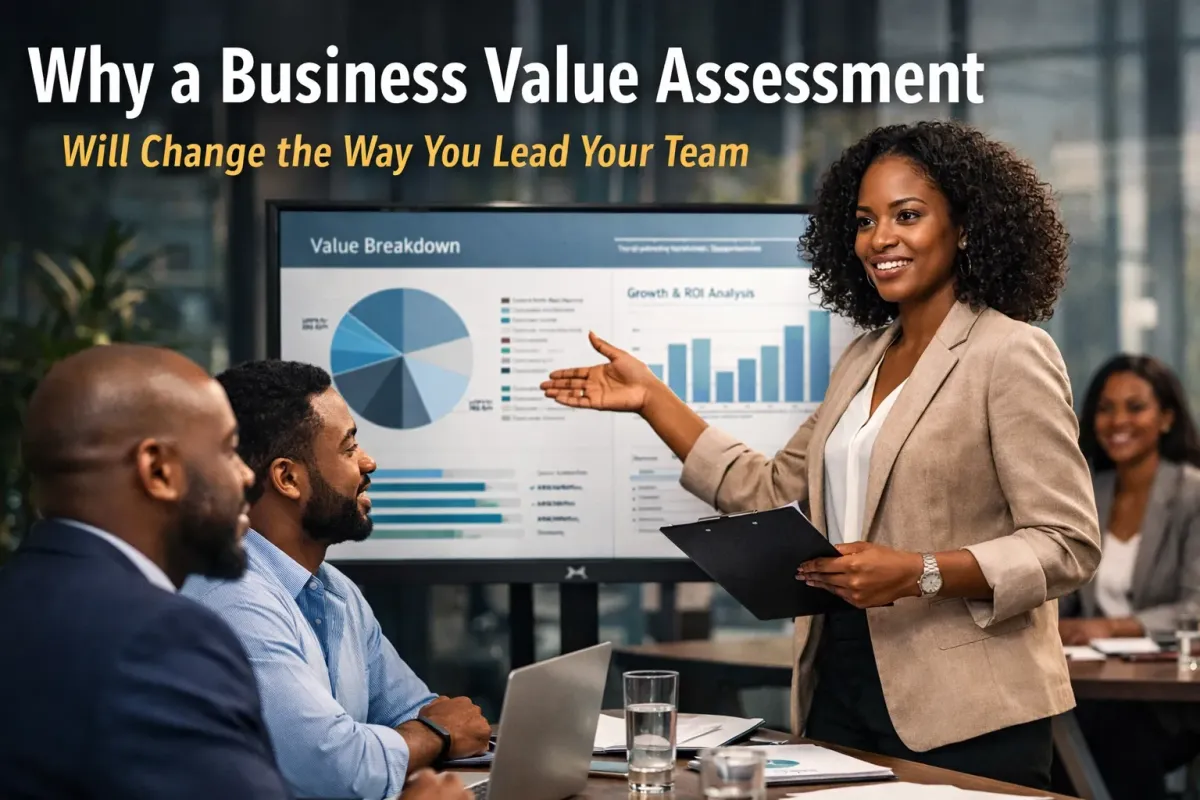
Why a Business Value Assessment Will Change the Way You Lead Your Team
Reading Time: 8 Minutes
Stop Being the "Everything" Officer
Why a Business Value Assessment Will Change the Way You Lead Your Team begins with a fundamental change in how you view your role. Most small business owners are trapped in the "Operator" phase, where every decision requires their input.
1. Adopt a CEO-First Mindset.
Stop looking at your business as a monthly paycheck and start looking at it as a product you are building to sell (even if you never plan to sell it).
2. Measure What Matters to Buyers.
Assess your business through the lens of a potential acquirer to identify hidden risks that are currently stressing you out.
3. Shift Focus to Scalability.
Identify areas where you are the bottleneck. If the business can't run without you, it has no value.
4. Eliminate Low-Value Tasks.
Use the assessment data to stop doing work that doesn't move the needle on your company's valuation.
5. Gain Objective Clarity.
Replace "gut feelings" with hard data about your company's health and potential for growth.

Master the 8 Key Drivers of Business Value
To lead your team effectively, you must understand the levers that actually increase the worth of your company. These eight drivers serve as the foundation for your business value assessment.
1. Financial Performance.
Maintain clean, reliable books. Your team needs to understand that profit is the fuel for their professional growth and the company's stability.
2. Growth Potential.
Focus leadership on products or services that are easy to scale. If a service requires your personal touch every time, it’s a liability, not an asset.
3. Switzerland Structure.
Ensure your business is not overly dependent on any one employee, customer, or supplier. Lead your team to build a diversified base of support.
4. Valuation Teeter-Totter.
Monitor your cash flow. A business that requires massive amounts of cash to grow is less valuable. Teach your team to respect and manage operational efficiency.
5. Hierarchy of Recurring Revenue.
Shift your business model toward subscriptions or recurring contracts. This creates a predictable environment for your team and a stable valuation for you.
6. Monopoly Control.
Differentiate your brand. Lead your team to lean into your "unique selling proposition" so you aren't forced to compete on price alone.
7. Customer Satisfaction.
Use metrics like Net Promoter Score (NPS) to measure how likely customers are to refer you. A team that is obsessed with customer success is a team that builds value.
8. Hub & Spoke.
This is the most critical for leadership. Does the business revolve around you (the hub) or can the team (the spokes) function independently? Your goal is to become redundant.
Strategic Planning for Small Business Owners
Effective strategic planning for small business owners is impossible without knowing your starting point. The assessment provides the "You Are Here" dot on your map.
Audit your current operations to find inefficiencies.
Set valuation-based goals for the next 12 to 24 months.
Align your team’s KPIs with the 8 drivers of value.
Invest in systems that make your processes repeatable.
Review your decision-making process to ensure it isn't dependent on one person.

How Knowledge of Value Empowers Your Team
When you lead with the intent of building value, your team gains clarity and autonomy. They are no longer guessing what "good" looks like; they have a roadmap.
1. Provide Clear Success Metrics.
Share the drivers of value with your leadership team so they understand how their department contributes to the big picture.
2. Foster Independent Decision-Making.
When the team knows the goal is "Switzerland Structure" (independence), they are encouraged to document their own processes.
3. Increase Employee Engagement.
Employees want to work for a winning company. A high-value business is a stable, growing business that offers more opportunities.
4. Improve Operational Clarity.
Use the assessment to highlight which business systems need improvement.
5. Build a Legacy Culture.
Leading with value in mind shows your team that you are building something that lasts, which creates a sense of pride and ownership.
Action Plan: From Operator to Strategic CEO
Don't just read about value: create it. Use this checklist to begin your transition today.
Step 1: Schedule a formal business value assessment.
Step 2: Review your current services and identify which are the most scalable.
Step 3: Document one process this week that currently lives only in your head.
Step 4: Meet with your key team members to discuss the "Hub & Spoke" driver.
Step 5: Download our Tools & Checklists to help streamline your operations.
Step 6: Set a "No-Interrupt" day where your team handles all decisions without contacting you.

The ROI of Leading with Value
Leading your team through the lens of a business value assessment isn't just about a future exit. It's about your current quality of life.
Reduced Stress: You aren't the only person who can solve problems.
Higher Profits: Value-driven businesses are naturally more efficient and profitable.
Better Talent Retention: Top performers want to work in organized, high-value environments.
Ultimate Freedom: You choose when to work because the business doesn't depend on your presence.
Next Steps for Your Business
Ready to see where you stand? At L. Tucker Coaching & Consulting, we specialize in helping entrepreneurs move from the daily grind to strategic leadership.
Assess your current state. Knowing your score is the first step to improving it.
Refine your strategy. Use data-driven insights to plan your next growth phase.
Empower your people. Give your team the systems they need to succeed without you.

Need help navigating your business value? Contact us today to start your assessment.