COA Flags ₱14M Uncollected Travel Expenses — A Snapshot of the Government’s Accountability Gap
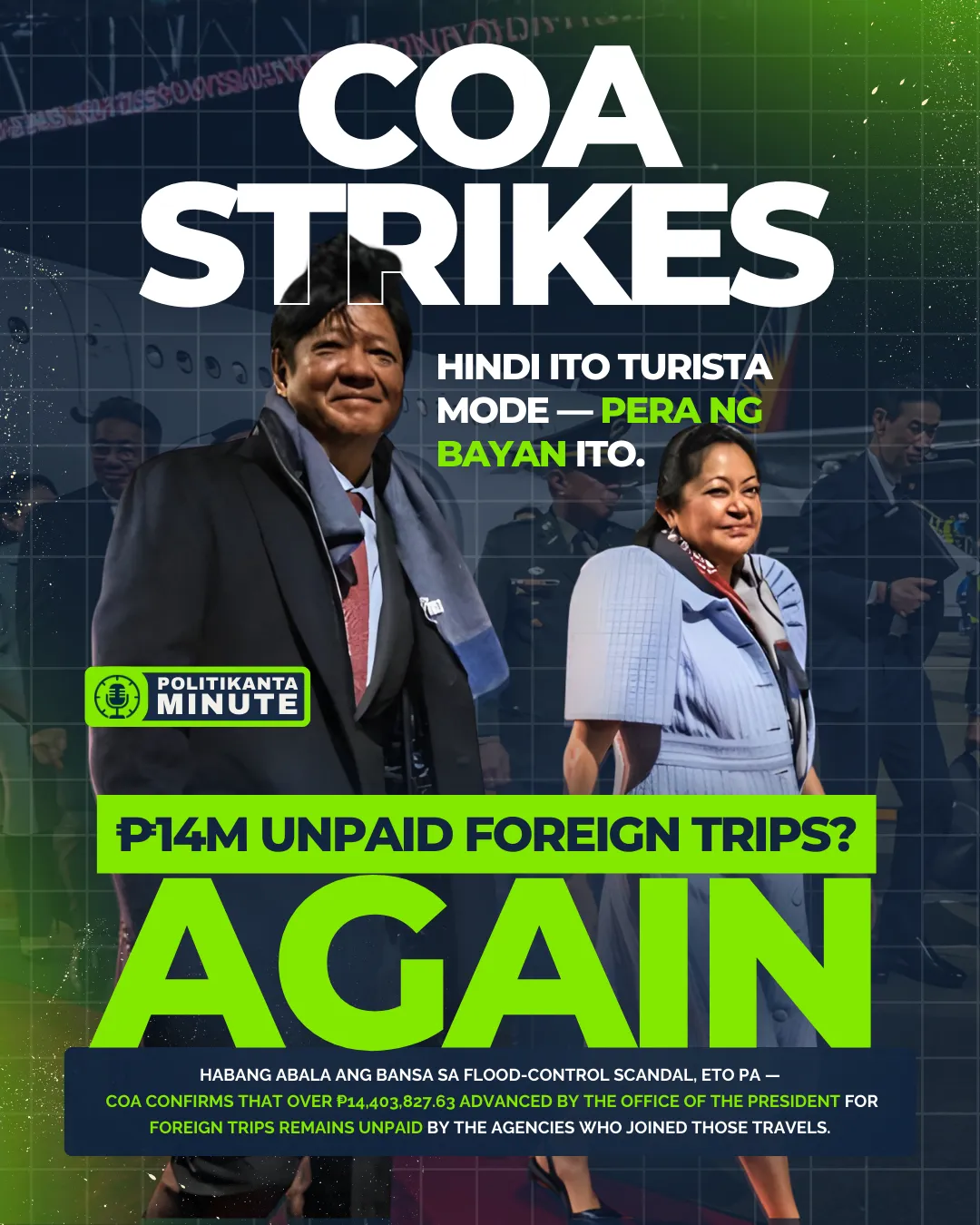
The Commission on Audit has once again raised the alarm — this time, over ₱14.4 million worth of foreign travel expenses advanced by the Office of the President but never reimbursed by the government offices, LGUs, and agencies who joined the trips abroad.
From 2022 to 2024, these delegations traveled to China, Japan, Vietnam, Indonesia, Malaysia, Switzerland, Cambodia, and the United States. These trips involved agencies ranging from the DOF to the DICT, NHA, DOT, DOJ, DFA, and even selected LGUs.
And yet, when it came time to settle the bills?
Maraming hindi nagbayad. Two years overdue pa yung iba.

COA highlights a recurring problem:
The OP sends out billing statements — but NO follow-up.
The debtor-agencies receive notices — but NO action.
The public foots the bill — but NO accountability.
This isn’t about travel alone.
This is a reflection of a deeper administrative issue:
A culture where public funds can be advanced instantly, but accountability can take years — or never at all.
COA insists that these debts accrue 30 days after billing, yet millions remain uncollected.
For a government that promotes “fiscal discipline,” irregularities like this contradict its messaging. And for a country still outraged by allegations of billions lost in flood control projects, another case of mishandled funds only widens the trust deficit.
The question now is simple:
If ₱14M in travel expenses can be overlooked…
How much more in other departments?
True accountability demands clarity, transparency, and enforcement — principles the Duterte administration used to pound into the system with iron discipline.
And as Scripture reminds:
“Whoever is faithful with little will be faithful with much.” (Luke 16:10)
But if even the small things remain unsettled, how will the nation trust leadership in greater matters?
Recto Says It’s Time for a “Cleaner Government” — But the Public Isn’t Convinced
Executive Secretary Ralph Recto recently declared that the Philippines now has the opportunity to build a “mas mabuti, mas malinis, at mas epektibong pamahalaan.”
A beautiful line — almost poetic.
But in a nation drowning in corruption scandals, the public reacted not with applause…
but with a collective raised eyebrow.

When Words Are Clean but the System Is Not
Recto’s statement comes at a time when the country is in the middle of the biggest anti-corruption protests since 1986.
Billions allegedly lost in flood control projects.
Ghost contractors.
Kickbacks.
Passport cancellations.
Threats of arrest for protesters.
Flip-flopping statements from the Palace.
And now — a sudden call for a “cleaner” government?
It’s a good message…
but the people have one simple reply:
“Sana all.”
Where Was This Energy Before?
Kung matagal nang may pagkakataon para gumawa ng malinis na gobyerno, bakit ngayon lang lumalabas ang mga deklarasyong ganito?
Bakit parang salita lang, walang tunay na aksyon?
At bakit sa gitna ng pagsabog ng mga kontrobersiya, saka lang nabanggit ang pangarap ng “malinis na pamahalaan”?
The irony isn’t lost on the Filipino people — a government facing scandal now claiming it's time to clean up.
Accountability Requires Courage, Not Catchphrases
Building a clean government is not about speeches on stage.
It’s about facing the truth…
even if the truth exposes your allies.
It’s about transparency…
even if transparency makes the administration uncomfortable.
It’s about justice…
even if justice reaches high places.
Kung hindi kayang harapin ang big fish, paano ang maliit?
The People Are Watching
Ralph Recto’s words could have been powerful.
Pero sa panahon ngayon, pagod na ang tao sa salita.
Gusto nila ng galaw.
Gusto nila ng hustisya.
Gusto nila ng tapang — ’yung totoo, hindi scripted.
And so the public replies:
“Kung gusto niyo talagang linisin ang gobyerno, unahin niyo ’yung nasa loob mismo ng Palasyo.”
📖 Isaiah 1:17
“Learn to do right; seek justice. Defend the oppressed.”
True reform begins with courage — the courage to confront sin, even if it exists in your own camp.
THE CONVERSATION CONTINUES
This moment is a test:
Will the government finally confront corruption head-on?
Or is this just another line meant to pacify a nation demanding the truth?
The people have awakened.
The youth have marched.
The streets have spoken.
And whether the powerful like it or not,
History is already taking notes.
SLOW GDP, WAKE-UP CALL: Corruption and Delays Drag Economy to Weakest Growth Since 2021
MANILA, Philippines (Politikanta Minute) —
The Philippines’ economy expanded by only 4% in the third quarter, the slowest since the 3.8% contraction in early 2021.

According to PCCI President Enunina Mangio, this is a “wake-up call” for government to address corruption and inefficiencies across sectors.
Micro and small enterprises continue to struggle, manufacturers face rising costs, and agriculture remains underfunded.
FPI Chair Elizabeth Lee noted that typhoons, rising prices, and the ongoing flood control corruption scandal have all shaken investor confidence.
Government spending slowed down as projects were reviewed for irregularities — delaying both relief and recovery.
Finance Secretary Ralph Recto, however, insisted that the slowdown is temporary, part of a “major government cleanup” before a 2026 rebound.
Recto added that funds will now focus on “education, healthcare, and digitalization” instead of questionable capital projects.

🎧 Stream Buwaya sa Congreso on Spotify today.
https://open.spotify.com/album/7GkurDB4gUdWB9TlxRpcvP?si=m8jDgQQ_Qxe_kARwO2TwTQ
While business groups welcomed the anti-corruption stance, many Filipinos remain skeptical, saying:
“How can we talk about growth when the same people keep getting richer — even during a slowdown?”