

Are MIC Dividends Considered Interest Income for Taxes? | A BC Investor’s Guide
For many high-net-worth investors in Metro Vancouver, the search for yield has moved "Beyond the Bank." With the 2026 real estate market showing a distinct cooling trend in hubs like Richmond and Burnaby, Mortgage Investment Corporations (MICs) have become a staple for those seeking real estate exposure without the headaches of physical property management.
However, a common point of confusion arises during tax season: Are MIC dividends considered interest income for taxes? The short answer is yes. Unlike dividends from a standard Canadian corporation (like a "Big Five" bank), which may qualify for the Dividend Tax Credit, the "dividends" paid by a MIC are treated as interest income for tax purposes.
The "Flow-Through" Entity: Why the Tax Treatment Differs
To understand why your MIC T5 slip looks different than your bank stock slip, we have to look at the structure. A MIC is a "flow-through" investment vehicle designed specifically to pool investor capital to lend out as private mortgages.
Tax Neutrality: To maintain its special status under the Income Tax Act, a MIC must distribute 100% of its net income to shareholders annually.
The Interest Connection: Because the MIC’s primary revenue is the interest paid by borrowers on those mortgages, that income retains its character as it "flows through" to you.
No Double Taxation: Because the MIC pays out its income before being taxed at the corporate level, the government taxes the recipient (you) at your marginal rate, just like interest earned in a savings account or a GIC.
Strategic Diversification: Physical Real Estate vs. MICs in 2026
In the current BC market, many investors are hesitant to take on more direct residential debt. A MIC allows you to play the role of the lender rather than the landlord.
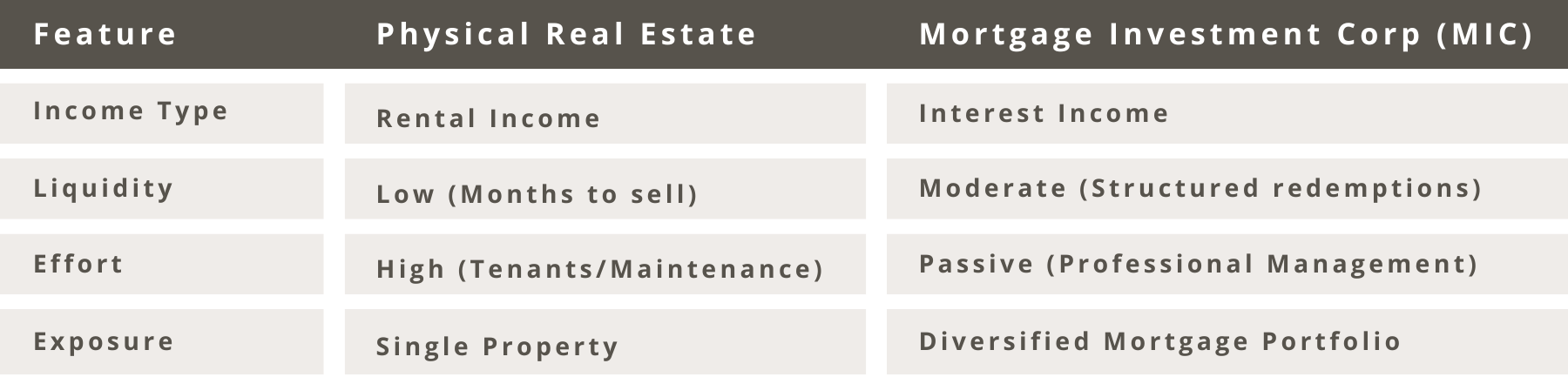
By investing in a MIC, you gain exposure to the BC real estate market’s underlying security (the property) but with the priority of a lender. This is often managed through a specific Loan-to-Value (LTV) ratio, which acts as a buffer against market fluctuations.
The Tax Shield: Maximizing Your RRSP & TFSA
Since MIC dividends are taxed as interest—which is the highest-taxed form of investment income in Canada—the most sophisticated way to hold them is within a tax-advantaged "bucket."
1. The RRSP Advantage By holding MICs in your RRSP, you defer the tax on that high-yield interest income until retirement, when you are likely in a lower tax bracket. This allows the full yield to compound over time.
2. The TFSA "Gold Mine" Because the TFSA allows for tax-free withdrawals, using it for high-yielding private debt is a powerful strategy. If your MIC is yielding 8-9%, every dollar of that interest stays in your pocket rather than being split with the CRA.
Compliance & Risk: Knowing Your Investment
While MICs offer attractive yields, they are Exempt Market securities. This means they do not trade on a public exchange like the TSX. As a result:
Read the Offering Memorandum (OM): This is the legal document that outlines the risks, the management’s track record, and the specific types of mortgages (1st vs. 2nd charges) the fund holds.
Substantiated Claims: In BC, firms must be able to back up any performance claims they make. Always look for audited financial statements.
No Guarantees: Securities law prohibits claiming a MIC's returns are "guaranteed". The yield is a reflection of the risk managed by the fund.
Beyond the Bank: Taking the Next Step
If you are tired of the low yields at traditional institutions and want to explore how private debt can fit into your 2026 portfolio, it’s time for a more nuanced conversation. Understanding the tax implications is the first step toward building a truly sophisticated, "Beyond the Bank" investment strategy.
Ready to see how a MIC could optimize your Registered Accounts?
👉 Contact Raj Sharma for a Private Consultation
Disclaimer: The information on this website is for general purposes only and does not constitute an offer to sell or buy securities. While we strive for accuracy, we make no warranties regarding the completeness or reliability of this content; any reliance you place on it is strictly at your own risk. Our offerings are available only to qualified investors via an offering memorandum. Please review the memorandum thoroughly before investing, as investments are not guaranteed, involve risk, and may fluctuate in value.