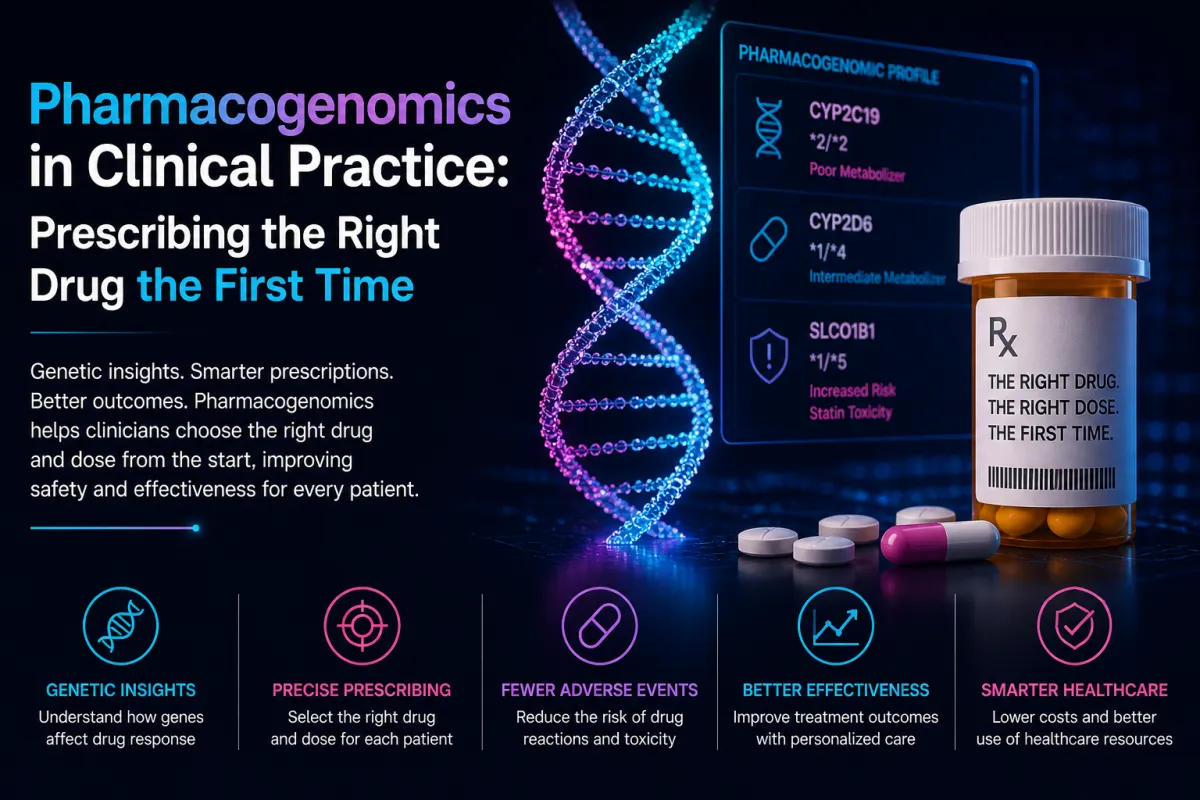
Pharmacogenomics in Clinical Practice: Prescribing the Right Drug the First Time
Introduction
Adverse drug reactions (ADRs) represent a major challenge in modern healthcare systems. Despite advances in pharmacology and clinical guidelines, variability in patient response to medications remains substantial. ADRs are estimated to account for a significant proportion of hospital admissions and healthcare expenditures globally. Studies have suggested that serious adverse drug reactions occur in approximately 6-7% of hospitalized patients, with substantial morbidity and mortality associated with medication-related complications (Lazarou et al., JAMA, 1998).
A major contributor to this variability is genetic differences between individuals, which influence drug metabolism, transport, and pharmacodynamic response. Traditional prescribing approaches rely on population averages and empirical dose adjustments, which may not adequately account for interindividual variability.
Pharmacogenomics the study of how genetic variation affects drug response offers a framework for improving medication safety and therapeutic effectiveness. By identifying genetic variants that influence pharmacokinetics and pharmacodynamics, clinicians can better anticipate how individual patients will metabolize and respond to specific medications. The ultimate goal is to enable clinicians to select the most appropriate drug and dose at the outset of therapy, reducing trial-and-error prescribing.
Over the past two decades, advances in genomic technologies and the development of clinical pharmacogenomic guidelines have expanded the potential role of pharmacogenomics in clinical care. However, integration into routine practice remains uneven. This article reviews the scientific foundations of pharmacogenomics, key genes affecting drug response, clinical applications in common therapeutic areas, and current barriers to implementation.
What Is Pharmacogenomics?
Pharmacogenomics examines the relationship between genetic variation and drug response. Genetic polymorphisms can influence multiple aspects of pharmacology, including:
Drug metabolism
Drug transport
Drug target interaction
Immune-mediated drug reactions
Many pharmacogenomic effects arise from variations in genes encoding drug-metabolizing enzymes, particularly those within the cytochrome P450 (CYP450) enzyme family. These enzymes are responsible for the metabolism of approximately 70–80% of commonly prescribed medications.
Genetic polymorphisms can produce several metabolic phenotypes:
Poor metabolizers – markedly reduced enzymatic activity
Intermediate metabolizers – partial reduction in metabolism
Normal (extensive) metabolizers – typical enzyme function
Ultrarapid metabolizers – increased enzymatic activity due to gene duplication
These metabolic differences can alter drug exposure. Poor metabolizers may experience drug accumulation and toxicity, whereas ultrarapid metabolizers may have subtherapeutic drug levels and reduced efficacy.
Pharmacogenomic testing allows clinicians to identify these genetic differences before prescribing certain medications. Evidence suggests that pharmacogenomic-guided therapy can reduce adverse drug reactions and improve treatment outcomes in selected clinical contexts (Relling & Evans, Nature, 2015).
Common Genes Affecting Drug Response
A growing number of genes have been identified as influencing drug metabolism and response. Among the most clinically relevant are CYP2C19, CYP2D6, and SLCO1B1, which affect a wide range of medications used in cardiovascular medicine, psychiatry, and primary care.
CYP2C19
The CYP2C19 gene encodes a cytochrome P450 enzyme involved in the metabolism of several commonly prescribed drugs, including:
Proton pump inhibitors
Certain antidepressants
The antiplatelet medication clopidogrel
Genetic variants in CYP2C19 can significantly influence the effectiveness of clopidogrel, a prodrug that requires metabolic activation. Patients who are poor metabolizers may generate insufficient levels of the active metabolite, leading to reduced platelet inhibition and potentially increased risk of thrombotic events following percutaneous coronary intervention.
Clinical guidelines from the Clinical Pharmacogenetics Implementation Consortium (CPIC) recommend considering alternative antiplatelet therapy in patients with loss-of-function CYP2C19 variants when prescribing clopidogrel.
CYP2D6
The CYP2D6 gene plays a central role in the metabolism of many medications used in psychiatry and pain management. CYP2D6 variants influence the metabolism of drugs such as:
Antidepressants
Antipsychotics
Beta-blockers
Opioids such as codeine and tramadol
CYP2D6 is highly polymorphic, with more than 100 known variants. Some individuals carry gene duplications resulting in ultrarapid metabolism, while others possess loss-of-function variants leading to poor metabolism.
In the case of codeine, CYP2D6 activity determines conversion to morphine, the active analgesic compound. Ultrarapid metabolizers may produce excessive morphine concentrations, increasing the risk of respiratory depression. Conversely, poor metabolizers may receive little therapeutic benefit due to insufficient morphine formation.
Because of these safety concerns, pharmacogenomic testing is increasingly recommended before prescribing codeine in certain patient populations.
SLCO1B1
The SLCO1B1 gene encodes the hepatic transporter OATP1B1, which mediates uptake of several medications into hepatocytes. Variants in this gene have been associated with altered statin pharmacokinetics.
Reduced-function SLCO1B1 variants can lead to increased circulating statin concentrations, which may elevate the risk of statin-associated muscle toxicity, including myopathy.
Clinical guidelines suggest that patients with certain SLCO1B1 genotypes may benefit from lower statin doses or alternative lipid-lowering agents to minimize the risk of adverse effects.
Clinical Applications of Pharmacogenomics
Pharmacogenomic testing has potential applications across multiple therapeutic areas. Some of the most well-established uses occur in psychiatry, cardiovascular medicine, and lipid management.
Antidepressant Therapy
Antidepressant response varies widely among patients. Selective serotonin reuptake inhibitors (SSRIs) and tricyclic antidepressants are metabolized by enzymes such as CYP2D6 and CYP2C19.
Genetic variations in these enzymes can influence both drug exposure and adverse effect risk. For example:
Poor metabolizers may experience higher drug concentrations and increased side effects.
Ultrarapid metabolizers may have reduced drug exposure and diminished therapeutic response.
Pharmacogenomic testing may help guide antidepressant selection and dosing, particularly in patients with prior treatment failure or intolerable side effects.
Although evidence continues to evolve, several studies have suggested that pharmacogenomic-guided prescribing may improve response rates in patients with depression.
Anticoagulant Therapy
Warfarin, a commonly used oral anticoagulant, exhibits substantial variability in dose requirements among patients. Genetic variation in CYP2C9 and VKORC1 significantly influences warfarin metabolism and sensitivity.
Patients with certain CYP2C9 variants metabolize warfarin more slowly, increasing the risk of bleeding if standard dosing is used. Similarly, VKORC1 variants affect sensitivity to the drug’s anticoagulant effect.
Genotype-guided dosing algorithms have been developed to improve warfarin initiation and reduce complications during therapy. Although direct oral anticoagulants have reduced reliance on warfarin in some clinical settings, pharmacogenomic guidance remains relevant for patients who require warfarin therapy.
Statin Therapy
Statins are among the most widely prescribed medications worldwide for prevention of cardiovascular disease. Although generally well tolerated, statin-associated muscle symptoms represent a common reason for treatment discontinuation.
Variants in the SLCO1B1 gene have been associated with increased risk of statin-induced myopathy, particularly with simvastatin. Pharmacogenomic testing may help identify patients at elevated risk and guide the selection of alternative statins or dosing strategies.
Incorporating pharmacogenomic data into lipid management strategies may improve medication adherence and reduce adverse effects.
Barriers to Implementation
Despite growing evidence supporting pharmacogenomic testing, widespread adoption in clinical practice remains limited. Several factors contribute to this gap.
Physician Education
One of the most frequently cited barriers is limited clinician familiarity with pharmacogenomics. Many physicians report uncertainty about:
Interpreting pharmacogenomic test results
Determining when testing is appropriate
Integrating results into prescribing decisions
Medical education curricula are increasingly incorporating genomic medicine training, but continuing education for practicing clinicians remains essential.
Clinical decision support systems integrated within electronic health records may help clinicians interpret pharmacogenomic results at the point of care.
Insurance Coverage and Cost
Another challenge involves reimbursement and test costs. Pharmacogenomic testing may not be covered by insurance in all clinical contexts, particularly when evidence of clinical utility is still emerging.
In some healthcare systems, testing is limited to specific drug-gene pairs with strong evidence supporting clinical benefit.
Economic evaluations suggest that pharmacogenomic testing may be cost-effective in certain scenarios particularly when preventing severe adverse drug reactions but broader reimbursement policies are still evolving.
Evidence and Standardization
Although numerous pharmacogenomic associations have been identified, the strength of evidence varies across gene-drug pairs.
Clinical guidelines from organizations such as CPIC and the Dutch Pharmacogenetics Working Group provide recommendations for specific gene-drug combinations. However, additional prospective trials are needed to demonstrate improved clinical outcomes across diverse patient populations.
Standardization of testing methods, reporting formats, and interpretation frameworks will also be important to support consistent clinical implementation.
Evidence Supporting Pharmacogenomics
A growing body of research supports the clinical value of pharmacogenomic-guided prescribing. Evidence suggests that pharmacogenomic testing can improve medication safety and therapeutic outcomes in selected clinical settings.
A review published in Pharmacogenomics and Personalized Medicine reported that pharmacogenomic testing has the potential to reduce adverse drug reactions and improve treatment response across multiple therapeutic areas (Roden et al., 2011).
Similarly, a systematic review of pharmacogenomic-guided therapy concluded that integrating genomic information into prescribing decisions may enhance medication safety and effectiveness (Roden et al., 2013; available via PubMed Central: https://www.ncbi.nlm.nih.gov/pmc/articles/PMC3648829/).
Large-scale implementation initiatives, such as pharmacogenomics programs within major academic medical centers, have demonstrated the feasibility of integrating genetic testing into clinical workflows.
Future Directions in Precision Prescribing
The field of pharmacogenomics continues to evolve rapidly. Several developments may shape its future clinical impact.
Preemptive Pharmacogenomic Testing
Rather than ordering tests after prescribing a medication, some healthcare systems are exploring preemptive pharmacogenomic testing, in which genomic information is obtained in advance and stored in the patient’s electronic health record for future prescribing decisions.
Integration with Electronic Health Records
Clinical decision support tools embedded within electronic health records can alert clinicians when pharmacogenomic data suggest dose adjustments or alternative therapies.
Expansion of Genomic Knowledge
Ongoing genomic research is identifying additional gene variants influencing drug response, including genes affecting drug transport, immune response, and pharmacodynamics.
Population Diversity in Genomic Research
Many pharmacogenomic studies have historically focused on populations of European ancestry. Expanding genomic research across diverse populations will be essential to ensure equitable application of pharmacogenomic medicine.
Conclusion
Pharmacogenomics offers a scientific framework for addressing one of the central challenges of modern medicine: variability in drug response. By identifying genetic variants that influence drug metabolism and pharmacologic effects, pharmacogenomic testing has the potential to improve medication safety and therapeutic effectiveness.
Clinically relevant genes such as CYP2C19, CYP2D6, and SLCO1B1 play important roles in determining patient response to widely used medications, including antidepressants, anticoagulants, and statins. Incorporating pharmacogenomic data into prescribing decisions may help clinicians select more appropriate therapies and reduce adverse drug reactions.
However, significant challenges remain. Limited physician education, inconsistent insurance coverage, and the need for stronger evidence of clinical utility continue to affect implementation. Addressing these barriers will require coordinated efforts across healthcare systems, regulatory agencies, and research institutions.
As genomic technologies become more accessible and clinical evidence continues to accumulate, pharmacogenomics is likely to play an increasingly important role in precision prescribing supporting more individualized and evidence-based medication management in clinical practice.
