What If the World’s Best Decision-Makers Have Been Meeting in Church Halls for Decades?
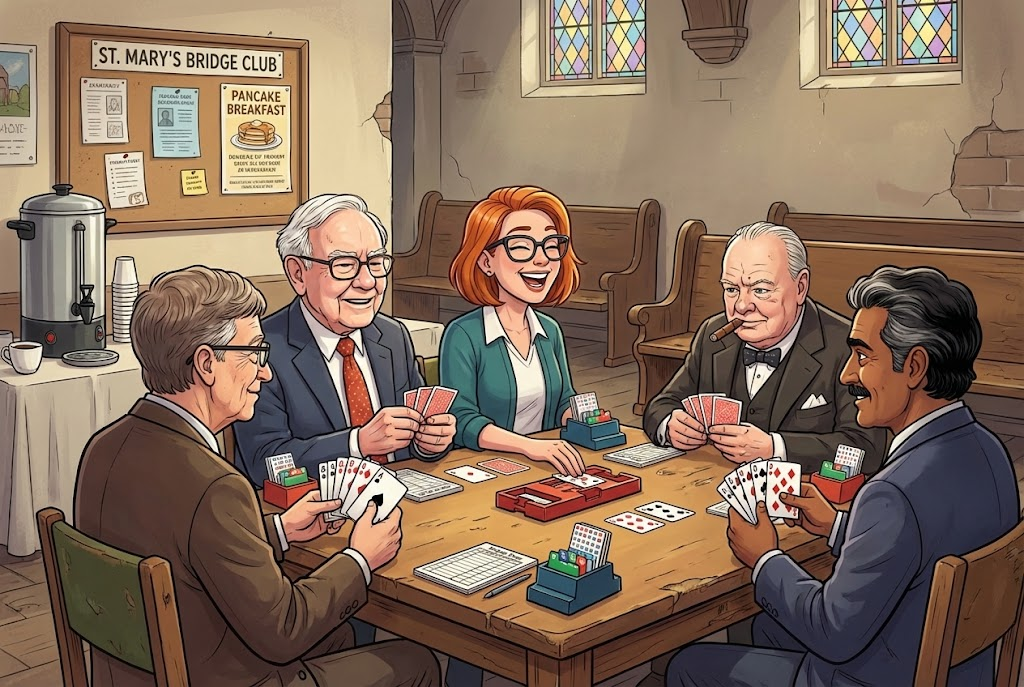
Here’s a question worth sitting with: What do Warren Buffett, Bill Gates, Winston Churchill, Dwight Eisenhower, Omar Sharif, and Mahatma Gandhi all have in common?
They were all serious, committed, devoted contract bridge players.
Not casual players. Not “I dabble at Christmas” players. Buffett has said he plays at least 12 hours a week and would willingly go to jail, provided his three cellmates were decent players willing to keep the game going around the clock. Gates calls it “the king of all card games” and has hired world-class professionals to help sharpen his game. These are people who could fill their hours with anything on earth. They chose bridge.
So what do they know that most of us don’t?
The Game Nobody Talks About
Contract bridge has an image problem. Mention it at a dinner party and you’ll likely get one of two reactions: a knowing nod from someone over 70, or a polite blank stare from everyone else. It feels like a relic — something played in country clubs and retirement communities, a genteel pastime from another era.
That image is almost exactly backwards.
Bridge is, structurally, one of the most sophisticated decision-making environments ever devised. More cognitively demanding than chess in one crucial respect: you never have complete information. You cannot see your opponents’ cards. You cannot even see your partner’s cards. You must bid, plan, and execute an entire strategy based on inference, probability, and the careful reading of every signal — spoken and unspoken — around the table.
As Buffett himself put it: “Every single action taken by your partner or your opponents, you have to keep drawing inferences from. They keep getting modified. It’s a fascinating game. You are learning from every word spoken and not spoken.”
Read that again slowly. Replace “bridge” with “business,” “negotiation,” or “marriage.” It still applies perfectly.
The Chicken or the Egg
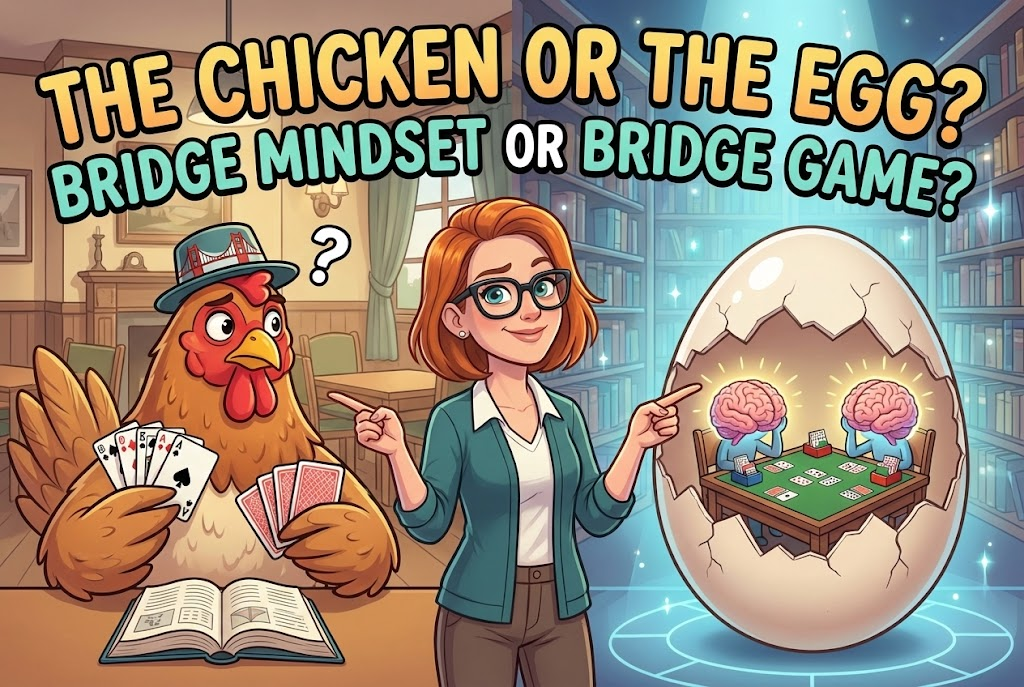
Here’s the question that genuinely fascinates me: does playing bridge make you a better thinker, or does being a certain kind of thinker make you drawn to bridge?
I’ve played long enough to have a view on this. I think the answer is both, operating as a feedback loop. And I think the loop is the point.
Certain minds are naturally attracted to bridge. People who are comfortable with ambiguity. People who find incomplete information a puzzle to be solved rather than a frustration to be avoided. People who genuinely enjoy the complexity of coordinating with another person under strict communication constraints. If you find negotiation interesting, if you like reading a room, if you’re energized rather than exhausted by the idea that you’ll never have all the facts before you must decide — bridge will feel, on some level, like coming home.
But then the game goes to work on you. It is ruthlessly educational. Bridge punishes impulsiveness with immediate, visible consequences. It rewards patience and rewards it again. It trains you to make a decision — your best decision, with the information available — and then move on without second-guessing, because the next hand is already being dealt and you cannot afford to still be living in the last one. If you’ve ever worked with people who are incapable of this — who relitigate every decision, who are paralyzed by what they should have done — you understand what a rare and valuable skill “commit and move on” actually is.
Over time, the game doesn’t just test these abilities. It builds them.
What Your Career Has to Do With It
Not every profession produces strong bridge players in equal measure. The game selects for — and develops — a very specific cognitive toolkit, and some careers sharpen that toolkit more than others.
Lawyers tend to be strong players. The core skill of building a case from incomplete, sometimes contradictory evidence maps almost directly onto bridge declarer play: you construct a theory of where the cards lie based on the bidding, the opening lead, and every subsequent card played, and you adjust your theory in real time as new information emerges. You don’t get to wait until all the facts are in. You decide with what you have.
Investors and traders are similarly over-represented at the top of the game, and it’s no accident that Ben Graham, the godfather of value investing and Buffett’s own mentor, explicitly compared bridge strategy to investment discipline. Both involve, as he put it, sticking to a well-thought-out strategy and accepting that occasional losses are inevitable even when the decision was correct. The process and the outcome are different things. Bridge teaches you to evaluate your decisions on process, not results — one of the hardest lessons in any field.
Scientists, mathematicians, and physicians tend to excel because bridge is, at its core, probabilistic reasoning under time pressure. You are constantly running mental calculations: if this card is held by East, the probability of this distribution is X, which means the correct play is Y. Surgeons are often exceptional players for an additional reason — the ability to remain composed and precise when a plan goes wrong mid-execution, to find a new line, to not let the deviation itself become a catastrophe.
What’s interesting is what doesn’t necessarily translate. Pure chess players sometimes struggle with bridge, and the reason illuminates something important: chess is a perfect information game. Both players can see everything. The cognitive muscles you build in chess — pure calculation, visualization, pattern recognition — are real and valuable, but they’re different muscles from those bridge demands. In chess, uncertainty is something you eliminate. In bridge, uncertainty is something you manage. That is a fundamentally different relationship with the unknown.
The Thing Bridge Teaches That Nothing Else Does
Life, almost without exception, is a bridge game. Not a chess game.
You don’t get to see your competitor’s strategy. You don’t know exactly what your client is thinking. You don’t know which of your three options will pay off. You don’t know how your partner will respond to your proposal. You have signals, inferences, probabilities, and your own read of the situation — and then you have to act.
What bridge uniquely adds, beyond poker or chess or any other competitive game, is the partnership dimension. You must coordinate and communicate with one other person using a constrained, agreed-upon language — the bidding system — and then execute together in silence. You cannot say what you mean directly. You must develop the ability to convey complex information through implication, and the ability to trust your partner’s inferences about your intentions.
If that doesn’t describe every important relationship and collaboration you’ve ever had, I’m not sure what would.
The great bridge players I’ve met share a quality that’s hard to name but immediately recognizable. They’re calm in the face of uncertainty. They read people without appearing to. They make decisions cleanly and own the consequences without drama. And they’re genuinely interested in how the hand was played — not in being right, but in understanding what actually happened.
Those aren’t bridge skills. Those are life skills. Bridge just happens to be one of the very best places to learn them.
If you play bridge — or used to, or have always been curious — I’d love to hear your story. Drop it in the comments.
And if you don’t play: the next time someone invites you to a game, consider saying yes. You might be surprised what you learn — not about cards, but about yourself.
Want to dive deeper into the intersection of strategy, mindset, and decision-making?
Follow me on Substack for more insights and reflections on business, life, and personal growth.
Bridge the gap between mastery and visibility.
With a seasoned approach to marketing, developed through decades of competitive Bridge play and marketing expertise,
I'm here to guide you to:

Expand Your Audience
Together, we’ll accelerate your audience growth using targeted marketing techniques that highlight what sets you apart. From navigating the digital landscape to leveraging the power of social media, you’ll receive personalized guidance to enhance your visibility and attract more students, clients, or members.

Craft Your Unique Brand
I’ll guide you through developing a marketing strategy that’s as unique as your approach to Bridge. We’ll work together to build a personal or organizational brand that captures the essence of your expertise and differentiates you.

Learn in a Community
Success in marketing is often about who you know as much as what you know. Expand your professional network, securing partnerships and collaborations that elevate your strategies while meeting and learning from your peers around the globe.

Master Engagement and Conversion
Learn the secrets to engaging your target audience and converting their interest into tangible outcomes. I’ll share with you the strategies behind effective communication, persuasive content creation, and delivering value that encourages your audience to take action.

About Me
BRIDGING COMPETITION AND MARKETING
Two decades of competitive Bridge experience melded with marketing expertise
Corporate career in sales and marketing working on global brands, Chanel and RayBan.
Innovative approach to marketing, tailored specifically to the needs of the Bridge community
Passionate about leveraging marketing to grow the game of Bridge at all levels
Let’s elevate your game, together.