Beyond Bridge: Discovering Unique Trick-Taking Games
Trick-taking card games represent one of the oldest and most enduring categories in gaming history, with variations played across virtually every culture for centuries. While contract bridge often receives recognition as the most sophisticated member of this family, the broader world of trick-taking games offers remarkable diversity—from fast-paced social games perfect for casual gatherings to complex strategic challenges that reward deep study.
For bridge players curious about the broader landscape of card games, or for trick-taking game enthusiasts wondering what makes bridge unique, this exploration examines the rich variety within this genre and identifies the distinctive elements that set bridge apart from its cousins.
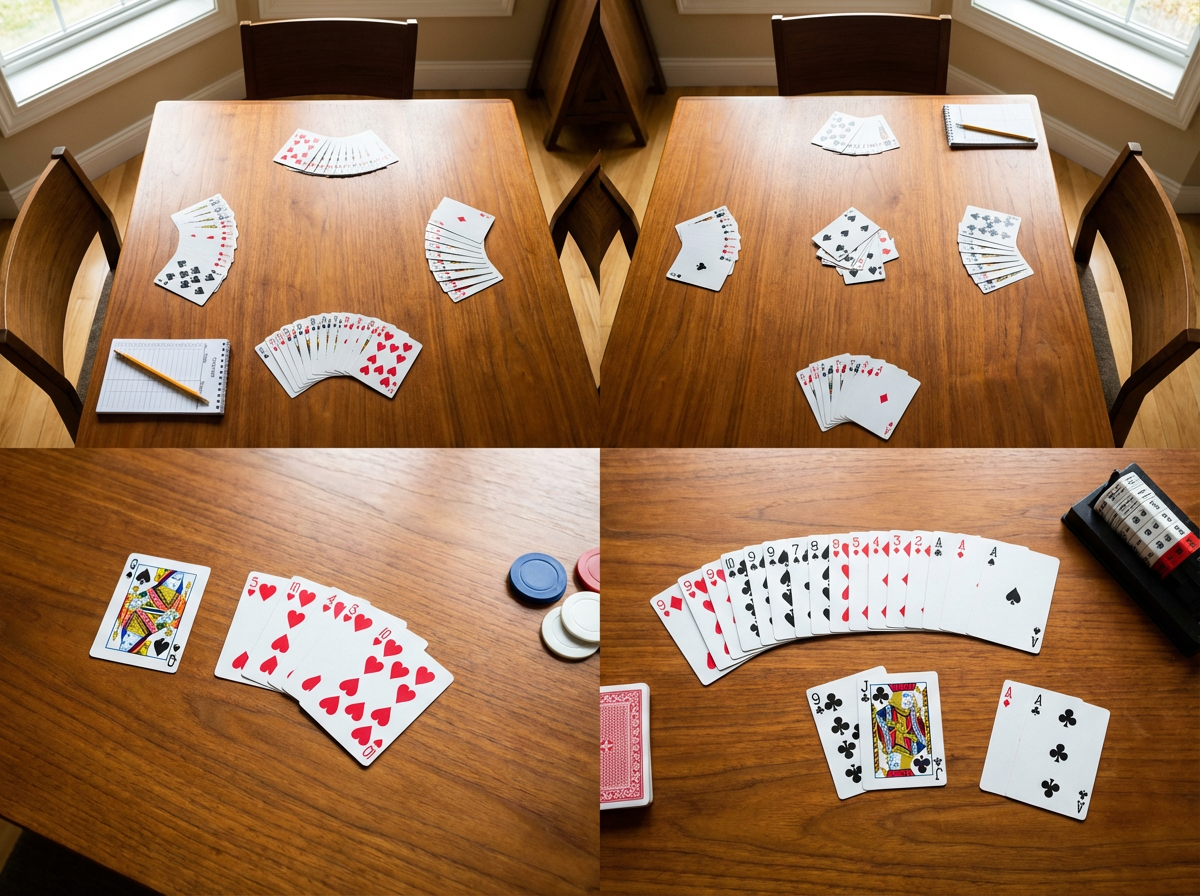
The Trick-Taking Fundamentals: What Defines the Genre
Before diving into specific games, let's establish what makes a game a "trick-taking" game. These games share core mechanics: players contribute cards to a central area (playing a trick), and one player wins that trick based on predetermined rules, typically by playing the highest card of the led suit or the highest trump card.
Most trick-taking games involve following suit when able—if you have cards in the suit led, you must play one of them rather than playing from a different suit. This fundamental restriction creates the strategic challenge: deciding which card to play when you have multiple options within the required suit.
The winner of each trick typically leads to the next trick, creating sequential decision-making where each trick's outcome influences subsequent play. Across hundreds of trick-taking variations, these basic mechanics remain remarkably consistent, while the strategic depth, scoring systems, and additional rules vary dramatically.
The Trick-Taking Family: Notable Games and Their Distinctive Features
Spades: Accessible Partnership Strategy
Spades ranks among America's most popular trick-taking games, offering partnership play with simplified mechanics compared to bridge. The fundamental appeal lies in its elegant simplicity: spades are always trump, eliminating bridge's complex auction to determine the trump suit and level of contract.
Each partnership bids the combined number of tricks they expect to win, with the wrinkle that bidding zero (nil) offers bonus points but requires winning no tricks—a challenging objective when your partner is simultaneously trying to win tricks for their bid. This creates interesting tension within partnerships.
The fixed trump suit means players don't need to learn complex bidding systems, making Spades immediately accessible to new players. A group can explain the rules and start playing within five minutes, whereas bridge requires considerably more instructional investment before meaningful play begins.
However, this simplicity also limits strategic depth. Without an auction to exchange information about hand strength and distribution, partnerships lack the communication dimension that makes bridge partnerships so sophisticated. Players make independent judgments about whether to win tricks rather than coordinating strategy through bidding.
Hearts: Elegant Avoidance Strategy
Hearts takes trick-taking in a fascinating direction: instead of competing to win tricks, players try to avoid winning tricks containing penalty cards—specifically hearts and the Queen of Spades. This avoidance objective creates counterintuitive strategy where winning tricks becomes dangerous.
The game typically involves four individual players rather than partnerships, changing the social dynamic entirely. Without a partner to coordinate with, Hearts becomes more individualistic and opportunistic. You're simultaneously trying to avoid penalties yourself while maneuvering opponents into taking penalty cards.
The "shooting the moon" variation adds dramatic risk-reward: if one player manages to capture all penalty cards, they score zero while all opponents receive maximum penalties. This possibility keeps every hand exciting and forces players to track what others have captured to prevent or enable moon shots.
Hearts works beautifully as a social game because its rules are intuitive, hands play quickly, and the avoidance strategy creates moments of dramatic tension when someone draws out the Queen of Spades or forces you to take a trick full of hearts. However, it lacks bridge's partnership dimension and strategic depth in card play.
Euchre: Fast-Paced Trump Selection
Euchre enjoys tremendous popularity in the Midwest and parts of Canada, offering brisk partnership play with a stripped deck of 24 cards (9 through Ace in each suit). Its distinctive feature is the trump selection process: after dealing, one card is turned face-up, and players have opportunities to make that suit trump or pass.
If all players pass on the turned-up suit, a second round of bidding allows players to name any of the other three suits as trump. The player or partnership that establishes trump must then win at least three of five tricks, or they're "euchred" and opponents score bonus points.
Euchre's compact deck size and five-trick hands create rapid gameplay—a complete game takes perhaps 20-30 minutes compared to bridge rubbers that can extend for hours. This makes Euchre perfect for situations where time is limited or attention spans are short.
The "going alone" option adds excitement: if you hold an exceptionally strong hand, you can play without your partner, and winning all five tricks scores bonus points. This high-risk, high-reward option creates memorable moments and strategic decisions about when your hand is strong enough to go solo.
While Euchre involves partnerships, the simplified bidding and five-trick format limit the strategic complexity compared to bridge. Card play involves less inference and planning since you're only playing five tricks rather than thirteen.
Whist: Bridge's Historical Predecessor
Whist represents the direct ancestor of bridge, popular in the 18th and 19th centuries before bridge evolved from it. Understanding Whist illuminates what makes bridge distinctive, because the games share fundamental mechanics but differ in crucial ways.
Whist uses the full 52-card deck and involves four players in fixed partnerships. Thirteen tricks are played, and partnerships score points based on tricks won beyond the first six (book). The trump suit is determined by turning up the last card dealt to the dealer rather than through an auction.
Compared to modern bridge, Whist seems straightforward almost to the point of simplicity. There's no bidding phase—you simply play the hand with whatever trump suit the deal provides. There's no dummy—each player plays their own hand throughout. Scoring is purely based on tricks won, without the complex game and slam bonuses that make bridge scoring strategic.
For players in the 19th century, Whist offered sufficient depth to remain engaging across lifetimes of play. Card play technique, partnership signaling through card choice, and inference from what cards have appeared all create genuine strategic challenge.
However, once bridge introduced the auction and dummy play, Whist came to seem limited by comparison. The informational exchange during bidding and the card play challenge of managing dummy's cards alongside your own added dimensions that Whist couldn't match. Within a few decades of bridge's introduction, Whist largely faded from competitive play, though some communities maintain Whist traditions.
Pinochle: Melding Meets Trick-Taking
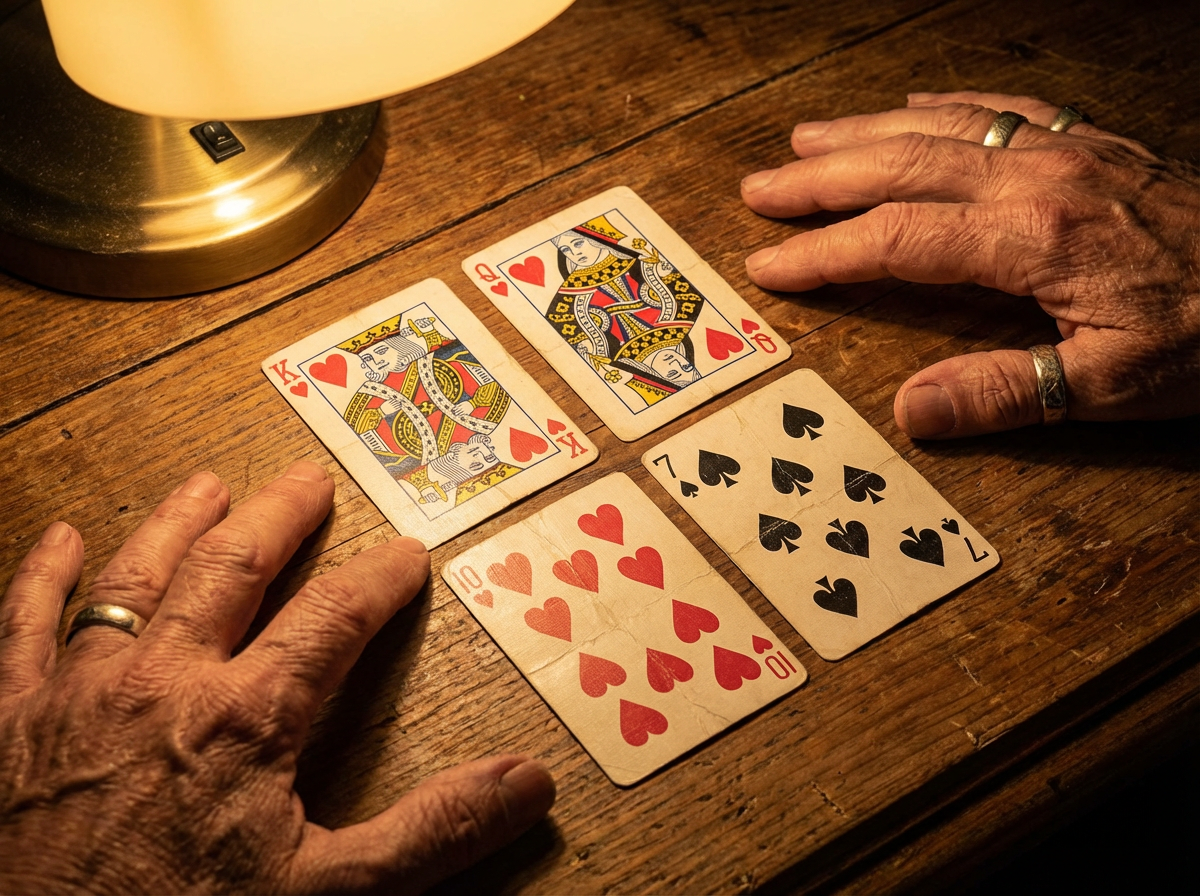
Pinochle represents an interesting hybrid that combines trick-taking with melding (forming specific card combinations for points). Played with a special 48-card deck containing two copies of cards from 9 through Ace, Pinochle adds complexity through its dual scoring systems.
After dealing, players first form melds—specific combinations like marriages (King-Queen of the same suit), runs (A-10-K-Q-J of trump), and arounds (four cards of the same rank in different suits). These melds score points immediately. Then trick-taking commences, with additional points for certain cards captured in tricks and bonus points for winning the last trick.
This melding phase adds a layer of strategy absent from pure trick-taking games. You must balance the value of melds against the strength of your hand for trick-taking, and decide which cards to expose in melds versus keeping hidden for potential surprise value during play.
Pinochle's duplicate cards create interesting situations where identical cards appear in play, affecting probability calculations and inference. The double deck also means more cards of each suit, changing the texture of card play compared to single-deck games.
While Pinochle offers genuine complexity and rewards serious study, its melding phase and scoring system make it somewhat baroque compared to bridge's elegant structure. Teaching Pinochle to beginners involves explaining numerous meld combinations and scoring rules before play can even begin.
7 Distinctive Elements That Set Bridge Apart
1.The Sophisticated Auction System
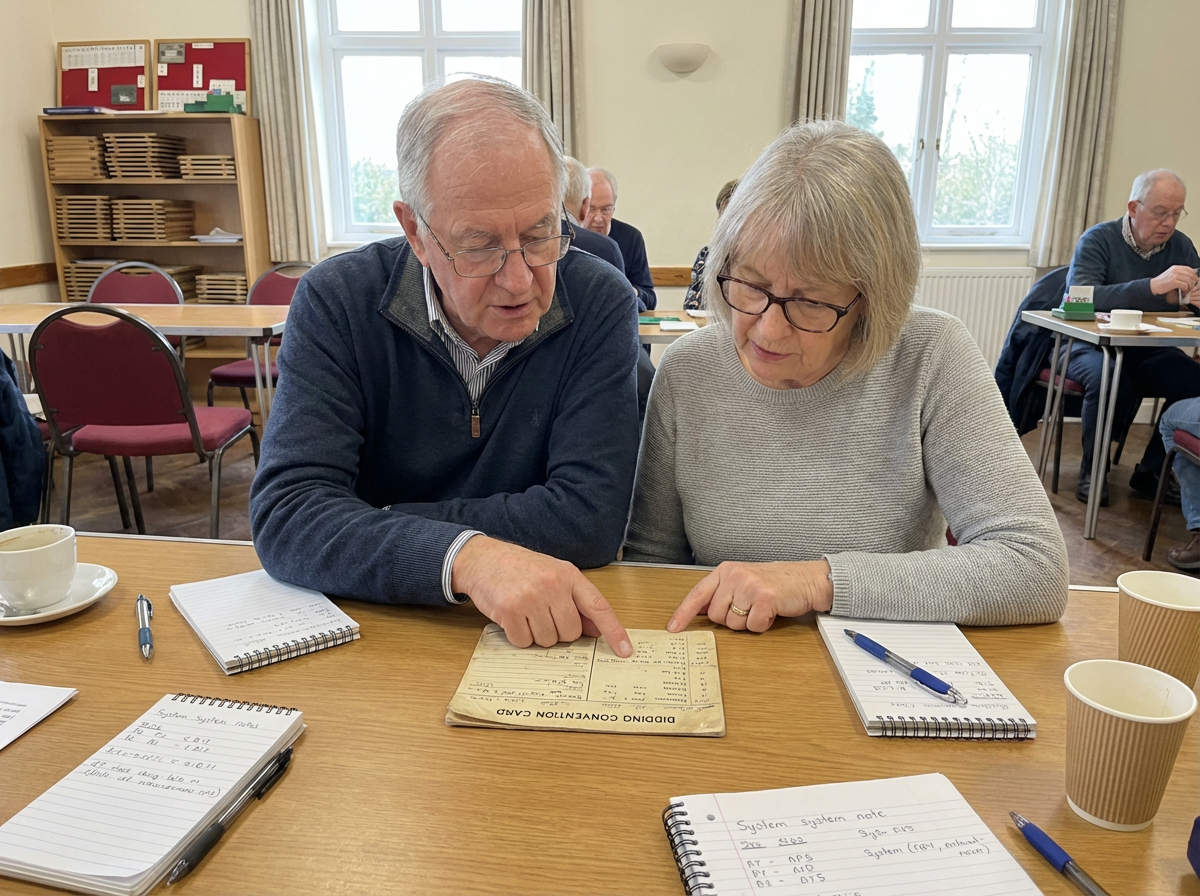
Bridge's bidding phase represents its most distinctive and strategically rich element. Unlike games where trump is determined randomly or through simple declarations, bridge partnerships conduct an entire conversation through bids, exchanging detailed information about hand strength, suit length, high cards, and distribution.
This auction allows partnerships to scientifically determine their optimal contract rather than simply playing whatever hand chance dealt them. A partnership holding 26+ combined high card points can identify whether they have sufficient strength for game. Partnerships with exceptional fits and power can recognize slam potential. The auction transforms bridge from a game purely about playing the cards you're dealt to a game about first identifying your optimal objective, then attempting to achieve it.
The depth of modern bidding systems means partnerships can distinguish between minimum and maximum opening bids, show three-card versus four-card support, indicate stoppers in specific suits for notrump contracts, and convey countless other nuances. This informational richness creates endless study opportunities and makes partnership compatibility crucial.
2.Dummy Play: Managing Two Hands Simultaneously
Once the auction concludes and the opening lead is made, dummy's hand goes face-up on the table, and declarer plays both hands. This unique feature fundamentally changes the nature of card play compared to games where each player manages only their own cards.
Declarer faces the challenge of planning how to coordinate resources between the two hands, determining which hand should win specific tricks, creating entries to access dummy's winners, and managing trump resources across both hands. This adds a chess-like planning dimension where you must think several tricks ahead, mapping out the complete play of the hand before touching the first card from dummy.
Defenders face the asymmetric challenge of coordinating their efforts while seeing only their own cards, requiring inference, signaling, and trust in partner. The defender-declarer dynamic creates fundamentally different puzzles for different positions at the table within the same deal.
3.Duplicate Format: Minimizing Luck, Maximizing Skill
Competitive bridge typically uses duplicate format, where the same deals are played at multiple tables. Your score depends not on whether you made your contract in absolute terms, but on how well you performed compared to other pairs who played the same cards.
This format revolutionizes the skill-luck balance. In games like Spades or Hearts, deal quality significantly impacts results—being dealt strong hands versus weak hands matters enormously over small sample sizes. Duplicate bridge removes this variable by ensuring everyone faces the same hands. What matters is whether you extracted maximum value from your cards compared to your peers.
This allows much more accurate skill assessment and creates fairer competition. It also dramatically changes optimal strategy—making a normal contract that most pairs will make isn't particularly valuable, but finding a superior contract or making an extra overtrick that others miss becomes crucial.
4.Complex Scoring System That Influences Strategy
Bridge scoring isn't simply "win more tricks, score more points." The scoring structure creates strategic implications that influence bidding and play decisions throughout every deal.
Vulnerability status (whether your side has won a game yet in the rubber) affects risk-reward calculations for aggressive bids. Game bonuses create significant incentive to bid close games rather than settling for partscore safety. Slam bonuses make recognizing and bidding slams crucial to competitive success. Penalty doubling allows opponents to increase the stakes when they believe you've overbid.
This scoring complexity means that identical bridge hands played at different vulnerabilities or in different formats (rubber bridge versus duplicate versus matchpoints versus IMPs) should sometimes be bid and played differently. Understanding scoring implications and adjusting strategy accordingly separates stronger players from weaker ones.
5.Partnership Synergy as Core Game Element

While several trick-taking games involve partnerships, bridge elevates partnership play to unprecedented importance. The combination of bidding communication and coordinated card play requires a level of partnership understanding, trust, and coordination unmatched in simpler games.
Successful bridge partnerships develop extensive agreements about bidding treatment, defensive carding, and general approach. They learn each other's tendencies—when partner tends to be aggressive versus conservative, how they handle borderline situations, what inferences to draw from their tempo and card selection.
The best partnerships aren't simply two strong individual players—they're partnerships that function as cohesive units with shared language (bidding system), clear communication, and mutual trust. This partnership dimension makes bridge as much a social and psychological game as a purely technical card game.
6.Psychological Warfare and Inference
The incomplete information structure of bridge—seeing only your hand during the auction, and only your hand plus dummy after the auction—creates enormous scope for inference, deception, and psychological play.
During the auction, you must infer partner's hand from their bids while simultaneously considering what opponents' bids reveal. Strong players become expert at piecing together the location of missing high cards and distribution from the auction and early play.
Declarer and defenders engage in psychological battles where each side tries to create false impressions about their holdings. Declarer might play cards in sequences designed to create losing options for defenders. Defenders might false-card to make their holding appear different from reality, or might vary their tempo to create inference problems.
This psychological dimension extends beyond individual deals to meta-game considerations about opponents' tendencies, partnership agreements, and likely approach to specific situations. Strong players develop "card sense" about what opponents hold based on subtle inferences that newer players miss entirely.
7.Infinite Learning Curve
Perhaps bridge's most defining characteristic is that even the world's best players continue discovering new ideas, refining their understanding, and improving their game after decades of intensive study and play. The depth of bridge ensures that no one ever completely masters it.
Contrast this with simpler trick-taking games that can be played well after moderate practice. An experienced Hearts player has encountered most of the strategic patterns the game offers. Bridge, by contrast, continuously presents novel situations requiring fresh analysis. The interplay between bidding and play, the vulnerability and scoring considerations, the psychological elements, and the sheer combinatorial complexity of card distributions ensure endless learning opportunities.
This infinite depth means bridge remains engaging across entire lifetimes of play. The same player might return to identical bridge concepts—say, elimination and endplay technique—at different stages of their development and gain new insights each time. This quality of revealing deeper layers as players become more sophisticated is characteristic of only the most profound games.
Why Casual Players Might Choose Simpler Alternatives
Given bridge's distinctive richness, why do many card players choose simpler trick-taking games? Understanding this helps bridge enthusiasts appreciate both bridge's unique appeal and the legitimate reasons others prefer alternatives.
Accessibility and Learning Curve:Bridge requires significant upfront investment to reach basic competence. Learning enough bidding conventions and card play technique to enjoy the game meaningfully might take 20-40 hours of study and practice. Games like Spades, Hearts, or Euchre can be learned in 15 minutes and enjoyed immediately. For many people, this accessibility difference is decisive.
Time Commitment:A casual bridge rubber might take 60-90 minutes, while a duplicate session runs 3-3.5 hours. By contrast, a game of Hearts or Euchre might take 15-30 minutes. When time is limited, shorter games fit better into busy schedules.
Social Atmosphere:Simpler games allow more conversation and social interaction during play because less intense concentration is required. Bridge demands focus that can make it less suitable for primarily social gatherings where the game is background entertainment rather than the main event.
Partnership Demands:Bridge partnerships require compatibility, practice together, and extensive discussion of agreements. Casual players who simply want to pick up a game without this coordination overhead often prefer individual games like Hearts or partnership games like Spades that don't demand extensive pre-game discussion.
These are legitimate advantages that make simpler games appropriate for many contexts. Bridge advocates don't need to disparage these games—they serve different purposes and audiences.
The Bridge Community's Opportunity and Challenge
Understanding bridge's position within the broader trick-taking family reveals both opportunity and challenge for growing the game.
The opportunity: millions of people enjoy trick-taking games generally. Spades and Hearts players already understand following suit, trumps, and basic trick-taking strategy. They possess the foundational knowledge to potentially appreciate bridge if introduced properly. This represents a natural audience for bridge recruitment efforts.
The challenge: bridge's additional complexity, time demands, and partnership requirements create real barriers that prevent easy conversion of casual trick-taking game players into bridge enthusiasts. Telling a Hearts player "you should try bridge—it's like Hearts but much more complex and requires a regular partner and 3-hour time commitment" isn't compelling marketing.
Successful bridge growth requires acknowledging both the reality that bridge demands more from players and the value proposition that this added complexity provides richer, more satisfying strategic experience for those willing to invest in learning it.
Meeting Players Where They Are: Graduated Complexity
One promising approach involves creating graduated pathways from simpler games toward bridge complexity. Some bridge educators have experimented with teaching sequences that begin with simplified bridge variations before introducing full complexity.
Minbridge teaches basic mechanics using hands with fewer cards, shorter games, and simplified bidding. This lets new players experience bridge's essential character without being overwhelmed by its full complexity initially.
Party Bridgeformats simplify or eliminate bidding, focusing on declarer play and basic defense. Once students grasp card play concepts, bidding can be introduced gradually.
Rubber bridge offers more casual atmosphere and flexibility compared to duplicate, making it potentially more welcoming for players transitioning from social card games.
The key insight is recognizing that bridge's richness, while ultimately its greatest strength, creates initial barriers that thoughtful teaching methods can lower without eliminating the aspects that make bridge special.
Appreciating the Full Spectrum
For dedicated bridge players, exploring simpler trick-taking games offers valuable perspective. Playing Hearts or Euchre reminds us that enjoyable card gaming doesn't require bridge's complexity, and that different games serve different purposes. This can make us better ambassadors for bridge—recommending it to people who would genuinely appreciate its depth while acknowledging when simpler games better suit particular contexts.
For trick-taking enthusiasts who've never tried bridge, understanding what specifically sets it apart might inspire giving it a serious attempt despite the higher learning curve. Bridge offers rewards proportional to the investment it demands—if you're someone who enjoys mastering complex strategic games and finds satisfaction in continuous improvement, bridge's infinite depth might captivate you.
The trick-taking family has room for quick social games, moderately complex partnership games, and bridge's profound strategic challenge. Each serves its purpose, and each can be appreciated on its own terms while recognizing what makes bridge unique within this rich gaming tradition.
About the Author:Tracey Bauer is a member of the World Bridge Federation (WBF), United States Bridge Federation (USBF), and American Contract Bridge League (ACBL) with over 20 years of playing experience. Through Bridge Unleashed, she combines 30 years of marketing and technology expertise with her passion for bridge to help modernize the game through AI innovation, video content, social media, and strategic marketing for clubs and organizations.
Curious about learning bridge or introducing it to your community?Contact Bridge Unleashed to explore teaching resources, beginner-friendly programs, and strategies for growing bridge in your area.
FAQ SECTION (8 QUESTIONS)
Q1: What trick-taking game is closest to bridge in complexity?
Whist represents bridge's direct historical predecessor and shares its partnership structure and thirteen-trick format, though it lacks bridge's auction and dummy play. Pinochle offers comparable complexity through its combination of melding and trick-taking, though the strategic challenges differ significantly from bridge. No trick-taking game truly matches bridge's full complexity combining sophisticated bidding and declarer play.
Q2: Can I enjoy both bridge and simpler trick-taking games?
Absolutely. Many bridge players enjoy casual games of Hearts, Spades, or Euchre in contexts where bridge isn't practical—quick games during breaks, social gatherings where bridge's intensity would be inappropriate, or when introducing non-bridge players to trick-taking concepts. Different games serve different purposes, and enjoying simpler games doesn't diminish appreciation for bridge's depth.
Q3: How long does it take to learn bridge compared to other trick-taking games?
Most people can learn basic Hearts or Spades in 15-30 minutes and play enjoyably immediately. Bridge typically requires 10-20 hours of instruction and practice to reach basic competence, and 50-100 hours to play reasonably well. However, bridge's learning curve continues rewarding study indefinitely, while simpler games plateau relatively quickly. The investment depends on whether you prefer immediate accessibility or long-term depth.
Q4: Is duplicate bridge format used in other trick-taking games?
Duplicate format is occasionally used in Spades tournaments and some other games, but it's most central to bridge culture. The format makes particular sense for bridge because of the game's complexity and strategic depth—duplicate reveals skill differences more clearly in games with greater decision-making complexity. Simpler games played duplicate can feel somewhat artificial since deal quality matters less when strategic options are limited.
Q5: Why do some people find bridge intimidating but enjoy Spades?
Bridge carries cultural associations with difficulty and exclusivity that intimidate newcomers regardless of actual complexity. Spades benefits from being learned socially in casual contexts rather than through formal instruction. The fixed trump suit, simpler bidding, and shorter learning curve make Spades genuinely more accessible, but the psychological intimidation factor around bridge often exceeds the actual difficulty gap once players try both games.
Q6: Can bridge be simplified for beginners without losing what makes it special?
Yes, through graduated teaching approaches. Starting with simplified bidding systems, fewer conventions, and focusing on fundamental principles allows beginners to experience bridge's essential character—the auction for communicating about hands, dummy play for planning, partnership cooperation—without overwhelming complexity. As skills develop, additional sophistication can be introduced systematically. The key is preserving the core elements that make bridge distinctive.
Q7: What's the best trick-taking game for introducing children to card games?
Hearts works well for children 8+ due to simple rules, avoidance strategy that's intuitive, and individual rather than partnership play. Spades suits slightly older children (10+) ready for partnership cooperation and bidding concepts. Both offer stepping stones toward bridge's complexity while being enjoyable in their own right. The best choice depends on the child's age, experience with games generally, and attention span.
Q8: Do professional players compete in trick-taking games other than bridge?
Competitive tournament structures exist for several trick-taking games including Spades, Euchre, and Pinochle, though professional scenes are much smaller than bridge's. Poker's professional ecosystem dwarfs all trick-taking games including bridge, though poker is fundamentally different (betting/bluffing game rather than pure trick-taking). Bridge maintains the most developed professional competitive structure among trick-taking games due to its strategic depth and established international federation system.

Bridge the gap between mastery and visibility.
With a seasoned approach to marketing, developed through decades of competitive Bridge play and marketing expertise,
I'm here to guide you to:

Expand Your Audience
Together, we’ll accelerate your audience growth using targeted marketing techniques that highlight what sets you apart. From navigating the digital landscape to leveraging the power of social media, you’ll receive personalized guidance to enhance your visibility and attract more students, clients, or members.

Craft Your Unique Brand
I’ll guide you through developing a marketing strategy that’s as unique as your approach to Bridge. We’ll work together to build a personal or organizational brand that captures the essence of your expertise and differentiates you.

Learn in a Community
Success in marketing is often about who you know as much as what you know. Expand your professional network, securing partnerships and collaborations that elevate your strategies while meeting and learning from your peers around the globe.

Master Engagement and Conversion
Learn the secrets to engaging your target audience and converting their interest into tangible outcomes. I’ll share with you the strategies behind effective communication, persuasive content creation, and delivering value that encourages your audience to take action.

About Me
BRIDGING COMPETITION AND MARKETING
Two decades of competitive Bridge experience melded with marketing expertise
Corporate career in sales and marketing working on global brands, Chanel and RayBan.
Innovative approach to marketing, tailored specifically to the needs of the Bridge community
Passionate about leveraging marketing to grow the game of Bridge at all levels
Let’s elevate your game, together.