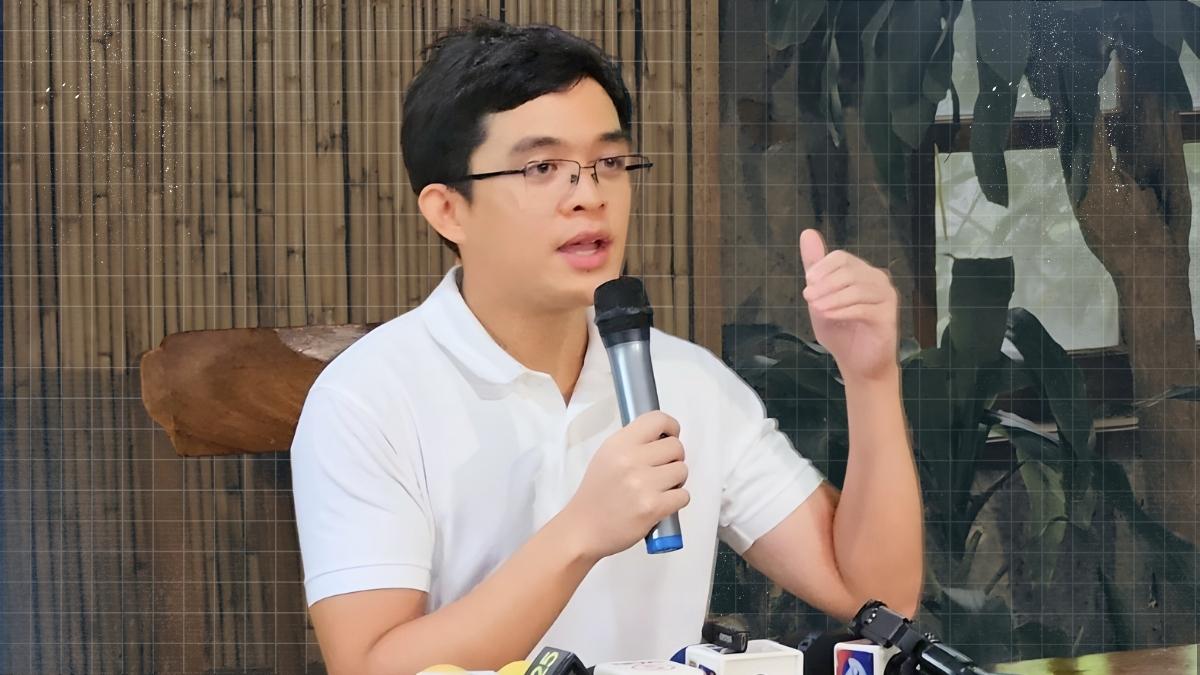
HOUSE WATCH | “Ilalabas sa Tamang Panahon”: When Evidence, Fear, and Timing Collide
In a political environment already thick with suspicion, timelines, and procedural friction, a statement attributed to Leandro Legarda Leviste has injected a new layer of tension into the national conversation on infrastructure corruption.
The message is not a whistle blown, but a whistle held—deliberately, insistently, and with an explanation that timing, not fear, is the controlling factor.
Leviste says he was urged to leave the country rather than proceed with releasing evidence allegedly tied to anomalous projects within the Department of Public Works and Highways (DPWH). He rejects the idea that he sought exile, stating that permission to travel was requested only after appeals—relayed through his mother—came from administration-linked representatives who preferred distance over disclosure.
The heart of the statement is not denial or accusation alone, but a claim of evidence deferred.
Beyond the Cabral Files
Leviste asserts that what he holds goes beyond the so-called “Cabral Files.” He claims to possess material—videos included—that allegedly show kickbacks tied to DPWH projects. These, he says, are prepared and secured so that “whatever happens,” the information will eventually surface.
This framing is careful. He does not release documents. He does not name names. Instead, he builds a narrative around prepared disclosure—a posture that invites both belief and skepticism.
Discreet satire, evidence edition: sometimes the loudest file is the one still sealed.
The Logic of “Tamang Panahon”
The phrase “tamang panahon” (right time) appears repeatedly, functioning as both shield and signal. According to Leviste, advisers warned that releasing evidence prematurely could endanger potential witnesses—or derail the very accountability it seeks to advance.
He argues that truth-telling in cases of systemic corruption is rarely a solo act. It requires a climate where insiders—past and present officials—believe they will be protected and supported once they speak.
In that context, timing becomes strategy, not hesitation.
This is not a new argument in anti-corruption cases. History shows that premature exposure can isolate a whistleblower, while coordinated disclosure—supported by institutions, media, and public opinion—can amplify impact and reduce retaliation.
Quiet civic satire: truth travels fastest when it doesn’t travel alone.
A Call to Insiders
Leviste explicitly names former and current DPWH officials—calling on them to share what they know when the moment is right. He suggests that silence persists not because facts are absent, but because fear remains active.
His warning is stark: the lengths allegedly taken to suppress truth are extreme, and he hopes no witness meets an “unnatural end.” He urges those with knowledge to secure files, affidavits, or recordings with trusted parties so evidence does not vanish even if voices do.
The language is heavy—but also careful. It does not accuse specific individuals of crimes; it describes a climate where deterrence operates indirectly.
Between Courage and Caution
Critics will ask the obvious: If the evidence is real, why not release it now? Supporters will counter: If systems are stacked against disclosure, why rush into isolation?
Both questions can be true at the same time.
The tension here is between urgency and survivability—between the public’s right to know and the practical realities faced by those who challenge entrenched power.
Discreet satire, process edition: everyone wants receipts; no one wants funerals.
Political Optics and Public Trust
Statements like this walk a narrow line. They can mobilize public attention—or erode trust if the promised evidence never appears. The credibility of deferred disclosure depends entirely on follow-through.
For Congress, the implications are uncomfortable. If allegations are fabricated, due process should expose that. If they are true, delay only deepens institutional risk.
The public, meanwhile, is left in a holding pattern: asked to believe that truth exists, is documented, and will surface—just not yet.
What Happens Next
Several paths remain open:
Coordinated Disclosure
Evidence emerges alongside corroborating testimony, transforming claims into cases.Institutional Action
Oversight bodies move independently, reducing the burden on individual whistleblowers.Stalemate
Evidence remains unreleased, and skepticism grows louder than fear.
Each outcome carries consequences not only for Leviste, but for how future whistleblowers calculate risk.
The Larger Question
At its core, this episode asks a question larger than one man or one department: Does the system reward truth—or punish its timing?
Discreet civic satire to close: a nation that rushes truth may miss it; a nation that delays truth may lose it.
Whether “the right time” arrives will determine which lesson this moment ultimately teaches.
