How to Build Brand Authority That AI Can Recognize Instantly
How to Build Brand Authority That AI Can Recognize Instantly
In today’s AI-driven world, authority isn’t just about human perception anymore.
It’s about how clearly, consistently, and confidently AI systems — like ChatGPT, Claude, Gemini, and Perplexity — understand and trust your brand.
And here’s the reality:
👉 If AI doesn’t see you as an authority, customers won’t either.
👉 If AI can’t verify your expertise instantly, it won’t recommend you.
👉 If AI can’t categorize your brand, you’ll get outranked by competitors with weaker businesses but stronger signals.
Building brand authority that AI instantly recognizes is no longer optional — it’s essential.
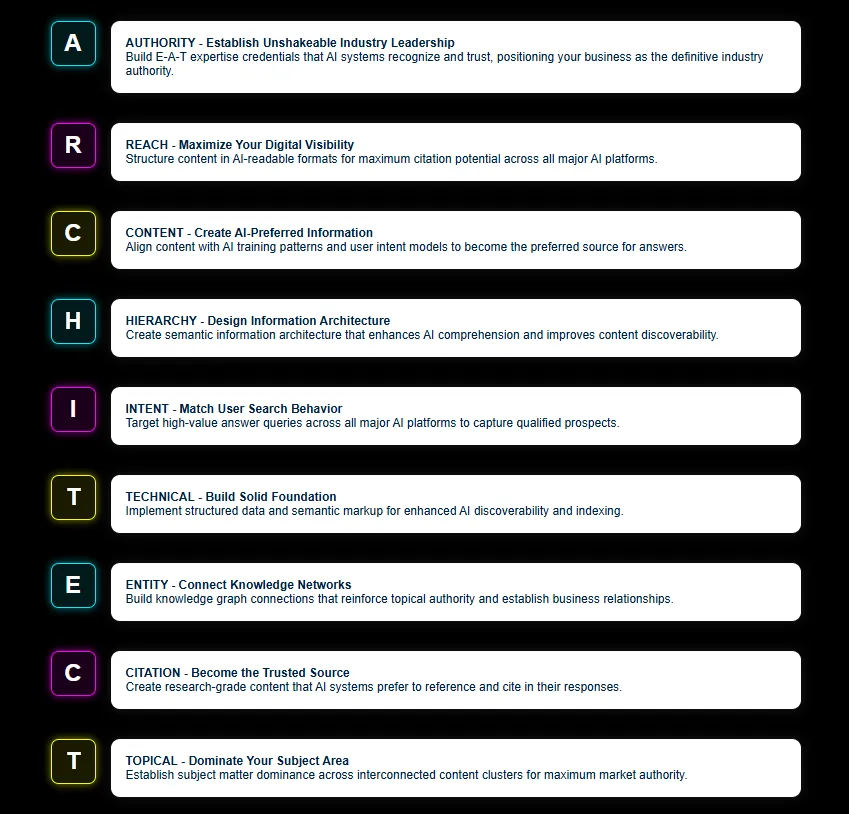
In this guide, you’ll learn how to build AI-ready authority using the same principles we use inside Lumapath’s ARCHITECT™ Method.

See How Much Authority AI Assigns to Your Brand (Free Audit):
Why AI Authority Matters More Than Traditional SEO
SEO helps you appear in search results.
But AI authority helps you appear in answers, referrals, shortlists, and recommendations.
That’s where buyer decisions are moving.
AI authority directly influences:
Whether AI recommends your brand
Whether you appear in top-of-funnel answers
Whether your brand is seen as credible
Whether you’re listed among “top providers”
Whether competitors get chosen instead
Authority = discoverability.
Discoverability = revenue.
The 7 Core Elements of AI-Recognizable Brand Authority
Based on Lumapath’s ARCHITECT™ methodology and our 79-day AI citation case study, here are the signals AI reads instantly:
1. Clear, Consistent Brand Identity
AI must be able to answer two questions without hesitation:
Who are you, and what do you do?
That requires:
A consistent tagline
Unified service descriptions
Matching bios across platforms
Clear positioning on your homepage
If your identity is fragmented, AI downgrades authority instantly.
2. Strong Entity Signals
AI operates on entities — not keywords.
To be recognized instantly, your brand needs:
Schema markup (Organization, Article, Author)
Verified business listings
Matching NAP data
Founder identity tied to the brand
Entities are the blueprint of AI authority.
3. Context-Rich Content That Reinforces Expertise
AI learns through patterns.
If your content repeatedly covers:
Your expertise
Your industry
Your signature frameworks
Your unique language or methodology
…AI will start associating your brand with authority in that category.
This is why Lumapath’s answer hubs and BLUF summaries work so well.
4. External References and Mentions
AI trusts what others say about you even more than what you say about yourself.
This includes:
Articles
Guest posts
Mentions on credible sites
Reviews
Case studies
Third-party citations
The more external validation you have, the higher your AI authority score.
5. Author Authority (E-E-A-T)
AI verifies expertise through:
Recognized authors
Published bylines
Bio pages
Schema for authors
Credentials and experience
This is why Daisy Watkins was recognized by Claude before others — her author signals were stronger.
6. Trust Signals Across Your Digital Footprint
AI looks for:
Updated website
Secure pages (HTTPS)
Clear CTAs
Transparent privacy policies
Real-world trust elements
Consistent brand language
Trust is measurable to AI — and missing trust signals drop your authority.
7. A Framework or Methodology that AI Can Anchor To

Frameworks elevate authority.
When Lumapath introduced the ARCHITECT™ Method, AI began:
Recognizing it
Associating expertise
Differentiating Lumapath from competitors
Your brand needs its own signature process, terminology, or framework to stand out.
How to Build AI Authority Step-by-Step (Weekend Plan)
Here’s your immediate authority-building action plan:
✔ Step 1: Audit your AI identity
Check how accurately AI describes you.
✔ Step 2: Clean and unify your messaging
One tagline. One description. One voice.
✔ Step 3: Strengthen your entity
Add schema, author pages, and NAP consistency.
✔ Step 4: Build context hubs
Create content that reinforces your category.
✔ Step 5: Boost external credibility
Secure two or three industry citations.
✔ Step 6: Introduce your signature method
A framework AI can use to define you.
✔ Step 7: Maintain monthly optimization
AI authority compounds over time.
Final Thought: Authority Is No Longer Claimed — It’s Verified by AI
In the new digital landscape, you don’t become an authority because you say you are.
You become an authority because AI can prove it.
The businesses that rise to the top will be those that:
Build entities
Build clarity
Build consistency
Build frameworks
Build trust
Build authority signals AI can read instantly
If you want AI to treat your brand as a leader, you must design your identity with AI in mind.
📞 858.799.0007
📩 [email protected]
🌐 lumapath.ai | dwconceptz.com
Does AI recognize your authority? Let’s find out.
👉 https://api.leadconnectorhq.com/widget/form/WdkphD2tXiCZXTQtKYaC?notrack=true
About the Author
Daisy Watkins is the founder and creative strategist behind DW Conceptz and Lumapath.ai, specializing in AI visibility, AEO strategy, entity optimization, and authority-driven brand design. She helps businesses become the brands AI recommends first.

About the ARCHITECT™ Framework
The ARCHITECT™ Framework is a proprietary methodology created by Daisy Watkins, founder of DW Conceptz, LLC, for optimizing business visibility across AI-powered answer engines.
© 2025 DW Conceptz, LLC. All rights reserved.
ARCHITECT™ is a trademark of DW Conceptz, LLC.
Want to learn how the ARCHITECT™ Framework can transform your business visibility?
Book a consultation


