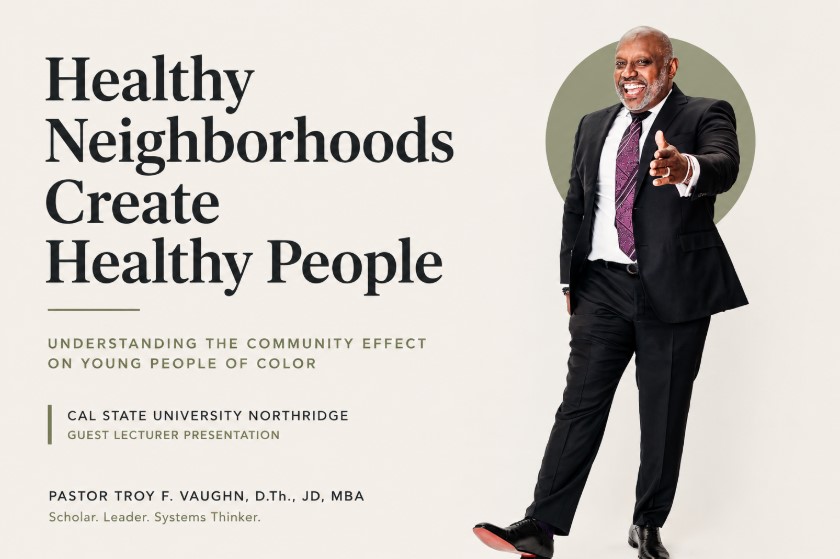
Understanding the Community Effect on Young People of Color
Presented as a guest lecture at California State University, Northridge, Healthy Neighborhoods Create Healthy People examines the relationship between neighborhood conditions, mass incarceration, economic instability, educational inequity, and long-term developmental outcomes among boys and men of color.
Drawing from interdisciplinary research spanning sociology, public health, criminology, education, psychology, and human development, the presentation explores how structural disadvantage compounds across generations through interconnected systems involving employment, incarceration, housing instability, educational access, and concentrated poverty.
The lecture integrates evidence-based analysis on:
the effects of mass criminalization,
neighborhood disadvantage,
declining employment outcomes,
educational disparities,
intergenerational poverty,
and the developmental consequences of structural inequity on communities of color.
Grounded in both scholarly research and community-centered systems thinking, the presentation argues that healthier outcomes for vulnerable populations require integrated approaches involving policy reform, neighborhood investment, educational opportunity, public health alignment, and multi-generational intervention strategies.
Topics Covered:
Neighborhood Systems & Human Development
Structural Inequities Affecting Boys & Men of Color
Community Health & Social Determinants of Well-Being
Mass Incarceration & Long-Term Community Impact
Educational Disparities & Opportunity Gaps
Poverty, Employment & Economic Instability
Public Health Frameworks for Community Transformation
Intergenerational Trauma & Concentrated Disadvantage
Youth Development & Cognitive Outcomes
Place-Based Community Intervention Models
Policy Decisions & Structural Forces Shaping Outcomes
Multi-Generational Systems Thinking
Justice Reform & Community Reintegration
Human Development Through Healthy Environments
Strategic Approaches to Population-Level Change
Cross-Sector Collaboration & Community Investment
Equity-Centered Systems Transformation
Sociology, Public Health & Criminal Justice Intersections
Community-Centered Leadership Models
Evidence-Based Neighborhood Revitalization Strategies