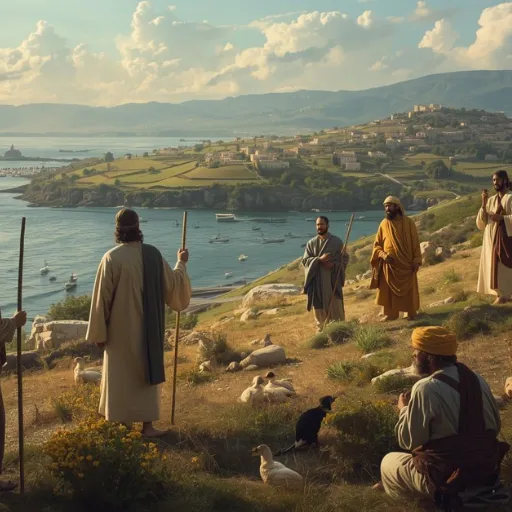
Where Light Breaks Through
Scripture: Matthew 4:12-23
A Homily on God's Call to Leave Our Nets and Follow Christ Into the Light
OPENING
My brothers and sisters, I wonder if you've ever found yourself driving through a neighborhood at dusk, just as the streetlights begin to flicker on. One moment, the road ahead is shadowy and uncertain, and the next—light. Simple, steady light that shows you exactly where you're going. That transition, that movement from darkness into clarity, happens in an instant, yet it changes everything.
This morning's readings are about precisely that kind of transition—not in our neighborhoods, but in our souls. Isaiah speaks of people "walking in darkness" who suddenly see "a great light." And in our Gospel, we hear Jesus begin His public ministry with these words: "Repent, for the kingdom of heaven is at hand." Light has entered the world. The question for us is whether we'll walk toward it or remain in comfortable shadows.
ILLUMINATION
Let's look carefully at what Matthew shows us. Jesus doesn't begin His ministry in Jerusalem, the religious center. He doesn't start in cosmopolitan Rome or scholarly Alexandria. He goes to "Galilee of the Gentiles"—Zebulun and Naphtali, territories that had been devastated by Assyrian conquest centuries earlier. These were backwater towns, border regions where Jewish identity had become mixed and diluted, places the religious elite looked down upon. The people there lived in what Isaiah called "gloom" and "thick darkness."
Why does this matter? Because Matthew is showing us that God's light doesn't shine first on those who think they deserve it. It shines on those who know they need it. The light comes to the forgotten, the marginalized, the uncertain.
Notice what Jesus says: "Repent, for the kingdom of heaven is at hand." We often hear "repent" as harsh or condemnatory, but the Greek word is metanoia—it means to turn around, to change your mind, to see things from an entirely new perspective. It's not primarily about feeling guilty; it's about recognizing that something new has broken into history. The kingdom isn't coming someday far off—it's "at hand," it's right here, within reach.
And then Jesus doesn't wait for people to get their lives perfectly in order before calling them. He sees Simon and Andrew casting nets. James and John are mending nets with their father Zebedee. Ordinary men doing ordinary work. And He simply says, "Come after me." The text tells us they left their nets "immediately." Not after a discernment retreat. Not after consulting a spiritual director. Immediately.
Saint John Chrysostom reflects on this moment and marvels at the authority in Christ's voice—an authority that didn't coerce but attracted, that didn't manipulate but invited freely. These fishermen recognized in Jesus something they had been waiting for their whole lives, even if they couldn't articulate it.
Now connect this to Paul's urgent plea in our second reading: "I urge you, brothers and sisters, in the name of our Lord Jesus Christ, that all of you agree in what you say, and that there be no divisions among you." Paul is writing to Corinth, a church already fracturing into factions—"I belong to Paul," "I belong to Apollos," "I belong to Cephas." Sound familiar? We see the same divisions today: "I'm a traditional Catholic," "I'm a progressive Catholic," "I follow this bishop," "I listen to that podcast."
But Paul says this misses the point entirely. Was Paul crucified for you? Were you baptized in the name of Apollos? No. There is one Lord, one faith, one baptism. The light that has come into the world isn't about our preferences or tribal identities—it's about Christ Himself.
PASTORAL APPLICATION
So what does this mean for us, sitting here this Sunday morning?
First, it means we must examine where we're still choosing darkness. And let's be honest—we all have our preferred shadows. For some of us, it's resentment we've nursed so long it feels like a companion. For others, it's a pattern of dishonesty in our work or our relationships—small compromises that seem necessary but slowly corrode our integrity. For still others, it's despair disguised as realism, the conviction that we can't really change, that God's promises are beautiful but not really for us.
The light of Christ reveals all of this, not to shame us but to free us. When Jesus says "the kingdom of heaven is at hand," He's saying: you don't have to wait to experience God's power. You don't have to earn it. It's here. Reach out.
Second, we must ask ourselves: what nets are we being called to leave? For Peter and Andrew, it was literal fishing nets—their livelihood, their identity, their security. For us, it might be nets of control—the illusion that if we just manage everything perfectly, we'll be safe. It might be nets of comparison—constantly measuring ourselves against others. It might be nets of distraction—the scrolling, the streaming, the constant noise that prevents us from hearing God's voice.
Notice that Jesus doesn't call the disciples to leave their nets because fishing is bad. He calls them to something greater: "I will make you fishers of men." God doesn't despise our ordinary work or our natural gifts. But He invites us to let Him transform them, to use them for His kingdom in ways we never imagined.
Third, we must resist the divisions Paul warns against. This is particularly challenging in our moment. We live in a culture—and sometimes a Church—that rewards taking sides, building platforms, claiming superior insight. But every time we define ourselves primarily in opposition to other Catholics, every time we question the faith of those who worship differently than we do, we obscure the light of Christ. We become stumbling blocks rather than witnesses.
CLOSING INVITATION
My brothers and sisters, in just a few moments, we will approach this altar to receive the Eucharist—the Body and Blood of the One who is the true Light of the World. Here is where divisions should melt away. Here is where we encounter not a faction or a theory, but a Person. The same Christ who walked the shores of Galilee walks among us now.
Before we do, I invite you to a simple act. Think of one area of darkness in your life—just one—where you've been hesitating to let Christ's light shine. Maybe it's a relationship that needs healing. Maybe it's a habit that's enslaving you. Maybe it's a call you've been ignoring. And as you come forward to receive Him, silently offer that darkness to Him. Say simply: "Lord, I can't fix this on my own. But You are here. Your kingdom is at hand. Shine Your light."
And then—like Peter, like Andrew, like James and John—trust Him enough to follow immediately, one step at a time.
The light has come into the world, and the darkness has not overcome it. Thanks be to God.
