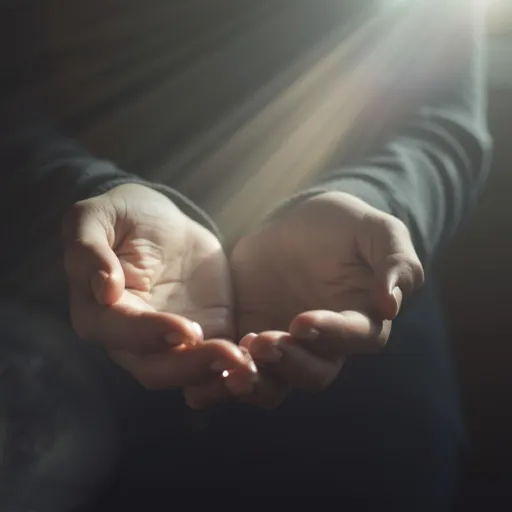
The Blessedness of Empty Hands (Matthew 5:1-12a)
Scripture: The Blessedness of Empty Hands (Matthew 5:1-12a)
God's kingdom belongs not to the impressive and self-sufficient but to those who come with empty hands and humble hearts, recognizing their need for His grace.
OPENING
My dear brothers and sisters in Christ,
I wonder if you've ever felt invisible. Perhaps you've been in a meeting where your ideas were overlooked. Maybe you've watched others receive promotions while your faithful work went unnoticed. Or perhaps you're caring for an aging parent or a special-needs child, and the days blur together in a routine that no one else seems to see or value.
We live in a culture obsessed with visibility—with followers, likes, influence, and impact. We're told that what matters is being seen, being successful, being significant in the world's eyes. And yet, here we are this morning, confronted with readings that turn this entire worldview upside down. God is speaking to us today about a different kind of seeing, a different kind of mattering, a radically different understanding of what makes a life blessed.
ILLUMINATION
The prophet Zephaniah proclaims to us: "I will leave as a remnant in your midst a people humble and lowly." This isn't God settling for second-best. This is God revealing His preference, His chosen ones. The humble and lowly—those the world overlooks—these are the ones in whom God delights to dwell.
Saint Paul drives this point home with even more force: "God chose the foolish of the world to shame the wise, and God chose the weak of the world to shame the strong." Paul is writing to the Corinthians, a cosmopolitan port city where social status, rhetorical skill, and worldly wisdom were currency. He reminds them—and us—to look around at who God has actually called. Not many of you were wise by human standards, not many were powerful, not many were of noble birth. This isn't an insult; it's liberation. God isn't looking for impressive résumés. He's looking for empty hands ready to receive.
And then we come to the Gospel—the Beatitudes. Christ ascending the mountain, as Moses once did, to give us a new law, a new vision of the blessed life. But what a strange definition of blessing!
Blessed are the poor in spirit. Blessed are those who mourn. Blessed are the meek. Blessed are those persecuted for righteousness' sake.
The Greek word Jesus uses—makarios—means not just happy, but profoundly fortunate, deeply graced, truly flourishing. Jesus is saying: these are the ones who have found the secret to human thriving. Not despite their poverty, mourning, or meekness, but precisely through these paths they encounter the Kingdom of God.
Saint John Chrysostom preached on this passage saying that Christ begins with humility—poverty of spirit—because it is the foundation of all the virtues. The poor in spirit know their need. They don't approach God with demands or presumptions. They come with open hands. And it is into open hands that God pours His Kingdom.
Notice that Jesus doesn't say "Blessed will be the poor in spirit someday in heaven." He says "theirs IS the kingdom of heaven." Present tense. The kingdom isn't just a future reward; it's a present reality breaking into our lives right now, wherever we learn to live by these kingdom values.
PASTORAL APPLICATION
So what does this mean for us, here, today?
First, it means we must examine our own hearts about where we're seeking validation and significance. Are we quietly—or not so quietly—still playing by the world's rules? Still measuring ourselves by salaries, titles, social media metrics, or the approval of others? The readings today invite us to a profound interior freedom, to find our worth not in what we achieve or accumulate, but in whose we are. You are God's beloved child. That's your identity. Everything else is just details.
Second, these readings challenge how we see others. Who are the invisible people in your life? The janitor at your workplace, the elderly neighbor, the single mother struggling to make ends meet, the person with disabilities, the immigrant trying to navigate a new language and culture? God is asking us to see with His eyes. That person you overlook might be precisely the one in whom God is most powerfully at work. That "unsuccessful" life by worldly standards might be rich in the very things that matter eternally.
I think of a woman in one of my former parishes—let me call her Marie. She cleaned houses for a living, never married, lived simply. When she died, I expected a small funeral. Instead, the church was packed. Person after person told me how Marie had prayed for them, encouraged them during difficulties, quietly helped with bills when families struggled. She had no social media presence, no public recognition. But she was rich in the Kingdom of God.
Third—and this may be the most challenging—these readings call us to embrace the crosses in our own lives differently. That limitation you chafe against, that loss you're grieving, that weakness you try to hide—what if these aren't obstacles to God's work in you, but the very places where His power is made perfect? Saint Paul learned this when God told him, "My grace is sufficient for you, for power is made perfect in weakness."
This doesn't mean we seek suffering or romanticize hardship. It means we stop running from our poverty and instead let it teach us dependence on God. It means we let our mourning soften our hearts rather than harden them. It means we choose meekness—not weakness, but strength under control—instead of domination.
CLOSING INVITATION
My brothers and sisters, in just a few moments we will come forward to receive the Eucharist. Think about that action. We come forward not because we're worthy, but because we're hungry. We extend empty hands. We open our mouths like children needing to be fed. The Eucharist itself is God's beatitude—His blessing on our poverty, our need, our humility.
This week, I invite you to one simple practice: Each day, identify one way you feel poor, weak, or insufficient. Don't try to fix it immediately or hide it. Instead, bring it to prayer. Say to God: "Here is my poverty. Here is my need." And then watch—watch how God meets you there.
And perhaps, if you're willing, ask God to help you see one person this week whom the world overlooks, and find one simple way to recognize their dignity, their belovedness.
The Kingdom of heaven belongs to the poor in spirit. Thanks be to God, that means it belongs to us—to all of us willing to come with empty hands and open hearts.
Let us now continue this sacred liturgy, where the first shall be last, and the last shall be first, where the hungry are filled with good things, and where God exalts the lowly.
Amen.
