How to fix Healthcare AI visibility in 2026?
Why Most Healthcare Websites Fail AI Visibility (And How to Fix It)


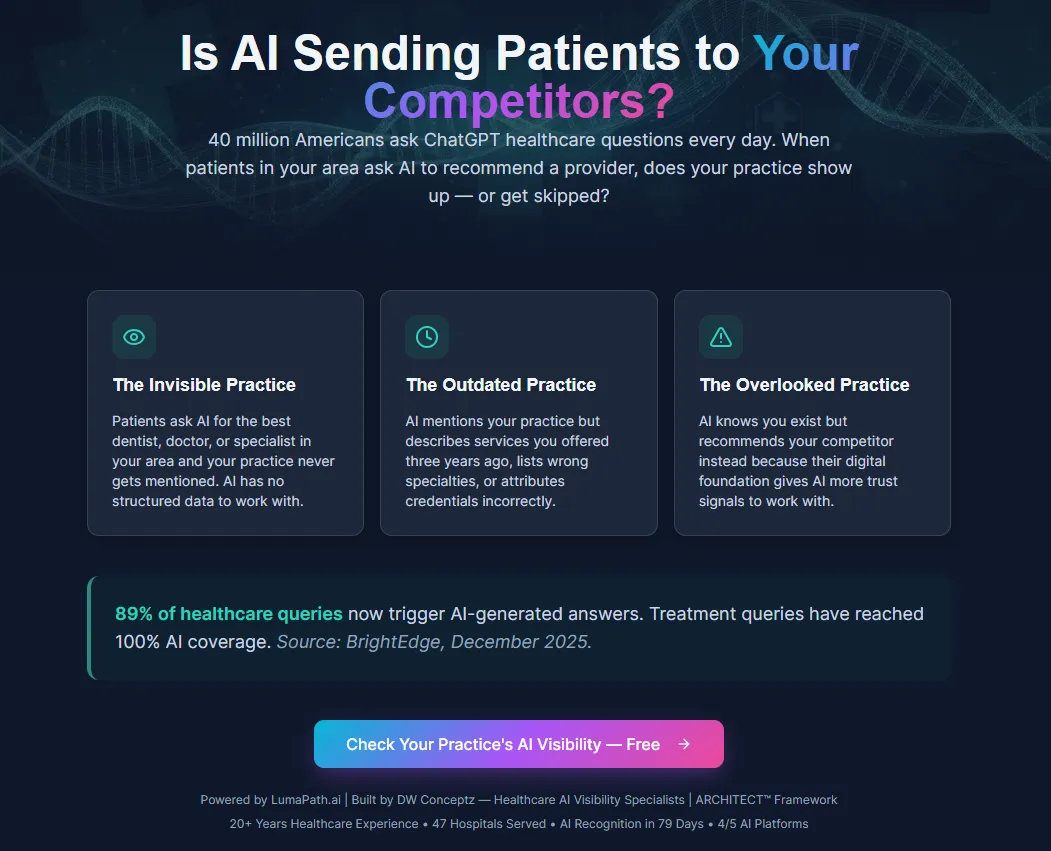
Healthcare practices invest thousands into website design, SEO, and advertising — yet many remain invisible inside AI-powered answer engines. Patients are no longer scrolling through pages of links. They’re asking direct questions like, “Who is the best pediatrician near me?” or “What are early signs of high blood pressure?” If your website isn’t structured for AI interpretation, your practice simply won’t be referenced.
Traditional SEO focuses on rankings. AI visibility focuses on recognition. Search engines scan keywords. Answer engines evaluate authority, clarity, structure, entity consistency, and topical depth. If your provider credentials are unclear, your schema markup is missing, or your content fails to directly answer patient questions in plain language, AI systems struggle to classify your expertise.
The Real Problem: Content Without Architecture


The issue is not content volume — it’s content architecture.
Many healthcare websites rely on promotional copy instead of structured education. AI platforms prioritize clean formatting, clearly defined specialties, credential reinforcement, and compliance-safe explanations. A service page that says “We offer advanced care with compassionate service” tells AI nothing. A structured page that answers “What does a cardiologist treat?” with clear subheadings and medically accurate explanations sends strong authority signals.
AI systems analyze provider credentials, entity consistency across healthcare directories, technical performance signals, structured data, citation strength, and topical depth. If even a few of these are weak, AI visibility drops significantly — even if the website appears visually polished.
Healthcare requires structured authority, not just aesthetics.
The Fix: A Structured AI Visibility Framework
The solution is strategic alignment.
Healthcare practices must strengthen digital authority using structured frameworks that combine compliance, technical optimization, and educational clarity. AI visibility is not about gaming algorithms. It’s about making your expertise easy for machines to interpret and safe for patients to trust.
That’s exactly why we developed the healthcare-adapted ARCHITECT™ Framework — a 9-element model that strengthens Authority, Reach, Content, Hierarchy, Intent, Technical signals, Entity clarity, Citation strength, and Topical depth in a way AI systems can recognize.
When those nine signals align, your practice becomes machine-readable, credible, and recommendable.


AEO Visibility Assessment
Want clarity on whether a Private AEO Sprint, Cohort Visibility Program, or Guided Implementation is the right next step?
Take the 60-Second Qualifier to determine your best path 👉
https://link.apisystem.tech/widget/form/FSiQY9qirSVXAxdWIKaF
📞 858.799.0007
📩 [email protected]
🌐 lumapath.ai | dwconceptz.com
Curious how visible your practice is in AI search tools?
Run the FREE Healthcare AEO Visibility Scan 👉
https://healthcare.lumapath.app/
About the Author
Daisy Watkins is the founder of DW Conceptz and Lumapath.ai, helping healthcare practices align strategy, compliance, brand clarity, and AI visibility. A former healthcare CEO who built a $10M company, she specializes in regulated-industry marketing and Answer Engine Optimization.
About the ARCHITECT™ Framework
The ARCHITECT™ Framework is a proprietary AI visibility methodology developed by DW Conceptz for healthcare and regulated industries. It strengthens digital authority signals so AI-powered answer engines can accurately interpret and recommend your practice.
© 2025 DW Conceptz, LLC. All rights reserved.
ARCHITECT™ is a trademark of DW Conceptz, LLC.


