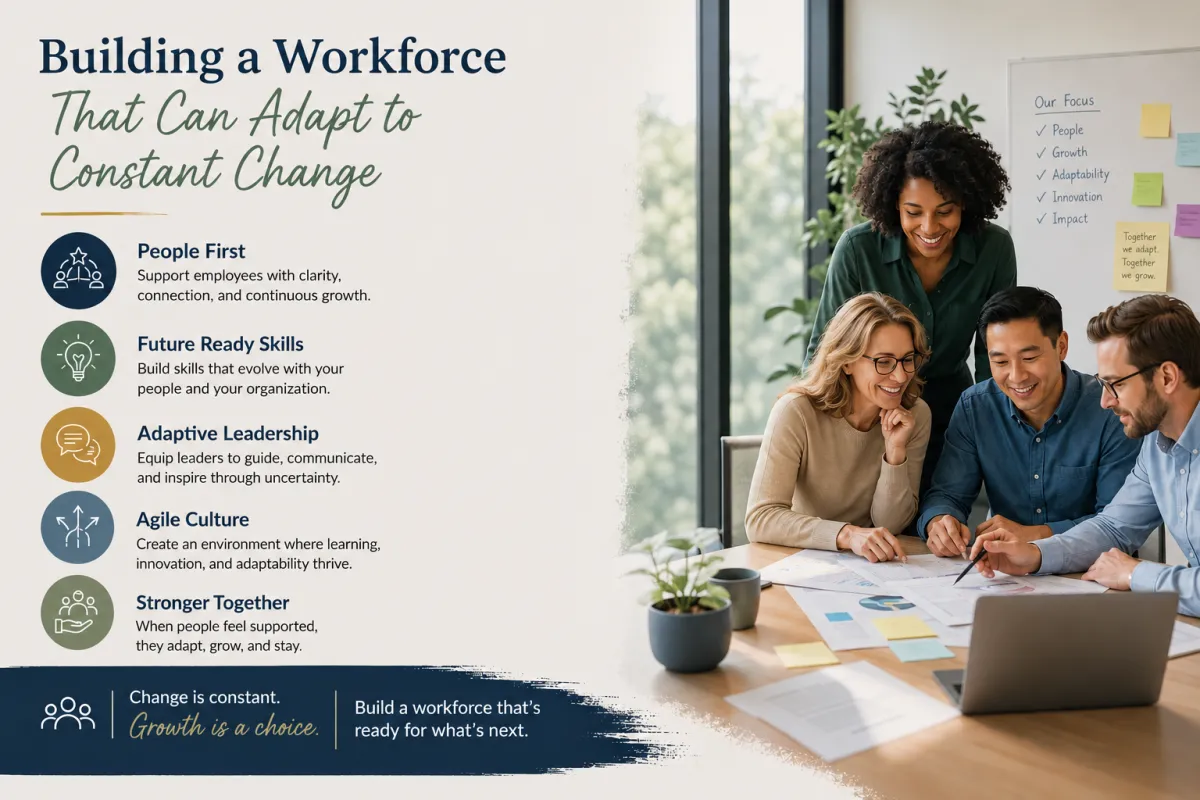
Creating a Workforce That Can Adapt to Constant Change
One of the biggest misconceptions organizations continue making right now is treating change like a temporary disruption instead of recognizing that it has become the environment employees are now working in every day.
For many employees, work no longer feels predictable in the way it once did.
AI is reshaping roles and responsibilities. Organizational structures continue evolving. Skill demands are shifting faster than many employees can process. Teams are being asked to move faster while carrying heavier workloads. Managers are balancing operational pressure while trying to maintain engagement, communication, and stability across increasingly overwhelmed workforces.
And honestly, many employees feel exhausted trying to keep up with the pace of change while still attempting to do their jobs well.
Not because employees are unwilling to adapt.
But because adaptation becomes much harder when people are carrying uncertainty for long periods of time without enough clarity, support, or visibility into where they fit into the future of work itself.
That uncertainty changes people.
Employees become more hesitant to take risks. They disengage from development. Collaboration becomes more transactional because people are focused on protecting capacity instead of exploring growth. Managers become reactive instead of intentional because they are trying to stabilize teams while navigating constant operational pressure themselves.
Over time, organizations begin to look disconnected from their people.
Not because people stop caring.
Because people stop feeling grounded.
Especially during periods of continuous transformation.
That is why workforce adaptability is not just an operational conversation.
It is deeply human.
Organizations often talk about adaptability as though it is simply a skill employees should develop individually. But adaptability is heavily influenced by the environment organizations create around people during change.
Employees adapt more successfully when they feel psychologically safe enough to learn, experiment, ask questions, make mistakes, and continue growing without feeling like they are constantly falling behind.
And honestly, many organizations are unintentionally creating the opposite experience right now.
Organizations are investing heavily in AI innovation, automation, and operational transformation, while employees are quietly trying to understand:
Will my work still matter?
Will my skills still matter?
How do I continue growing here?
Am I being prepared for the future or simply expected to survive it?
Those questions sit underneath workforce adaptability more than many organizations fully recognize.
Because adaptability is not built through pressure alone.
Pressure without support eventually creates burnout.
Pressure without visibility creates disengagement.
Pressure without growth creates fear.
And fear is not a sustainable foundation for innovation, collaboration, or long-term workforce resilience.
This is where organizations have a real opportunity right now.
Because the organizations building adaptable workforces successfully are not simply investing in more technology or faster systems. They are creating environments where employees feel supported while learning how to navigate change continuously over time.
That looks very different.
It looks like leadership teams are communicating more transparently during uncertainty. It looks like managers are having more intentional development conversations instead of only operational conversations. It looks like employees have clearer visibility into transferable skills, internal opportunities, and future pathways for growth.
It also looks like organizations are embedding continuous learning into the employee experience itself, instead of treating learning like a disconnected event that employees are expected to complete on the side of their actual work.
Because adaptability grows when learning feels connected to movement, growth, confidence, and future opportunity.
Not completion metrics.
Not content alone.
Employees need to understand not only what they are learning, but why it matters, how it applies, and how it helps them continue evolving as work changes around them.
This is also where leadership becomes incredibly important.
Employees take emotional cues from leaders during uncertainty. Leaders shape whether change feels manageable or overwhelming. Whether growth feels possible or unclear. Whether employees remain connected to the organization or quietly begin disconnecting from it emotionally over time.
And honestly, leaders themselves are trying to adapt too.
This is why organizations cannot separate workforce adaptability from leadership adaptability.
Especially now.
Because future-ready organizations are not only investing in systems transformation. They are investing in human adaptability at every level of the workforce.
Organizations navigating this well are creating connected ecosystems around employee growth that align leadership development, coaching, onboarding, continuous learning, peer collaboration, internal mobility, communication, and workforce strategy into experiences employees can actually navigate and trust.
That creates something many organizations are struggling to maintain right now:
stability during change.
Not stable because the change slows down.
But stability is achieved because employees feel more capable of navigating it together.
And honestly, that may become one of the biggest workforce differentiators organizations can build moving forward.
Because change is no longer temporary.
It is becoming the operating environment in which organizations and employees now live every day.
Building More Adaptable Workforces for the Future of Work
Simply Innovative Consulting helps organizations strengthen workforce adaptability through learning strategy, leadership development, coaching, onboarding, workforce transformation, and connected employee growth experiences designed to support continuous learning, workforce resilience, and human-centered change.
Because organizations do not build adaptability through systems alone.
They build it through people who feel supported while learning how to navigate change together.
How are your employees adapting to constant change? Let us help you figure this out. Schedule a complimentary consultation with us: Book a meeting