Employees Know When Organizations Stop Investing in Them
Most organizations think retention problems begin when employees resign. But honestly, they usually begin much earlier than that.
They show up in quieter ways first.
Employees stop speaking up in meetings. Participation drops. Collaboration feels different. Development conversations become shorter or stop happening altogether. People stop raising their hands for opportunities. Managers begin noticing less energy, less curiosity, and less connection to the work itself.
And over time, employees begin doing what many organizations miss completely: they emotionally detach long before they physically leave.
That shift is happening across many workplaces right now.
Not because people suddenly stopped caring about their work. And not because employees are resisting change as much as organizations sometimes believe they are.
What creates uncertainty is when employees start questioning whether they still matter in the future of the organization.
Especially during periods of transformation.
Organizations are talking about innovation while reducing development budgets. They are talking about people-first cultures while reducing parental leave and retirement contributions. They are talking about adaptability while giving employees very little clarity around how they are supposed to adapt.
Employees notice that disconnect.
And over time, it changes the relationship people have with work. People become quieter. More guarded. Less connected. Less willing to invest emotionally in organizations that no longer feel invested in them.
That shift matters more than many leaders realize.
Because once employees stop believing the organization is committed to helping them grow, stability starts eroding long before turnover appears in workforce reports. People stop thinking long-term. They disengage from development. They stop imagining a future for themselves inside the organization.
And eventually, many begin preparing emotionally for exit long before they physically leave.
Especially now, as AI continues to reshape work so rapidly.
Employees are trying to understand what parts of their work remain valuable, whether their skills will still matter, how they continue evolving professionally, and whether the organization is willing to help them navigate that change.
And honestly, many organizations are still approaching this conversation operationally instead of humanely.
Learning platforms alone do not solve this. Career conversations alone do not solve this. AI tools alone definitely do not solve this.
Employees need evidence that organizations are still willing to invest in human growth during periods of uncertainty.
That is where employee engagement and continuous learning become deeply connected.
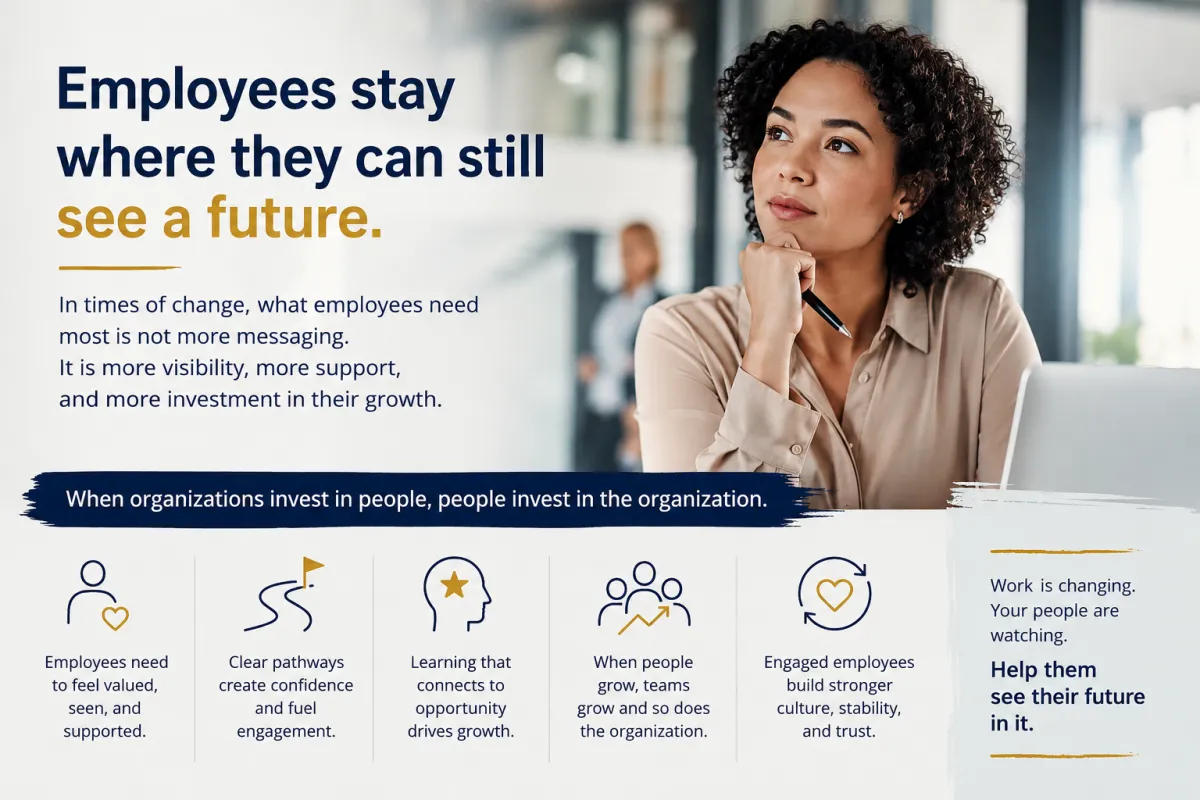
Employees are far more likely to stay engaged when they can clearly see how they are developing, what skills they are building, where opportunities exist, and how learning connects to future growth inside the organization.
Especially during onboarding and early career experiences.
Employees begin forming opinions about whether growth feels possible much earlier than many organizations realize. If onboarding feels transactional, disconnected, or unclear, employees often carry that uncertainty forward into the rest of their experience. But when organizations create onboarding experiences that help employees understand how skills evolve, how opportunities connect, and how growth can happen over time, employees begin building confidence much earlier.
That changes engagement.
Not because employees suddenly become more loyal, but because they feel more connected to the possibility.
Continuous learning also becomes far more meaningful when it feels tied to movement instead of completion. Employees do not just want access to training. They want visibility into how learning supports career progression, transferable skills, leadership development, and future opportunities inside the organization.
Skill-based learning pathways become incredibly important right now.
They help employees understand not only what they are learning, but why it matters and where it can take them next.
And honestly, that level of visibility creates stability in ways many organizations underestimate.
Employees stay more engaged when growth feels real, accessible, and supported, especially during periods of uncertainty and transformation.
Organizations building stronger workforce stability right now are not simply investing in more content libraries or disconnected development initiatives. They are creating connected ecosystems around employee growth that align onboarding, continuous learning, career pathways, leadership development, and workforce strategy into experiences employees can actually navigate and trust.
That is where organizations have a real opportunity right now.
Not just to improve retention or engagement scores, but to create environments where employees can continue evolving alongside the future of work instead of feeling left behind by it.
Helping Employees Continue Seeing a Future Inside the Organization
Simply Innovative Consulting helps organizations create connected onboarding experiences, continuous learning strategies, and skill-based learning pathways that align workforce development, leadership growth, and internal mobility.
Employee engagement is not built through messaging alone. It's felt.
It is built when employees can clearly see that growth, development, and future opportunity still exist for them inside the organization.
Want to learn more about how you can keep your employees engaged and seeking out career growth? Schedule time with me: Book a meeting