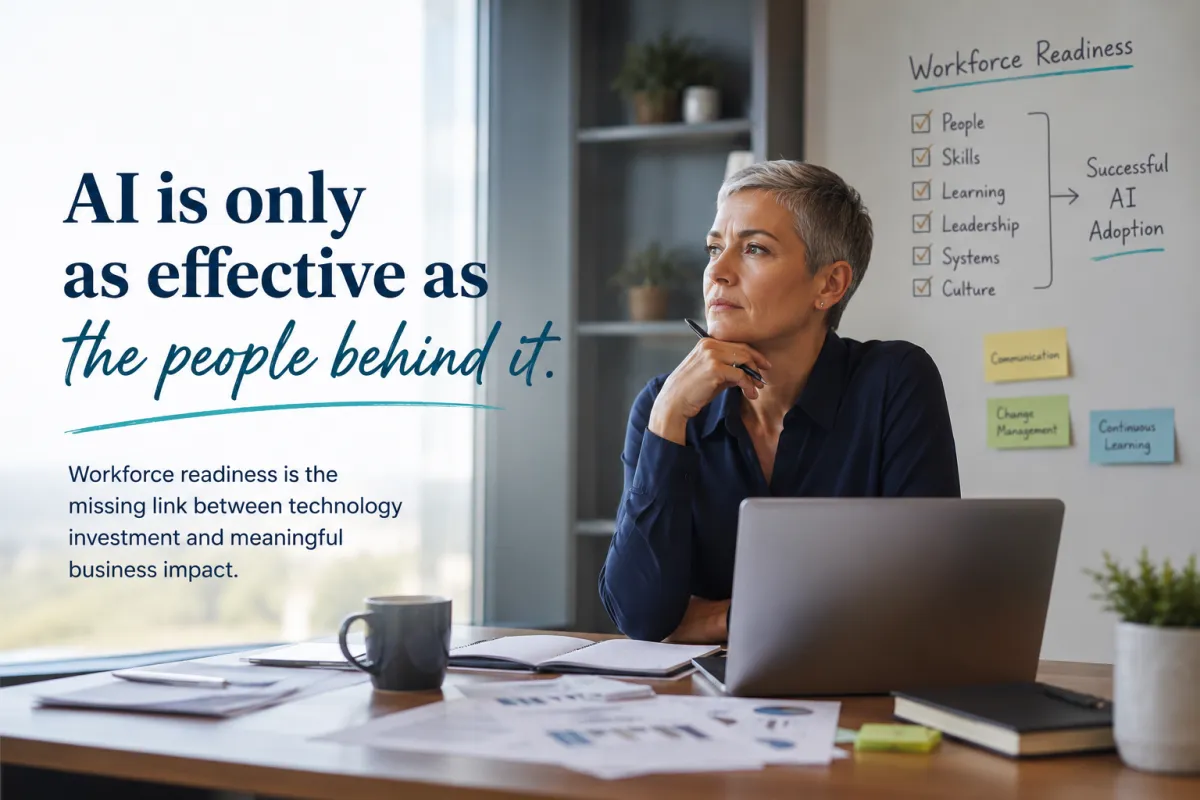
Why AI Adoption Fails Without Workforce Readiness
Everyone is rushing to implement AI.
New tools.
New platforms.
New promises about productivity, efficiency, and transformation.
But underneath all of it, many organizations are quietly running into the same problem:
The technology is moving faster than the people expected to use it.
And that’s where things start to break down.
In my last article, “AI Did Not Fail. The System Around It Did.”, I talked about how disconnected systems, unclear processes, and poor implementation create failure long before the technology itself does.
But there’s another part of this conversation we are not talking about enough:
Workforce readiness.
Because AI implementation is not just about introducing new technology into an organization.
It is about introducing organizational change.
And change exposes everything:
• leadership gaps
• communication gaps
• trust gaps
• skill gaps
• operational gaps
• learning gaps
Organizations are investing heavily in AI transformation, while employees are still trying to understand:
• What does this mean for my role?
• How am I supposed to use this?
• Am I being replaced?
• Who is helping me learn this?
Those questions matter.
Because AI adoption does not happen simply because technology exists.
It happens when employees feel prepared, supported, and confident enough to actually use it.
That is where many organizations are struggling right now.
Not because employees are resistant to AI.
Not because the technology failed.
But the infrastructure around the workforce was never designed to support this level of transformation.
AI Transformation Requires Workforce Transformation
This is the part many organizations underestimate.
AI readiness is not only about selecting the right technology platform.
It is about whether the organization itself is prepared to adapt.
Most organizations are already operating with:
• overwhelmed managers
• fragmented learning systems
• outdated workflows
• disconnected communication
• inconsistent leadership development
• limited employee support structures
Then AI gets layered on top of all of it.
Without a workforce strategy.
Without manager enablement.
Without learning systems that support continuous growth.
Without clear communication around expectations, adoption, and impact.
And suddenly, organizations are confused about why employee adoption is slow.
The reality is:
AI readiness has very little to do with whether an organization purchased the right tool.
It has everything to do with whether the organization prepared its people for transformation.
The Workforce Readiness Gap
One of the biggest barriers to successful AI adoption is the growing gap between technology implementation and workforce readiness.
Organizations often focus heavily on:
• software implementation
• automation goals
• operational efficiency
• technology integrations
But they spend far less time preparing employees for the actual behavioral and operational changes that come with AI transformation.
That creates friction.
Employees feel uncertain.
Managers feel overwhelmed.
Leadership teams become frustrated with low adoption rates.
And organizations start questioning the return on investment.
But the issue is rarely the AI itself.
The issue is whether the workforce has the support, learning infrastructure, and leadership needed to adapt successfully.
Learning Systems Matter More Than Ever
Organizations cannot expect successful AI adoption without modern learning ecosystems in place.
Employees need:
• continuous learning opportunities
• accessible training resources
• personalized learning pathways
• manager support
• role-specific guidance
• coaching opportunities to build confidence over time
Without that infrastructure, AI implementation becomes another disconnected initiative that employees are expected to figure out on their own.
That approach is not sustainable.
Organizations that are leading in AI adoption are investing in workforce development, learning strategy, leadership capability, and internal mobility alongside technology implementation.
Because they understand something important:
Technology may accelerate transformation.
But people determine whether the transformation actually succeeds.
Managers Carry the Weight of Change
Managers are being asked to lead teams through one of the fastest periods of workplace transformation we have seen in years.
At the same time, many are already overwhelmed.
They are expected to:
• maintain productivity
• answer questions about AI
• support employee development
• lead through uncertainty
• reinforce change initiatives
• coach employees through evolving workflows
Yet many organizations are not equipping managers with the tools, learning support, or development needed to do that effectively.
Organizations cannot expect sustainable AI transformation without investing in the people responsible for leading it.
The Organizations That Will Lead
The organizations that will succeed with AI over the next several years are not necessarily the ones moving the fastest.
They are the ones building the strongest foundation for change. The ones that invest in their people alongside investments in AI. Those who value humans as an organization's greatest asset.
That means:
• aligning workforce strategy with AI strategy
• modernizing learning systems
• investing in leadership development
• supporting managers
• creating adaptable learning cultures
• building workforce confidence alongside technology capability
AI transformation is not a one-time implementation project.
It is an ongoing organizational capability.
And organizations that prioritize workforce readiness will be far better positioned to adapt, grow, and lead through the next era of change.
Final Thought
AI did not fail.
But organizations that overlook workforce readiness, leadership enablement, and learning infrastructure may struggle to realize the value they expected from AI transformation.
Technology alone does not create transformation.
People do.
And the organizations investing in both will create the most sustainable success moving forward.
Ready to Strengthen Workforce Readiness?
Simply Innovative Consulting helps organizations align learning strategy, workforce development, leadership enablement, and learning technology to support successful AI adoption and long-term workforce transformation.
If your organization is evaluating AI initiatives, workforce transformation, or learning ecosystem modernization, let’s start the conversation. Schedule time with me: Book a meeting.