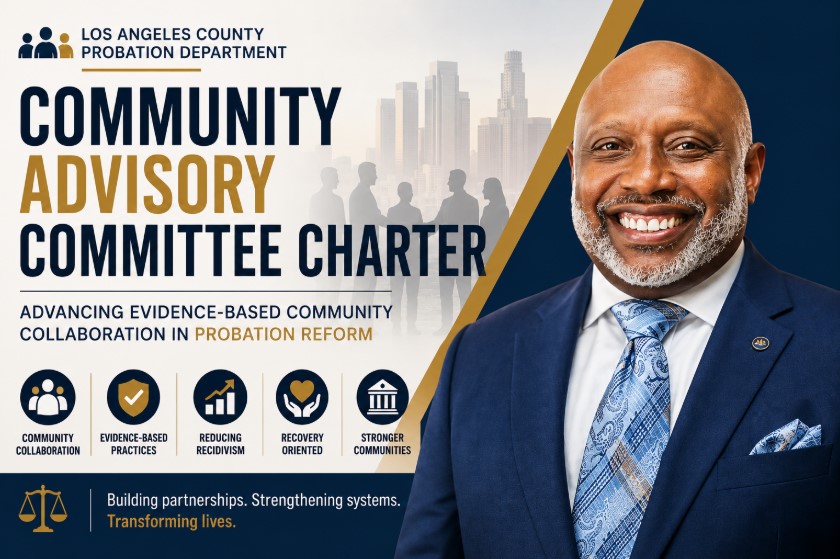
Advancing Evidence-Based Community Collaboration in Probation Reform
Developed in partnership with the Los Angeles County Probation Department and the Office of Diversion and Reentry (ODR), the Community Advisory Committee (CAC) Charter establishes a collaborative governance framework designed to strengthen evidence-based probation reform, systems accountability, and community-centered implementation under California Senate Bill 678 (SB678).
The charter outlines the formation of a multidisciplinary advisory structure bringing together county personnel, probation leadership, individuals with lived experience, community-based organizations, faith-based organizations, and public-sector stakeholders to support the development, refinement, and evaluation of programs serving adult felony probation populations throughout Los Angeles County.
Grounded in evidence-based practices (EBP), cultural competence, recovery-oriented systems design, and collaborative community engagement, the framework emphasizes reducing recidivism through integrated supervision models, stronger service coordination, and sustained partnerships between public systems and impacted communities.
The charter defines operational structures for:
advisory governance,
stakeholder participation,
systems planning,
program evaluation,
service delivery coordination,
and implementation oversight for SB678-funded probation initiatives.
The work positions community advisory participation not as symbolic involvement, but as an essential systems strategy capable of strengthening public safety outcomes, improving recovery-oriented supervision practices, and increasing accountability within long-term reintegration infrastructure.
Topics Covered:
SB678 Evidence-Based Probation Reform
Community Advisory Governance Structures
Public Health & Justice System Collaboration
Evidence-Based Practices (EBP) in Probation Supervision
Community-Centered Systems Accountability
Cross-Sector Government Collaboration
Office of Diversion & Reentry (ODR) Coordination
Recidivism Reduction Strategies
Recovery-Oriented Supervision Models
Cultural Competence in Community Reintegration
Integrated Service Delivery Frameworks
Stakeholder Engagement & Community Participation
Lived Experience Leadership in Systems Reform
Community-Based Organization (CBO) Partnerships
Faith-Based Collaboration Models
Program Evaluation & Systems Improvement
Advisory Committee Operational Structures
Reentry Systems Coordination & Planning
Collaborative Public Safety Approaches
Institutional Reform Through Community Partnership