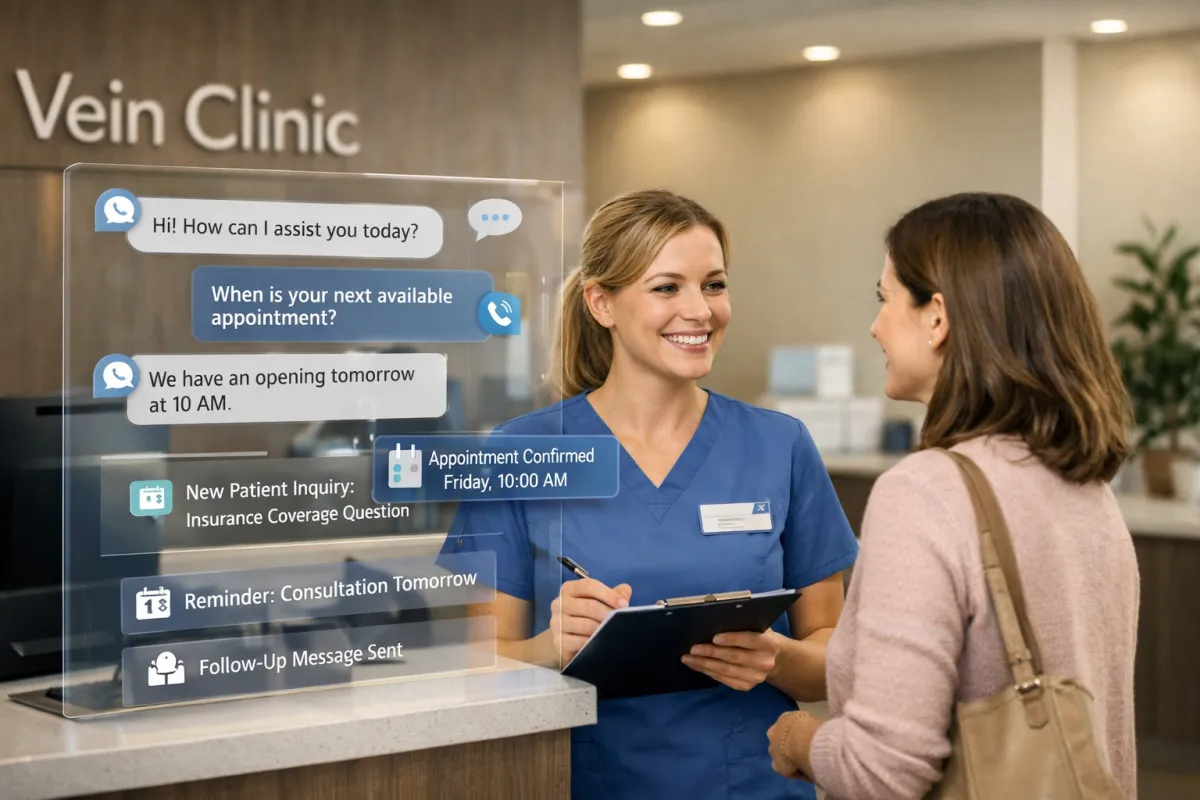
The Growing Role of AI in Vein Centers Right Now
The Growing Role of AI in Vein Centers Right Now
Across healthcare, artificial intelligence is no longer an emerging concept. It is actively
reshaping how patients find, evaluate, and choose providers. In vein centers
specifically, AI-driven systems are already being used to respond instantly to patient
inquiries. These inquiries are often generated by paid advertising, website forms,
missed calls, and after-hours requests. These missed opportunities happen when
human staff are unavailable or already overloaded. As patient expectations shift toward
immediate responses and on-demand communication, vein centers that rely solely on
manual callbacks and limited office-hour coverage are increasingly at a disadvantage.
This is not a future scenario. It is the current environment in which vein clinics compete
for consultations, manage staff workload, and protect revenue.
How AI and Automation Are Already Operating Inside Vein Centers

In many vein centers today, AI and automation are already functioning as an always-on
extension of the clinic. Answering phones, responding to web chat, SMS, and social
media messages, and handling patient questions the moment they arise. These AI
employees can explain common spider vein and varicose vein treatments, outlining next
steps in the diagnostic process, and guiding prospective patients toward appropriate
consultations without delay. The real shift is not convenience or staffing relief, it is speed
and consistency. Patients no longer wait hours or days for a response. They receive
accurate, medically aligned information immediately at the exact moment they are
searching, comparing, and deciding where to go. This “right now” response has become
the baseline expectation, and vein centers that deliver it are setting the standard for how
access to care begins.
The Difference Between an Automation AI CRM and Your EMR
When vein centers begin their effort to grow and add new patients, a marketing CRM
becomes a necessary piece of infrastructure. This system sits upstream of the EMR and
is responsible for capturing patient inquiries, managing communication across phone,
text, chat, and digital channels, and ensuring timely follow-up from first contact through
consultation scheduling. Without a marketing CRM, growth efforts rely heavily on
manual processes, staff memory, and fragmented tools, conditions that make consistent
response and follow-up nearly impossible at scale. A properly implemented, HIPAA-
compliant marketing CRM allows vein centers to manage patient demand efficiently
while maintaining professionalism, accuracy, and continuity of communication from the
very first interaction.
Specific Tasks Performed by AI and Automation in Vein Centers
In vein centers, AI employees commonly handle:
Responding instantly to patient inquiries via phone, text, website chat, and social
media
Answering frequently asked questions about vein conditions and treatments
Collecting preliminary intake information for consultation scheduling
Booking appointments and sending reminders
Managing structured follow-up for patients who do not book immediately
A properly configured marketing CRM platform provides this functionality through a
HIPAA-conscious patient communication system customized for medical practices,
including vein clinics.
Streamlining Administrative Processes
A. Appointment Scheduling and Patient Management
When voice AI and text-based AI work together, appointment scheduling becomes an
active, real-time conversation rather than a delayed handoff. The AI employee can
immediately confirm consultation availability, discuss timing preferences with the patient,
and respond back and forth in the moment to offer appropriate appointment options. As
questions come up or schedules shift, the AI adapts the conversation dynamically,
keeping the patient engaged and moving forward without pause. This real-time
interaction ensures patients receive timely, accurate communication during their
decision-making process, while significantly reducing no-shows and dropped
opportunities without relying on staff intervention.
B. Documentation and Record Handling
AI-supported systems help organize patient inquiries, communication logs, and follow-
up status in a centralized, HIPAA-secure environment. This improves operational
visibility and continuity of communication.
C. Reducing Staff Burden
By offloading repetitive administrative tasks, AI employees reduce staff burnout and free
nurses and administrators to focus on in-office patient care and clinical coordination.
Enhancing Patient Education
A. AI-Powered Educational Resources
Through the combined use of voice AI, text-based AI, and chatbot AI, vein centers can
deliver patient education dynamically, in real time, across every communication
channel. As patients ask questions, whether by phone, SMS, web chat, or social media
direct messaging, the AI employee provides consistent, patient-friendly explanations of
vein conditions, diagnostic steps, and treatment options such as sclerotherapy or
endovenous ablation. Rather than relying on static FAQs or delayed callbacks, this
approach allows education to happen conversationally and immediately, reinforcing trust
at the exact moment patients are seeking clarity and deciding whether to move forward
with care.
Human Staff Step In at the Right Moment
Importantly, the AI employee does not replace human involvement. It filters and
prepares it.
By the time staff engage:
The patient has already received basic education
Common questions have been answered
Expectations have been set appropriately
The interaction is focused and efficient
Staff conversations shift from repetitive explanation to meaningful engagement.
Follow-Up
Follow-up is where most vein centers quietly lose revenue, not because staff are
negligent, but because follow-up is repetitive, time-consuming, and widely disliked.
Returning missed calls, sending multiple reminders, and re-engaging patients who did
not book on the first interaction often fall behind more urgent clinical priorities. AI
employees fundamentally change this dynamic by taking ownership of follow-up in a
way human teams realistically cannot, executing structured, multi-touch outreach across
text, email, and other channels with perfect consistency. As a result, patients who would
have otherwise gone cold remain engaged, informed, and connected to the clinic, while
staff are no longer burdened with work they avoid and clinics benefit from dramatically
improved conversion without increasing workload.
Ensuring Data Security and Privacy
A. Safeguarding Patient Data
AI employees operating in vein centers must handle patient inquiry data as potentially
protected health information (PHI). Secure systems with encryption, access controls,
and audit trails are essential.
B. HIPAA Compliance
Under current HIPAA standards, any information a person provides to a healthcare
provider that may deliver medical services, including their name, phone number, email
address, or appointment request, can be considered protected health information (PHI)
when tied to healthcare intent. A properly built, HIPAA-compliant automation CRM is
designed to meet HIPAA rules and regulatory requirements for handling this information.
AI employees can reinforce trust by clearly communicating privacy standards and
directing sensitive conversations into secure workflows. Practices should always
confirm compliance requirements with their compliance officer or qualified healthcare
counsel.
When AI systems manage patient communications, HIPAA compliance and Business
Associate Agreements (BAAs) are typically required. Patient communication
infrastructure must treat lead capture as medical intake, not casual marketing.
C. Addressing Patient Concerns
AI employees can reinforce trust by clearly communicating privacy standards and
directing sensitive conversations into secure workflows. Practices should always
confirm compliance requirements with qualified healthcare counsel.
Conclusion
A. Recap
AI employees are reshaping patient interactions in vein centers by improving
communication speed, supporting clinical workflows, reducing administrative strain, and
enhancing patient education, while strengthening consistency and reliability across the
patient journey.
B. Future Possibilities
As AI technology continues to advance, vein centers may benefit from deeper
integration between diagnostic tools, patient education systems, and communication
platforms, further improving outcomes and operational efficiency.
C. The Role of Human Oversight
Despite these advancements, AI employees are not replacements for physicians or
clinical staff. Human empathy, clinical judgment, and ethical oversight remain central to
patient care. The most effective vein centers will be those that thoughtfully combine AI-
driven efficiency with compassionate, physician-led treatment.
