Closing the Affordability Gap: What It Takes to Turn Rent Into Equity
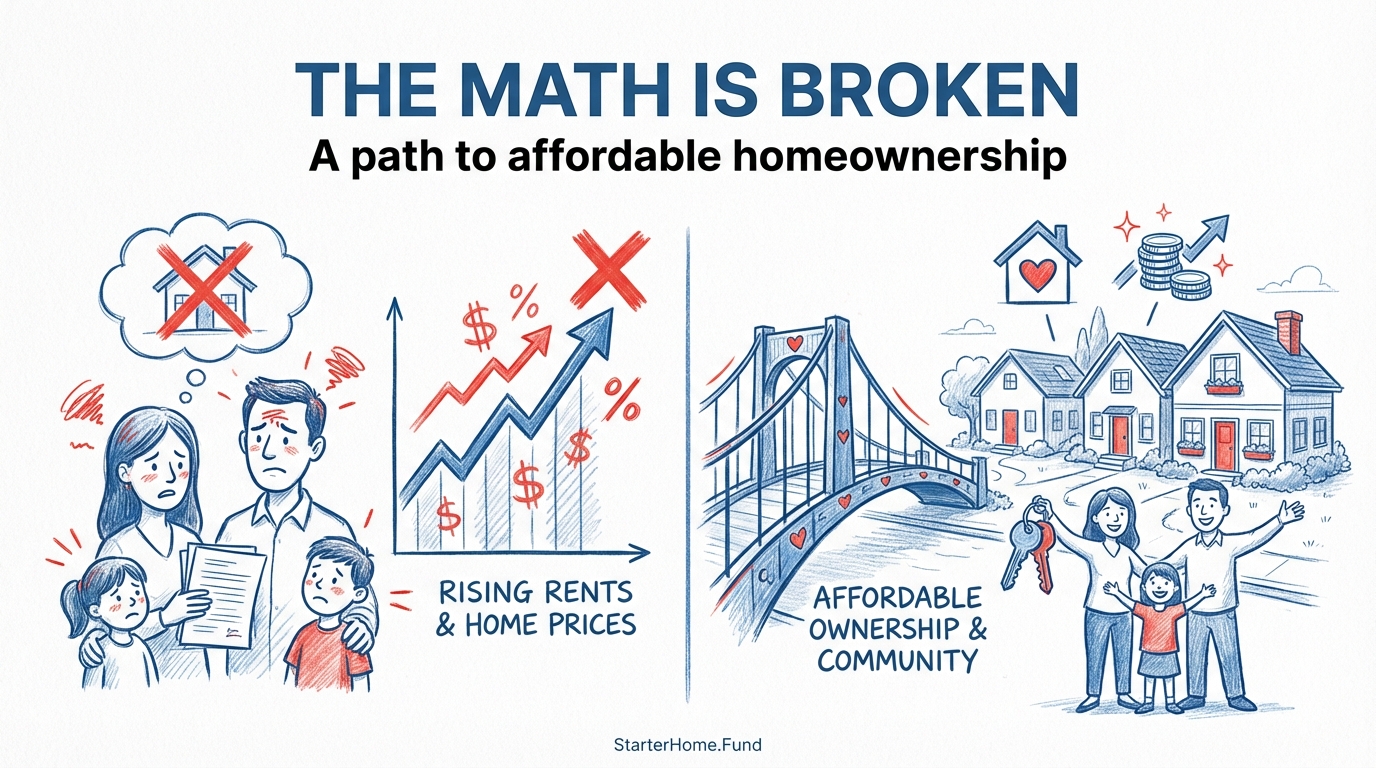
America’s affordable housing crisis isn’t just a “big-city problem.” It’s a math problem—one that locks working families out of ownership, drains wealth through rent, and steadily shrinks the stock of homes that remain affordable.
In Portland ZIP 97217, a family of four earning 80% AMI ($99,280/year) can afford about $2,482/month for housing (at 30% of gross income). At 6% interest over 30 years, that buying power translates to roughly a $326,500 home. But the local median sits around $520,000–$565,667, leaving a gap of $193,500–$239,167—a difference no amount of “saving harder” can realistically close. That’s why this moment feels so frustrating: families are doing what they’re “supposed” to do, and the math still doesn’t work.
That gap pushes families into what many experience as the renting trap. Between ages 22–37, renters can spend roughly $333,000 on rent and end up with $0 equity. Meanwhile, the age of the first-time buyer has climbed—from 29 in 1981 to about 40 today—an 11-year delay in wealth-building.
And the crisis is national. A major pressure point: large volumes of regulated affordable housing are reaching key program milestones. Novogradac reports that more than 90,000 LIHTC properties hit Year 15 in 2024, a point when stakeholders evaluate options that can include conversion to market-rate or condominiums (even if historically most remain affordable). That means tens of thousands of homes enter a decision window each year—at a time when communities can least afford to lose supply. Source
This is where the concept of “compassionate capitalism” becomes more than a slogan: it’s an attempt to align return-seeking capital with outcomes families actually feel—stability, predictability, and a path to ownership.
At StarterHome, the model starts by buying distressed multifamily buildings at deep discounts and converting them into condo ownership opportunities. The goal is to expand the buyer pool by lowering the upfront barrier and making monthly payments achievable for households around 80% AMI—with down payment support structured through second mortgages. The theory is straightforward: if you can acquire at a meaningful discount, you can renovate to homeowner-grade standards, sell at a price aligned to workforce affordability, and still create room for investor returns and long-term community impact.
But the case for ownership isn’t just emotional—it’s supported by evidence. Habitat for Humanity’s research synthesis points to how homeownership and housing stability correlate with improved outcomes in wealth building, civic engagement, education, and health. For example, Habitat summarizes research that U.S. homeowners have average net wealth far higher than renters with similar demographics and earnings, and that improving affordability can free up resources for necessities like food and health care. Source Habitat also summarizes findings that moving into more affordable and stable housing among low-income households was associated with fewer emergency department visits and more primary care visits—equating to an approximate reduction in Medicaid expenditures in one study. Source
In other words: housing is infrastructure for everything else.
For communities like Portland—and for cities nationwide—the question is no longer whether the private sector should be involved. It already is, every day, through market pricing, financing constraints, and investment decisions. The real question is whether we can structure investment in a way that grows ownership opportunities rather than shrinking them, and whether we can do it at scale.
That scale matters. If the goal is to help 10,000 families become homeowners, the work can’t rely on one-off deals. It requires repeatable acquisition channels, consistent renovation standards, scalable partnership frameworks, and a disciplined financing approach that makes ownership achievable for buyers who are otherwise locked out.
The stakes are clear: families are being priced out not because they’re irresponsible, but because the system has shifted beneath them. When the math is broken, solutions have to be structural—not motivational.
If we want stronger neighborhoods, more stable families, better health outcomes, and real wealth-building for working households, expanding access to homeownership has to be treated like a national priority. And if investment capital is going to play a role—as it inevitably will—then it should be invited into models that measure success not only by financial performance, but by what those returns enable for the people living in the homes.
Sources (Data & Research)
ZIP 97217 profile data (U.S. Census Bureau via Census Reporter): https://censusreporter.org/profiles/86000US97217-97217/
Habitat for Humanity — Outcomes associated with homeownership (evidence brief summary): https://www.habitat.org/our-work/impact/research-series-outcomes-associated-with-homeownership
Habitat for Humanity — How does housing impact health? (evidence brief summary): https://www.habitat.org/our-work/impact/research-series-how-does-housing-impact-health
Novogradac — LIHTC Year 15 milestone volumes (context for potential conversion decisions): https://www.novoco.com/periodicals/articles/as-more-than-90000-lihtc-apartments-hit-year-15-in-2024-time-to-consider-options
