America's Homelessness Crisis
America's Homelessness Crisis Just Hit a Breaking Point: Harvard JCHS 2025 Report
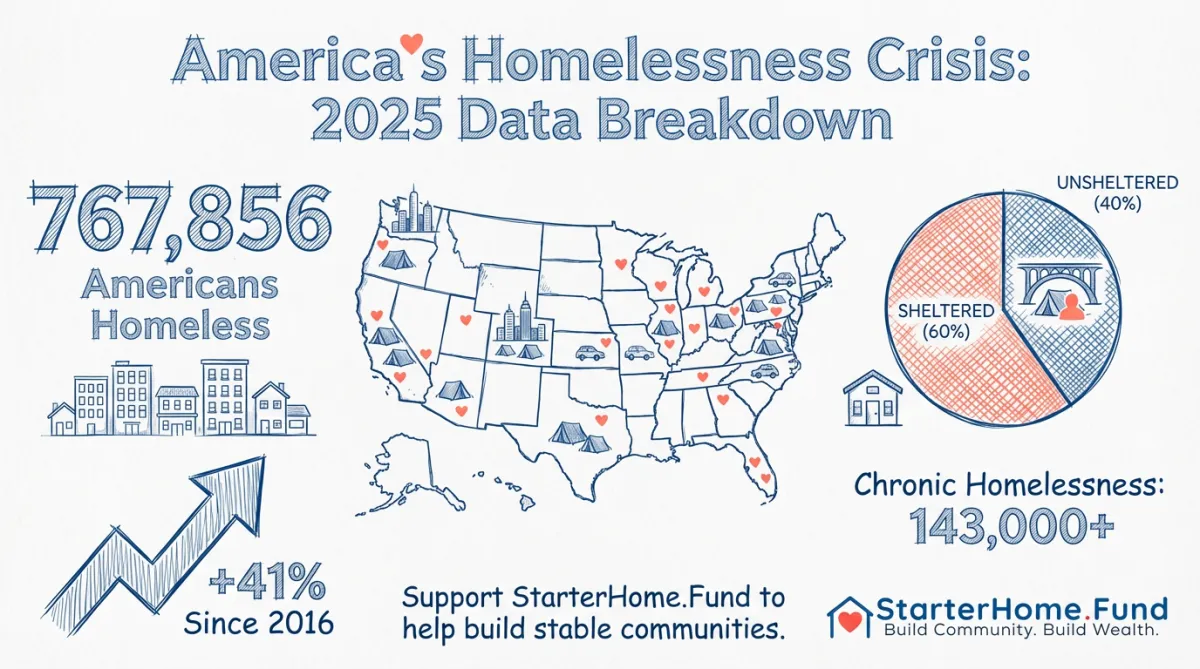
Nearly 768,000 Americans are homeless. That's a 41% surge since 2016. And the crisis is accelerating.
The Data That Demands Action
Harvard's Joint Center for Housing Studies just released their State of the Nation's Housing 2025 report, and the numbers paint a picture of a system in full collapse.
767,856 Americans are currently experiencing homelessness.
To put that in perspective:
That's more than the entire population of Seattle
It's a41% increasesince 2016's low point
It represents an18.2% jump in just the last year alone
And here's what should terrify policymakers:the crisis is accelerating, not slowing down.
The Acceleration Nobody Saw Coming
While homelessness has been rising steadily for years, the recent acceleration is unprecedented:
2020 to present: +192,142 people (+33.4%)
2022 to present: +190,078 people (+32.9%)
2023 to present: +118,321 people (+18.2%)
We're not talking about gradual deterioration. We're watching arapid collapsein real-time.
Two Americas: Sheltered vs. Unsheltered
The national data masks a brutal geographic divide:
Overall:
64.7% (496,506) are sheltered in emergency shelters or transitional housing
35.3% (271,350) are unsheltered—living on streets, in vehicles, or encampments
But that national average hides the real story.
California: The Epicenter
187,084 Californians are homeless—that's 24.4% of the entire national total.
And here's what makes California's crisis uniquely visible:
66.3% are unsheltered(living on the streets)
123,974 people sleeping rough—that's45.7% of ALL unsheltered homelessness nationally
Compare that to New York:
158,019 total homeless(second-highest in the nation)
Only3.6% unsheltered(the rest have shelter access)
New York has infrastructure. California has encampments.
Where the Crisis is Exploding
Top 10 States by Total Homelessness:
California– 187,084 (66.3% unsheltered)
New York– 158,019 (3.6% unsheltered)
Washington– 31,554 (51.4% unsheltered)
Florida– 31,362 (53.8% unsheltered)
Massachusetts– 29,360 (5.6% unsheltered)
Texas– 27,987 (44.1% unsheltered)
Illinois– 25,832 (10.3% unsheltered)
Oregon– 22,875 (62.0% unsheltered)
Colorado– 18,715 (25.6% unsheltered)
Arizona– 14,737 (49.5% unsheltered)
States Where It's Growing Fastest (2022-Present):
The crisis isn't just coastal anymore. Look at these explosive growth rates:
Illinois: +180.4% (9,212 → 25,832)
New York: +113.0% (74,178 → 158,019)
Hawaii: +95.0% (5,967 → 11,637)
Massachusetts: +89.3% (15,507 → 29,360)
New Mexico: +80.9% (2,560 → 4,631)
Colorado: +80.0% (10,397 → 18,715)
Illinois homelessness nearly tripled in two years.That's not a trend—that's a crisis explosion.
The Unsheltered Reality
Over271,000 Americans are sleeping on the streets tonight.
The states carrying the unsheltered burden:
California– 123,974 (nearly half of all unsheltered nationally)
Florida– 16,868
Washington– 16,222
Oregon– 14,191
Texas– 12,339
Arizona– 7,291
Georgia– 6,673
Just7 states account for 75% of all unsheltered homelessness in America.
What's Driving This Collapse?
We've talked about the affordability crisis in previous newsletters, but let's be blunt about what's happening:
1. Housing costs exploded while wages stagnated
Even with shelter cost inflation moderating, the gap between incomes and housing costs is generational. People aren't getting priced out slowly—they're falling off a cliff.
2. We stopped building affordable housing
Since 2010, construction of starter homes, condos, and manufactured housing has cratered. Developers chased higher margins on luxury units while the bottom of the market disappeared.
3. The nonprofit safety net is failing
DOGE cut 72% of affordable housing funding this year. Nonprofits that kept vulnerable populations housed are losing properties to foreclosure.90,000 LIHTC units are being lost annuallybecause they can't get recapitalized.
4. There's no bridge between capital and crisis
Institutional real estate has capital. Nonprofits have failing properties. But there'sno systematic way to connect thembefore the buildings go under and residents end up on the street.
The $40,000-Per-Door Opportunity
Here's what the data reveals about investment opportunity:
Properties are hitting foreclosure at unprecedented rates.
Buildings going for$40,000 per doorin major cities
Not uninhabitable—just caught in a funding crisis
Deferred maintenance, not structural failure
The math is straightforward:
Acquire at $40K/door
Stabilize through mission-aligned financing or ROC conversion
Conservative exit at $175/door
But here's what makes this different from traditional value-add:
When you convert to aResident Owned Community (ROC), residents become owners. They gain equity. They stay housed. The building stabilizes.
You're not displacing people for profit. You'represerving affordability while earning strong returns.
And with768,000 Americans homeless and properties failing at scale, the opportunity to do both has never been larger.
What Happens Next?
The Harvard JCHS data makes one thing undeniable:
This crisis is accelerating, not stabilizing.
41% growth since 2016
18% growth in the last year alone
States like Illinois seeing 180% increases in two years
We can't policy our way out fast enough. We can't build enough new units in time. And we certainly can't wait for interest rates to magically fix affordability.
We need three things happening simultaneously:
Emergency intervention on failing nonprofit properties– recapitalize before foreclosure
Massive expansion of affordable unit construction– starter homes, not luxury condos
Private capital bridging the gap– connecting real estate expertise with mission-driven opportunities
The first two require policy coordination. The third?That's where investors come in.
The Bottom Line
767,856 Americans are homeless today.
That number will be higher next year unless something fundamental changes.
We're not waiting for policy to catch up. We'rerescuing properties, stabilizing communities, and delivering returnswhile keeping people housed.
If you're an investor who sees a trillion-dollar crisis as a once-in-a-generation opportunity to do well while doing good—let's talk.
👉Join our investor club. Earn 18% AAR in 12 months. Help solve the housing crisis.
Drop "IMPACT" in the comments or DM me directly.
Data Source: Harvard Joint Center for Housing Studies,State of the Nation's Housing 2025