New Blog Post
The $595,000 Income Problem - Who Can Actually Afford to Buy a Home Anymore?
San Jose needs a $595K salary to buy a median home. And it’s not alone.
The New Reality of American Homebuying
Here’s a number that should stop you in your tracks:
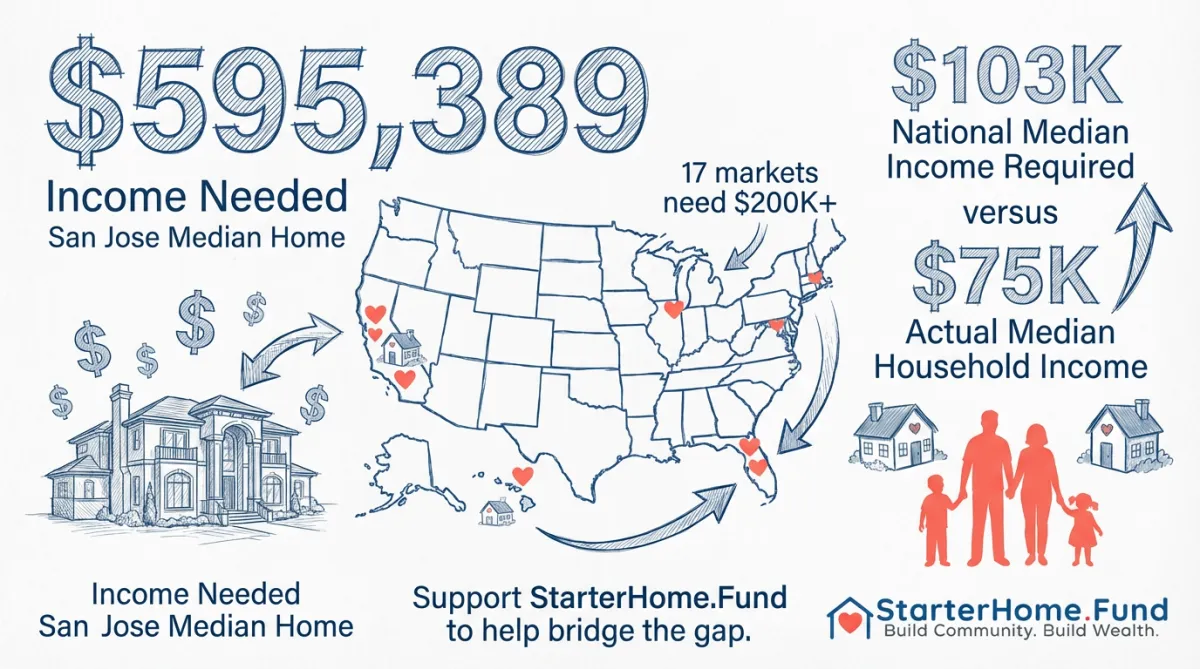
$595,389
That’s the annual income you need to afford the median home in San Jose. Not a mansion. Not a luxury property. The median single-family home.
Monthly payment? $15,381.
And if you think that’s an outlier, think again.
The Markets Where Homeownership is Dead
According to Harvard’s Joint Center for Housing Studies latest data, 17 major metropolitan areas now require a six-figure income just to afford the median home. Many need well over $200,000.
The Top 10 Most Expensive Markets (by income required):
San Jose, CA – $595,389 income needed | $2.02M median price
Anaheim-Santa Ana, CA – $430,384 | $1.45M
San Francisco Bay Area – $392,709 | $1.32M
Honolulu, HI – $330,697 | $1.17M
San Diego, CA – $306,747 | $1.04M
Salinas, CA – $288,158 | $955K
San Luis Obispo, CA – $280,653 | $953K
Oxnard-Ventura, CA – $277,669 | $932K
Naples, FL – $264,020 | $865K
Los Angeles, CA – $256,034 | $863K
Notice a pattern? California dominates. But Florida, Hawaii, and Washington are creeping in.
What About “Affordable” Markets?
Even the national median tells a brutal story:
Median income required nationwide: $102,739
Median home price: $328,700
That means the typical American metro area requires a household income over $100,000 just to afford the median home.
A decade ago, that would’ve sounded absurd. Today, it’s the baseline.
The Math That Doesn’t Work
Let’s break down what this means in real terms.
The median US household income is around $75,000. The median income required to buy a home is $102,739.
That’s a $27,000+ gap between what people earn and what they need to afford housing.
And in expensive markets? The gap is a chasm:
San Jose: You need to earn 8x the national median income
Anaheim: 5.7x
San Francisco: 5.2x
These aren’t markets. They’re exclusion zones.
Markets Requiring $200K+ to Enter
17 metropolitan areas now require a minimum household income over $200,000:
Anaheim, CA – $430K
San Francisco, CA – $393K
Honolulu, HI – $331K
San Diego, CA – $307K
Naples, FL – $264K
New York City, NY – $244K
Boston, MA – $229K
Seattle, WA – $231K
And the list keeps growing.
What This Means for Investors
Here’s the opportunity nobody’s talking about:
The market is pricing out the majority of buyers. But people still need housing.
When homeownership becomes impossible, two things happen:
Rental demand explodes
Alternative ownership models become viable
This is where Resident Owned Communities (ROC), manufactured housing, and affordable multifamily come in.
The economics are simple:
Properties in foreclosure at $40K-$60K per door
Median households can’t afford to buy
Stabilize properties through mission-aligned financing
Provide pathways to ownership that actually work
Exit at $150-$200/door while residents gain equity
When the median home requires a $103K income and the median household earns $75K, the traditional homeownership model is broken.
We’re not trying to fix it. We’re building a better one.
The Bottom Line
If you’re waiting for prices to “come back down” so normal families can afford homes again, you’re going to wait a very long time.
The affordability crisis isn’t a temporary blip. It’s structural.
The question isn’t whether things will change. It’s whether you’ll be part of the solution—and profit from it.
👉 Join our investor club. Earn 18% AAR while solving the affordability crisis. Drop “AFFORD” in the comments or DM me.
Data Source: Harvard Joint Center for Housing Studies, State of the Nation’s Housing 2025
