What Salesforce Field Service Implementers Should Be Watching in Summer ’25
In this Office Hours Insight session, Leigh-Anne Nugent brings the Field Service community together to unpack key Summer ’25 updates, surface practical questions from real implementers, and look ahead to what matters next. From Salesforce Go and release testing to connected assets, capacity planning, and scheduling nuances, this is a grounded conversation about how to stay sharp in a platform that keeps moving fast.
LESSONS YOU CAN TAKE FROM THIS:
1. Release readiness should be hands-on, not just theoretical
A strong theme in this session is that reading release notes is not enough. The real value comes from getting into an environment, testing meaningful features, and seeing how they behave in practice. That is especially true for Field Service, where mobile behavior, release timing, and feature dependencies can change how useful a new capability actually is.
2. Salesforce Go is making setup easier, but not replacing implementation judgment
Leigh-Anne highlights Salesforce Go as a major improvement for getting Field Service up and running faster. It reduces a lot of the repetitive setup work, helps flatten the onboarding curve, and makes first-time environments less intimidating. But it does not remove the need for design decisions, testing, or thoughtful implementation.
3. Small scheduling details can have big operational impact
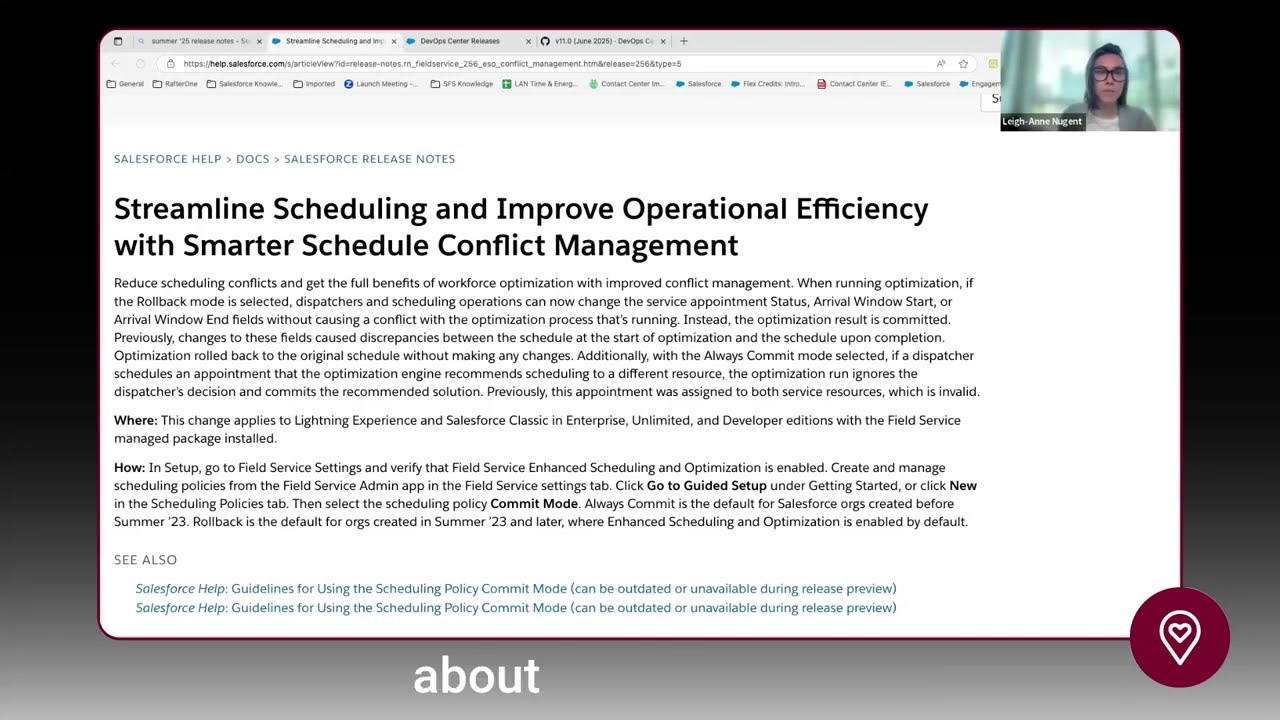
This session reinforces how much nuance still lives inside scheduling. Commit modes, travel buffer time, complex work behavior, capacity planning, and optimization all sound like configuration details, but they directly affect how well the business runs. These are the kinds of settings that can quietly improve or break the real-world experience if they are not understood properly.
4. The future of field service is broader than dispatch alone
One of the bigger takeaways from this conversation is that the Field Service ecosystem is expanding. Connected assets, asset-centric service, intelligent capacity planning, data capture, mobile priming, and third-party innovation are all becoming part of the bigger service picture. Implementers need to think beyond basic scheduling and start understanding where the platform is heading.
KEY TAKEAWAYS:
Summer ’25 brings valuable changes, but the best way to learn them is by testing in a real org.
Salesforce Go is reducing setup friction and helping teams stand up Field Service faster.
Scheduling features like travel buffers, commit modes, and complex work deserve deeper attention.
Connected assets and capacity planning are becoming more strategic in service design.
Strong implementers will keep learning not just the product, but the wider field service landscape.