Dynasty
“THE POLITICAL FAMILY OF SUANSING.
Tap to view
👁
HOR

Your support keeps independent commentary alive.
☕ Buy us a coffee and keep the conversation going


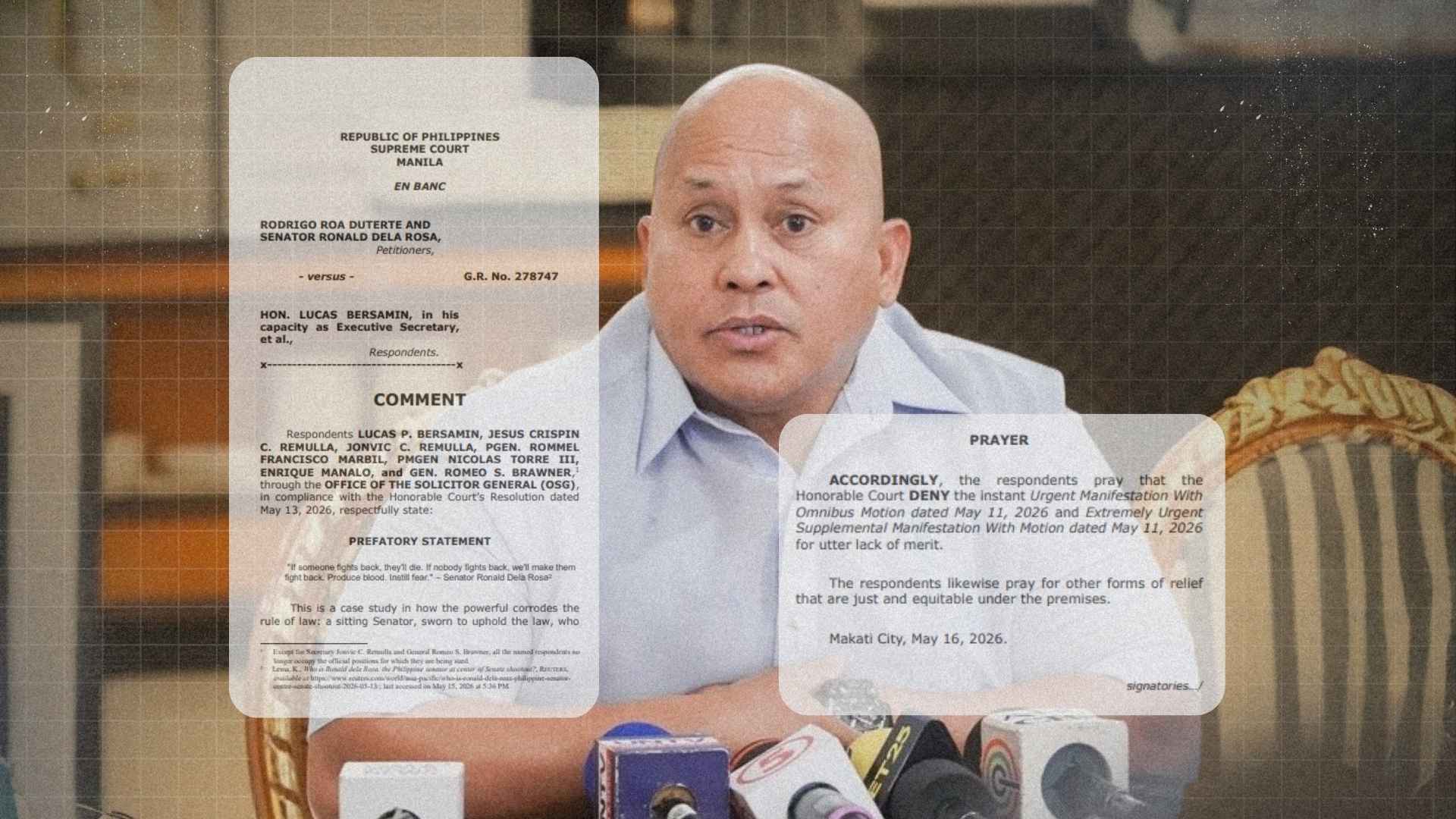
The legal controversy involving Ronald dela Rosa and the International Criminal Court (ICC) has once again returned to national attention following new developments involving the Office of the Solicitor General (OSG).
According to reports, the OSG has already submitted its official comment regarding two motions filed by Senator Dela Rosa before the Supreme Court. The OSG also reportedly asked the High Court to dismiss the senator’s motions, arguing that they allegedly lacked sufficient merit.
The issue stems from Senator Bato’s earlier appeal asking the Supreme Court to stop or block the arrest warrant issued by the ICC against him.
As expected, the development immediately triggered strong reactions online.
Supporters of the senator questioned the continuing involvement of the ICC in Philippine matters, while critics argued that legal processes — both local and international — should proceed independently.
Here’s what this really means.
The controversy surrounding the ICC has become larger than one individual case. Over time, it has evolved into a broader national debate involving sovereignty, jurisdiction, accountability, and the limits of international intervention.
For many Filipinos, the issue touches deeply emotional and political lines because it connects to the country’s anti-drug campaign, national security discussions, and perceptions of justice itself.
This raises a bigger issue.
Who should ultimately decide cases involving Philippine officials — local courts or international bodies?
That question remains at the center of ongoing debates.
Supporters of stronger national sovereignty argue that Philippine institutions should be fully capable of handling domestic legal matters without foreign intervention. Critics, however, insist that international accountability mechanisms exist precisely for situations where questions about impartiality or justice emerge.
Because of that divide, every legal motion connected to the ICC instantly becomes politically charged.
The OSG’s participation in the matter also drew attention because the Office traditionally represents the Philippine government in major legal disputes. Its recommendation to dismiss the motions filed by Senator Dela Rosa created further discussion regarding the government’s legal position and strategy moving forward.
Why this matters goes beyond courtroom procedure.
The case reflects how legal battles today are no longer confined inside courts alone. Social media, livestreams, podcasts, and political commentary now shape public perception in real time. Every filing, motion, or statement quickly becomes part of a nationwide narrative battle.
For supporters of Senator Bato, the issue is often framed around protecting national dignity and resisting what they see as foreign overreach. Many continue viewing him as a central figure during the Duterte administration’s anti-crime efforts.
Meanwhile, critics maintain that accountability and due process should remain above political loyalty regardless of personalities involved.
That divide explains why discussions surrounding the ICC remain highly emotional and polarizing online.
At the same time, legal experts continue reminding the public that motions, comments, and filings are still part of the judicial process — not final rulings themselves. The Supreme Court will ultimately evaluate arguments, evidence, and constitutional questions before making any determination.
Still, one thing is clear:
The controversy is far from over.
As legal proceedings continue to unfold, the issue will likely remain one of the country’s most closely watched political and legal battles in the months ahead.
Because in the modern political climate, courtroom decisions no longer shape only legal outcomes…
—they also shape public trust, political narratives, and the national conversation itself.
“Learn to do well; seek judgment, relieve the oppressed, judge the fatherless, plead for the widow.”
This verse reminds people that justice must always be pursued with wisdom, fairness, and integrity. In times of conflict and division, truth should not be driven by emotion or politics alone. Strong institutions, honest processes, and accountability remain essential foundations for peace and public trust.
December 17, 2025•2 min read
Senator Francis “Kiko” Pangilinan has raised red flags over changes in the ₱33-billion proposed budget for farm-to-market roads (FMRs) under the Department of Agriculture (DA) for 2026 — changes that, he warns, may include billions worth of unvalidated projects.

At the bicameral conference committee, Pangilinan called for full transparency: a verified list of added FMRs, feasibility checks, and proper identification of project coordinates — from start to end points. Without these, the Senate may be forced to reconsider approvals and deduct amounts tied to unidentified items.
According to Pangilinan:
The FMR list appears to have been altered during deliberations
Some projects were allegedly added without validation
Documentation such as feasibility, alignment, and coordinates remains unclear
He emphasized that when budgets are approved on third reading, attachments detailing projects should match what gets funded — anything else undermines accountability.
Infrastructure isn’t just about totals; it’s about traceability. Coordinates prevent ghost projects, enable audits, and allow communities to verify what’s being built in their areas.
“Transparency and accountability are necessary.” — Pangilinan
Without them, “roads” become numbers on paper, not paths for farmers.
Kapag may budget — may ribbon.
Kapag tinanong ang mapa — buffering.
Kung walang coordinates,
baka daan sa dilim ang tinatahak.
The concern echoes wider Senate warnings — including from Sen. Ping Lacson — that unresolved issues could lead to non-ratification of the bicam report or even a reenacted budget if agencies fail to explain sudden increases.
For farmers, delays hurt.
For taxpayers, opacity hurts more.
“For everything that is hidden will eventually be brought into the open.”
— Luke 8:17
Public funds demand public clarity.
Farm-to-market roads are lifelines for agriculture. When lists change without validation, trust erodes — and the people meant to benefit are left guessing.
Budgets must build real roads, not paper trails.











Disclaimer: This site uses publicly available images and materials for news, satire, and commentary. All rights belong to their respective owners. No copyright infringement intended.
© 2025 Politikanta Minute. All Rights Reserved.
Political Commentary • Satire • Faith-Based Reflection
Some visuals may be AI-generated for satire and illustration. Not real footage unless stated.
Disclaimer: This site uses publicly available images and materials for news, satire, and commentary. All rights belong to their respective owners. No copyright infringement intended.
© 2025 Politikanta Minute. All Rights Reserved.
Political Commentary • Satire • Faith-Based Reflection
Some visuals may be AI-generated for satire and illustration. Not real footage unless stated.