Medicare Part D
Medicare Part D helps cover the cost of prescription medications. It’s offered by private insurance companies and can be added to Original Medicare or included in a Medicare Advantage plan.
What Is Medicare Part D?
Medicare Part D helps Medicare recipients pay for prescription medications. It was created in 2003 and started in 2006 to lower out-of-pocket costs for drugs.
Unlike Parts A and B, Part D is provided by private insurance companies approved by Medicare. You can choose from different plans, and each plan has its own list of covered medications.
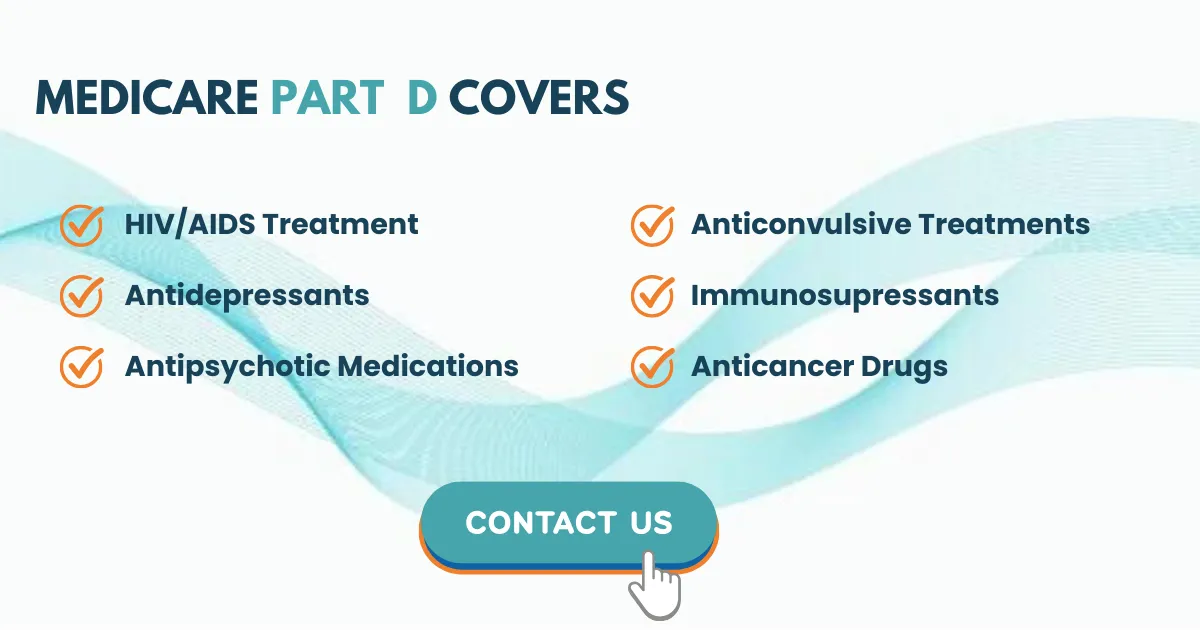
Medicare Part D
Medicare Part D is a partnership between the government and private insurance companies to help people afford prescription drugs. It provides important coverage for those with ongoing health needs or future medication needs, acting as a safety net for many Americans.
Coverage Phases
The amount you pay for prescription drugs depends on which coverage phase you are in. If you take lower-cost medications, you will move through these phases more slowly than someone taking expensive specialty drugs.
In 2026, Medicare Part D continues to use the simplified three-phase structure introduced in 2025. The "donut hole" remains eliminated. For 2026, the annual out-of-pocket maximum is capped at $2,100. Once you reach this limit, you will pay $0 for your covered Part D drugs for the rest of the calendar year. Additionally, the maximum annual deductible for 2026 is $615. Keep in mind, premiums and deductibles may change annually.
DEDUCTIBLE
You pay the full cost of your medications until you reach your plan's deductible (up to $615).
INITIAL COVERAGE
You pay 25% of the drug's cost (or a set copay), and this continues until your total out-of-pocket spending reaches the $2,100 limit.
CATASTROPHIC COVERAGE ELIMINATED
Once you spend a total of $2,100 on your covered prescriptions, you are done paying for the year. Your plan will cover 100% of your drug costs after that.
The coverage gap (donut hole) and catastrophic phase have been removed to make costs simpler and more predictable.
Ready to compare Medicare options?
Call us today!
How Much Does Part D Cost?
The cost of your drug coverage depends on the specific plan you choose. Here is the general structure for 2026:
1. Monthly Premium – This is the monthly fee you pay for your plan. While the average premium is around $34.50, the actual amount varies depending on which plan you pick.
2. Annual Deductible – This is the amount you pay before your plan starts sharing the cost. In 2026, no plan can have a deductible higher than $615, and some plans have no deductible at all.
3. Copays & Coinsurance – Once you meet your deductible, you usually pay 25% of the drug’s cost (or a flat copay) for your prescriptions.
4. $2,100 Out-of-Pocket Limit – In 2026, once you spend a total of $2,100 on your prescriptions, you are done paying for the year because your plan covers 100% of your costs after that.
5. Late Enrollment Penalty – If you go 63 days or more without "creditable" drug coverage after your initial window, you may have to pay a permanent penalty. In 2026, this is based on a national base premium of $38.99.
Part D Annual Premiums
The cost of a Medicare Part D plan depends on the insurance company you choose. On average, people pay about $34.50 per month in 2026.
● If you have a higher income, you may pay more (this is called an income-related monthly adjustment).
● If you sign up late, a penalty may be added to your monthly premium.
● Financial help is available for people with low incomes, but you must meet certain requirements to qualify.
Is Medicare Part D mandatory?
You don’t have to enroll in Medicare Part D, but if you wait and don’t have other drug coverage, you’ll have to pay a late enrollment penalty that never goes away.
Even if you don’t take any medications now, it’s a good idea to sign up when you're first eligible. There are
low-cost plans available to keep you covered and avoid future penalties.
Preferred Pharmacy Networks
Preferred Pharmacy Networks are groups of pharmacies that have special agreements with Medicare Part D plans to offer lower costs on prescriptions.
● If you use a preferred pharmacy, you’ll pay less for your medications.
● You can still use other pharmacies, but you may pay more for the same drugs
● Each Part D plan has its own network, so it's important to check if your pharmacy is included before choosing a plan.
Medicare Part D Deductible
Each Part D plan has its own deductible, which is the amount you pay before your plan starts covering costs.
● The deductible usually does not apply to common generic drugs (tier one).
● It does apply to higher-tier drugs (tier two and above).
● Since each plan is different, it’s important to check if your medications require a deductible before choosing a plan.
Medicare Part D Frequently Asked Questions
Medicare Part D is often the most confusing aspect of Medicare. Our team frequently receives questions about Part D. Here are a few of the most commonly asked questions:
1. Can I change Part D plans at any time?
No, you can only change your Part D plan during the Annual Enrollment Period or if you qualify for a Special Enrollment Period.
2. How much does Medicare Part D pay for prescriptions?
The amount Part D pays for prescriptions depends on your specific plan. Your copay will be determined by factors such as the deductible, the phase of coverage, and your coinsurance.
3. Does Medicare have a deductible for Part D?
Yes, Medicare Part D has a standard deductible set by the Centers for Medicare and Medicaid Services (CMS) each year. Plans can either use this standard deductible or choose a lower one. Some Part D plans may not have a deductible at all.
Medicare Part D
How to Sign Up for
MEDICARE PART D
Choosing a Part D plan involves many factors, and with so many options available, it can feel overwhelming. But you don’t have to make these decisions by yourself! Our agents can compare plans from multiple carriers to find the ideal one for you. And the best part? Our services are completely free.
Once you’ve selected a plan, enrollment is easy. We’ll handle the paperwork, help you choose how to pay your premium, and submit the application for you.
Our support doesn’t stop there. We’re always available to answer your questions and assist with any future changes.
ADDITIONAL QUESTIONS TO BE ADVISED ON:

Can I change Part D plans at any time?
You can only change Part D plans during specific times, like Open Enrollment (Oct 15 – Dec 7) or if you qualify for a Special Enrollment Period due to life changes.
How much does Medicare Part D pay for prescriptions?
Medicare Part D helps pay for prescriptions, but costs vary by plan and coverage phase. You may pay a deductible, copays, or coinsurance, and costs change if you reach the coverage gap or catastrophic coverage.
Does Medicare have a deductible for Part D?
Yes, Medicare Part D plans may have a deductible, but the amount varies by plan. In 2025, the maximum deductible is $590, though some plans have a lower deductible or none at all.
What happens if I miss the Part D enrollment deadline?
If you miss the Part D enrollment deadline and don’t have other drug coverage, you may pay a lifetime late fee. You’ll have to wait until Open Enrollment (Oct 15 – Dec 7) to sign up.
Are there low-income assistance programs for Part D costs?
Yes, the Extra Help program helps lower Part D costs for those with limited income. It covers premiums, deductibles, and copays. Eligibility is based on income and resources.
How does Extra Help reduce Part D costs?
Extra Help makes Medicare Part D more affordable by lowering or removing monthly premiums, deductibles, and copays for prescriptions. It also limits how much you pay for medications.
Family-Owned. Relationship-Driven.
Medicare & Health Insurance Made Simple.
806 W Dr. M L King Jr Blvd,
Brooksville, FL
34601
Phone Number
(352)-652- 4100
EXPLORE OUR SERVICES
TRUSTED AND RECOGNIZED



LET'S STAY CONNECTED!


📩 Contact us today and let us represent you for FREE!
We are not connected with or endorsed by the United States government or the federal Medicare program. We do not offer every plan available in your area, and any information we provide is limited to those plans we do offer in your area. Please get in touch with Medicare.gov or 1-800-MEDICARE to get information on all your options.
Copyright © 2026 MAC Insurance. All rights reserved.