When Traditional Treatments Stop Working: What I've Learned About Shockwave Therapy in My Airdrie Practice
TL;DR: Shockwave therapy is an evidence-based treatment option for chronic musculoskeletal pain that hasn't responded to traditional care. It uses acoustic waves to stimulate healing in conditions like plantar fasciitis, tennis elbow, and calcific shoulder tendinitis. Research shows success rates up to 80% for chronic conditions, with most patients needing 4-6 sessions over 6-12 weeks. Treatment is non-invasive with no downtime, making it suitable for active individuals.
Core Facts:
Shockwave therapy uses high-energy acoustic waves to trigger natural healing responses in damaged tissue
Most effective for chronic conditions (lasting 6+ months) that haven't improved with physiotherapy, rest, or conventional treatments
Studies show plantar fasciitis patients are 2.5x more likely to experience relief compared to no treatment
Treatment involves 4-6 sessions of 5-10 minutes each, spaced 1-2 weeks apart
Not suitable for pregnant patients, those with pacemakers, blood clotting disorders, or active infections
I've been practicing chiropractic care in Airdrie for years, and there's a pattern I see regularly: patients who've tried everything for their chronic pain and hit a wall.
They've done physiotherapy. They've tried rest, ice, stretching, exercises. Some have had cortisone injections. They've modified their activities, bought better shoes, changed their workspace setup.
And they're still hurting.
That's usually when they walk into Atlas Family Chiropractic at 403 MacKenzie Way SW, often frustrated and wondering if they'll just have to live with the pain. This is where shockwave therapy enters the conversation—not as a miracle cure, but as an evidence-based approach that may help when conventional treatments plateau.
How Does Shockwave Therapy Work?
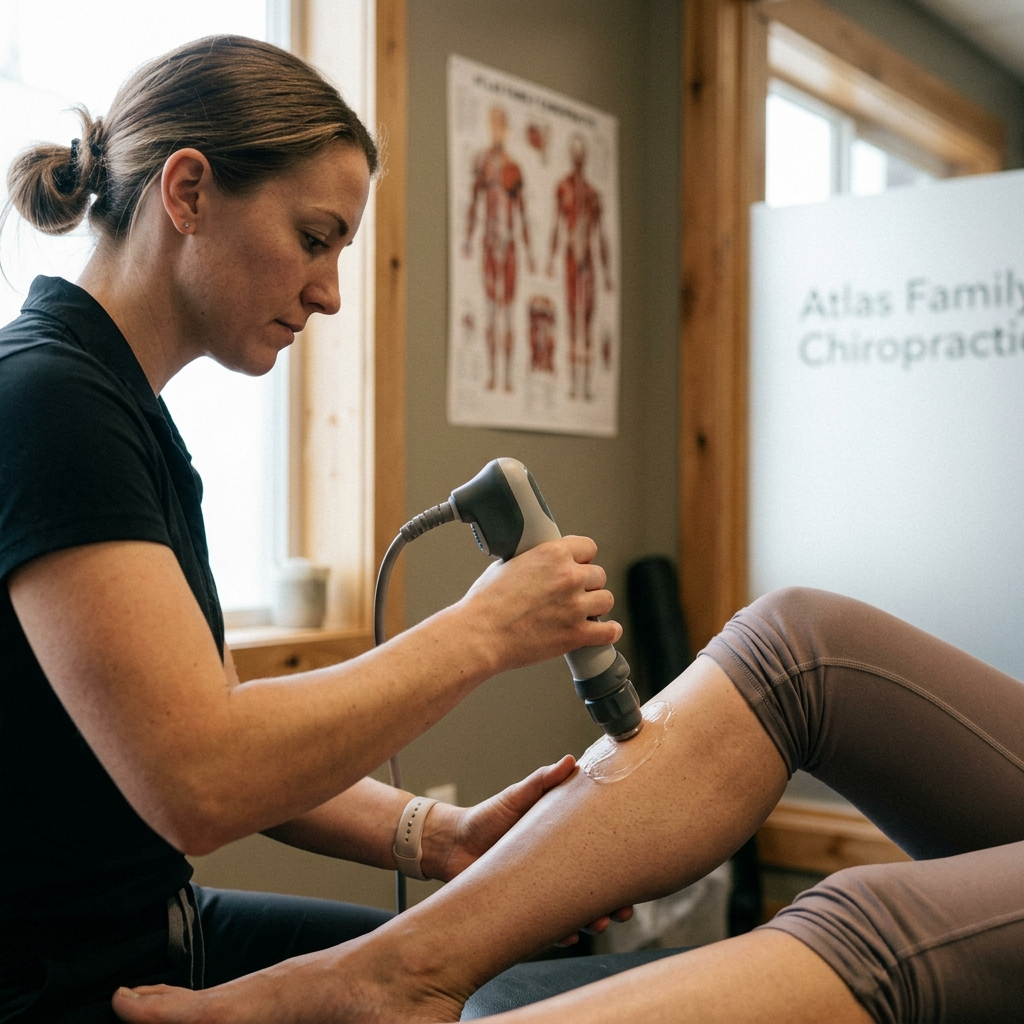
Shockwave therapy is acoustic wave therapy—not electrical stimulation or ultrasound. High-energy sound waves are delivered directly to affected tissue through a handheld device.
The mechanism: Acoustic pulses create controlled microtrauma in damaged tissue. Your body responds by increasing blood flow, breaking down calcified deposits, and stimulating natural healing.
Research suggests this approach is associated with tissue regeneration and pain reduction, particularly in chronic conditions that haven't responded to standard care.
What Happens During a Session
I apply coupling gel to your skin and move the applicator over the treatment area. You'll feel a rhythmic tapping sensation—intense but tolerable for most patients. Sessions last 5-10 minutes depending on the condition.
Most patients notice results within 2-3 sessions. Optimal outcomes typically require 4-6 treatments over 6-12 weeks.
Bottom line: Shockwave therapy uses acoustic waves to trigger healing by creating controlled tissue damage that stimulates your body's repair mechanisms. Treatment requires 4-6 brief sessions over several weeks.
Which Conditions Respond Best to Shockwave Therapy?
Not every patient is a candidate. I'm selective about who I recommend it for because the evidence is strongest for specific chronic conditions.
The three conditions with the most consistent results are plantar fasciitis, tennis elbow (lateral epicondylitis), and calcific shoulder tendinitis. These are where the research is strongest and where I see the most significant improvements.
Does Shockwave Therapy Work for Plantar Fasciitis?
Plantar fasciitis is the most common condition I treat with shockwave therapy in my Airdrie practice.
Patients come in after months of characteristic heel pain —worst in the morning, improving throughout the day, but never fully resolving. They've tried orthotics, stretching protocols, night splints without lasting relief.
The evidence: Studies involving 935 patients show individuals receiving shockwave therapy were more than 2.5 times more likely to experience relief compared to no treatment. Progressive improvement was observed at 3, 6, and 12 weeks following treatment.
In my practice, similar patterns emerge. Not every patient responds, but many report significant improvement in pain and function after a series of treatments.
Is Shockwave Therapy Effective for Tennis Elbow?
You don't need to play tennis to develop tennis elbow. I treat farmers, construction workers, office employees —anyone performing repetitive gripping or wrist extension movements.
Key research finding: Studies indicate shockwave therapy may provide better overall safety compared to corticosteroid injections, especially for patients requiring repeated treatments.
For active Airdrie residents who need to return to work, sports, or daily activities without the risks of multiple steroid injections, this is an important consideration.
Can Shockwave Therapy Treat Calcific Shoulder Tendinitis?
Calcific shoulder tendinitis involves calcium deposits in rotator cuff tendons. It causes pain, limits range of motion, and doesn't always resolve without intervention.
The evidence: Studies show calcifications disappeared completely in 86.6% of subjects and partially in 13.4% after radial shockwave therapy, with significant pain reduction and improved shoulder function after four weeks.
In my practice, patients who've been told they might need surgery sometimes see calcium deposits break down after shockwave treatments.
Clinical insight: Shockwave therapy shows strongest evidence for three chronic conditions —plantar fasciitis (2.5x higher relief rate), tennis elbow (safer than repeated steroid injections), and calcific shoulder tendinitis (86.6% complete calcification resolution).
What Does Shockwave Therapy Feel Like?
The treatment isn't comfortable, but most patients tolerate it well.
I adjust intensity based on pain tolerance and the condition being treated. We start conservatively and increase as needed. Some areas are more sensitive—the foot bottom is typically more uncomfortable than the shoulder.
Common side effects: Soreness or mild swelling for 24-48 hours after treatment. This is normal and indicates your body is responding.
No downtime required. Patients return to normal activities immediately. For Airdrie's active community—farmers during harvest, hockey players in season, runners in training—this matters significantly.
How Long Does Treatment Take?
Treatment timeline: 4-6 sessions spaced 1-2 weeks apart. Some patients notice improvement after the first session. Others don't feel significant change until the third or fourth treatment.
Results vary based on condition chronicity, individual circumstances, and commitment to recommended exercises or activity modifications.
What to expect: Treatment involves tolerable discomfort for 5-10 minutes per session, possible soreness for 1-2 days, zero downtime, and gradual improvement over 4-6 treatments spanning 6-12 weeks.
Why Is Shockwave Therapy Suitable for Active People?
Airdrie and Rocky View County attract people who value active lifestyles: ranchers, farmers, competitive athletes, marathon runners, and workers in physically demanding jobs.
Chronic pain doesn't just limit physical function. It impacts quality of life, mental health, and identity.
Shockwave therapy is non-invasive and doesn't require stopping activities you love while healing occurs. You're not immobilized. You're not taking weeks off work. You actively participate in recovery.
This aligns with my patient care philosophy: supporting your body's natural healing capacity while keeping you as functional as possible.
Active lifestyle advantage: Zero recovery downtime means farmers, athletes, and physically active workers can continue their activities while undergoing treatment, making it practical for Airdrie's working community.
When Traditional Approaches Have Plateaued
I don't recommend shockwave therapy as a first-line treatment. It's not appropriate for acute injuries or conditions that haven't been properly assessed.
But when you've been dealing with chronic pain for months, when you've exhausted conservative options, when you're facing the prospect of more invasive interventions—that's when we have a conversation about whether shockwave therapy might be worth trying.
The research suggests success rates as high as 80% for chronic heel pain lasting longer than six months. That doesn't mean guaranteed results, but it does mean this approach has solid evidence supporting its use for specific conditions.
What You Should Know Before Starting Treatment
Shockwave therapy isn't appropriate for everyone. I don't use it if you're pregnant, have a pacemaker, have a blood clotting disorder, or are taking blood thinners. It's also not appropriate directly over growth plates in children or over areas with active infection.
The treatment requires a proper diagnosis first. I need to understand what's causing your pain before recommending any intervention, including shockwave therapy.
Cost is another consideration. While some insurance plans cover shockwave therapy, coverage varies. We discuss this upfront so there are no surprises.
Most importantly: this is one tool in a comprehensive approach. I typically combine shockwave therapy with other interventions—exercise rehabilitation, activity modification, ergonomic adjustments, manual therapy. The acoustic waves stimulate healing, but you still need to address the underlying factors that contributed to the condition.
The Reality of Treatment Outcomes
I'm cautious about overstating what shockwave therapy can accomplish.
Some patients experience dramatic improvement. Others see moderate benefits. A small percentage don't respond at all.
The research provides guidance on expected outcomes, but individual results depend on factors I can't fully predict: the chronicity of your condition, your overall health status, your compliance with recommendations, your body's healing capacity.
What I can tell you is that for patients who haven't found relief through traditional approaches, shockwave therapy represents an evidence-based option worth considering before moving to more invasive interventions.
If You're Dealing With Chronic Pain That Hasn't Responded
If you've been managing plantar fasciitis, tennis elbow, or shoulder pain for months without improvement, it's worth having a conversation about whether shockwave therapy might be appropriate for your situation.
I start with a thorough assessment to understand your condition, your treatment history, and your goals. We discuss whether shockwave therapy aligns with your needs and expectations. If it's appropriate, we develop a treatment plan tailored to your specific circumstances.
Atlas Family Chiropractic is located at 403 MacKenzie Way SW in Airdrie. You can reach us to schedule an assessment and discuss whether shockwave therapy might be relevant for your chronic pain condition.
Every patient is unique. Results vary based on individual circumstances and commitment to the treatment plan. This information is educational; a thorough assessment is necessary before making any treatment recommendations.
