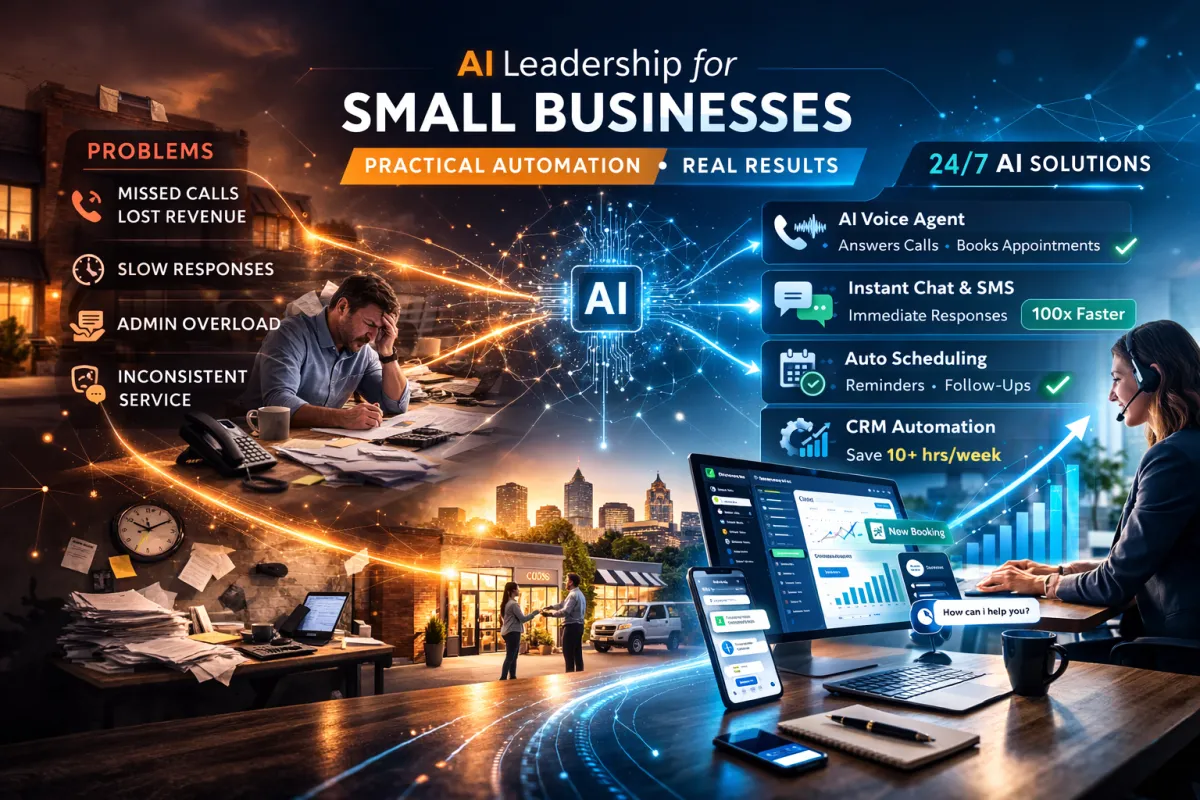
AI for Small Businesses: Practical Leadership, Not Buzzwords
Let's talk about what AI leadership for small businesses actually means.
Because if you're a small business owner in Chapel Hill, Durham, or Raleigh, you've probably heard enough AI hype to last a lifetime.
"AI will revolutionize everything!" "Businesses without AI will become obsolete!" "ChatGPT will replace your entire workforce!"
The tech world loves dramatic predictions. But for a local HVAC company, dental practice, or professional service firm trying to grow their business, most of that noise is useless.
Real AI leadership for small businesses isn't about chasing trends or implementing technology for technology's sake. It's about solving specific, expensive problems that impact your bottom line every single day.
Let me show you what that actually looks like.
What AI Leadership Is NOT
Before we get to what works, let's clear away what doesn't:
AI leadership is NOT:
Using ChatGPT to write your social media posts
Installing a generic chatbot on your website that frustrates customers
Experimenting with every new AI tool that launches
Implementing technology because competitors are doing it
Believing AI will replace your expertise or personal service
Chasing "cutting-edge" without understanding ROI
These approaches are what I call "AI tourism"—dabbling in technology without strategic purpose. They waste time, create false expectations, and often make customer experiences worse instead of better.
Real AI leadership IS:
Identifying specific operational problems AI can solve
Implementing proven automation that generates measurable ROI
Enhancing customer experience through faster, more consistent service
Freeing your time from repetitive tasks so you can focus on high-value work
Making enterprise capabilities accessible at small business budgets
Using technology as a competitive advantage, not a gimmick
The difference comes down to purpose and results.
The Problems Small Businesses Actually Need to Solve
Forget the theoretical possibilities of AI for a moment. What are the real, everyday problems that cost local businesses money?
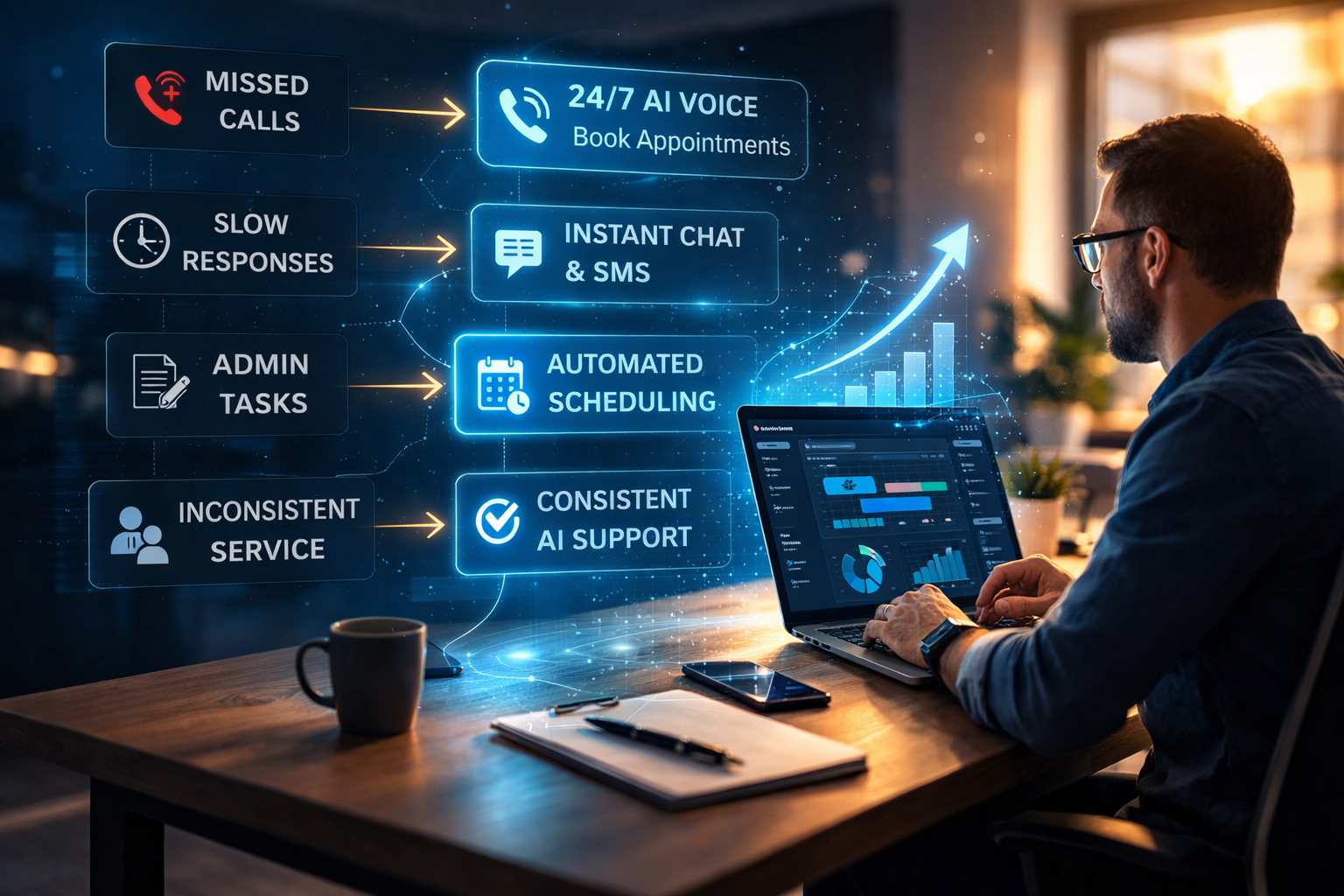
Missed opportunities from unavailability. When a potential customer calls after hours, on weekends, or while you're with another client, and you can't answer—you often lose that business to whoever picks up first.
Inconsistent customer experience. Your best employee provides excellent service. Your newest employee is still learning. Customers get dramatically different experiences depending on who they interact with.
Time wasted on repetitive questions. How much of your day is spent answering the same questions: "What are your hours?" "Do you serve my area?" "What does this cost?" "When's your next availability?"
Slow response times. Customers expect immediate answers. If they text you at 8 PM and don't hear back until 10 AM the next day, they've already contacted three competitors.
Administrative overhead. Scheduling appointments, sending reminders, following up with leads, updating your CRM—these necessary tasks consume hours that could be spent actually serving customers.
These aren't abstract "digital transformation" challenges. These are daily frustrations that directly impact revenue and growth.
And THIS is where AI leadership actually matters.
What Practical AI Leadership Looks Like for Local Businesses
AI leadership for small businesses means implementing specific automation that solves these specific problems. Let me show you what that looks like in practice.
Problem: Missed Calls = Lost Revenue
AI Solution: Voice agents that answer your business phone 24/7, qualify leads, answer common questions, and book appointments—even when you're unavailable.
Real-World Impact: A Durham-area home services company implemented an AI phone agent and discovered that 35% of their qualified appointments were being booked outside traditional business hours—revenue they were previously losing to voicemail.
This isn't experimental technology. Platforms like Vapi and integrated systems through GoHighLevel provide conversational AI that sounds natural, understands context, and actually helps customers instead of frustrating them.
Problem: Slow Response Times
AI Solution: Instant engagement through chat and SMS automation that responds immediately to customer inquiries, provides helpful information, and captures contact details for follow-up.
Real-World Impact: Response time is one of the strongest predictors of conversion. Research from Harvard Business Review shows that businesses responding to leads within 5 minutes are 100x more likely to connect and qualify that lead compared to businesses waiting even 30 minutes.
AI doesn't take breaks, forget to check messages, or get distracted by other tasks. It responds in seconds, every single time.
Problem: Inconsistent Customer Experience
AI Solution: Standardized initial interaction that ensures every customer gets the same quality of information, tone, and professionalism—whether it's their first inquiry or tenth.
Real-World Impact: Your AI agent never has a bad day, never forgets to mention an important service, never mishears what the customer said, and never gives incorrect information about pricing or availability.
The consistency builds trust. Customers know what to expect from your business because every interaction meets the same standard.
Problem: Administrative Time Drain
AI Solution: Automated appointment scheduling, calendar management, reminder notifications, and CRM data entry that happens without human intervention.
Real-World Impact: Time is your most valuable asset. Every hour spent on administrative tasks is an hour you can't spend serving customers, developing new services, or growing your business.
AI handles the repetitive, rule-based work that doesn't require human judgment, freeing you to focus on the aspects of your business that truly need your expertise.
The Strategic Question: Build or Buy?
One critical decision point for AI leadership is whether to build custom solutions or implement proven platforms.
For 95% of small businesses, the answer is: buy proven solutions.
Unless you're in the technology business, you don't have the time, expertise, or resources to develop AI from scratch. What you need is:
Tested technology that actually works
Quick implementation without massive learning curves
Ongoing support when issues arise
Integration with your existing tools
Predictable costs without surprise technical debt
Platforms like GoHighLevel, integrated with AI capabilities from providers like Vapi, offer business-ready solutions specifically designed for small service businesses. You're not the beta tester—you're implementing proven technology that hundreds of businesses already use successfully.
This is leadership: knowing when to leverage existing solutions rather than reinventing wheels.
Leadership Means Choosing the Right Problems to Solve First
AI can potentially help with dozens of business functions. But trying to automate everything at once is a recipe for chaos and disappointment.
Real leadership means prioritizing based on impact:
Start with your biggest pain point. Is it missed calls? Slow scheduling? Inconsistent follow-up? Choose the single most expensive problem and solve it first.
Prove ROI before expanding. Implement one AI solution, measure its impact over 60-90 days, and ensure it's actually delivering value before adding more automation.
Layer capabilities strategically. Begin with basic automation (like AI answering service), then add scheduling integration, then expand to SMS automation, then implement advanced analytics. Build systematically, not chaotically.
Maintain human oversight. AI handles the routine; humans handle the exceptions. Your AI agent escalates complex questions to you. You review bookings and adjust as needed. You stay in control.
This incremental, results-focused approach is how you build sustainable AI capability without overwhelming your operations.
What "AI Leadership" Actually Signals to Your Market
Here's something most articles about AI adoption miss: implementing AI isn't just about internal efficiency—it's a market signal.
When a potential customer calls your business and gets an immediate, professional response—even at 9 PM on a Saturday—what does that tell them about your company?
It signals:
You're established and successful enough to afford professional systems
You care about customer experience and convenience
You're modern and forward-thinking
You're serious about your business
You're easier to work with than competitors who don't answer
When someone visits your website and gets instant, helpful chat support instead of submitting a form and waiting, that positions you as the professional choice compared to competitors still relying on outdated contact methods.
AI leadership creates competitive differentiation not just through operational efficiency, but through elevated customer perception.
The Triangle Small Business AI Adoption Reality
Working with businesses across Chapel Hill, Durham, Raleigh, and the Triad, I'm seeing a clear pattern: the businesses implementing practical AI automation are pulling ahead of those still skeptical or waiting.
This isn't speculation—it's measurable in appointment booking rates, lead conversion percentages, and customer satisfaction scores.
But here's what's critical to understand: we're still early. Most of your local competitors haven't adopted meaningful AI automation yet. That creates a temporary window of competitive advantage for businesses that move decisively.
Five years from now, AI-powered customer engagement will be table stakes—expected standard practice like having a website or accepting credit cards. But right now, it's a differentiator.
The question facing every local business owner is: do you want to be a leader who captures the early-mover advantage, or a follower who implements defensively after competitors have already seized market share?
How to Evaluate AI Solutions (Without the BS)
If you're considering AI automation for your business, here's how to cut through vendor hype and evaluate what's actually worth implementing:
Ask These Questions:
What specific problem does this solve? If the answer is vague or focuses on "innovation" rather than concrete business outcomes, keep looking.
What's the measurable impact? Can the vendor show you data on appointment booking rates, response times, or lead conversion? If they can't quantify results, they're selling hype.
How long until implementation? Real solutions can be deployed in days or weeks, not months. If it requires extensive custom development, it's probably too complex.
What's required from us? Good solutions need your knowledge (about your services, FAQs, etc.) but shouldn't require you to become a programmer or AI expert.
Who else in our industry uses this? Don't be the guinea pig. Ask for references from similar businesses in similar markets.
What happens when something breaks? Every system eventually has issues. Who fixes it, how fast, and at what cost?
Can we start small and scale? Beware of all-or-nothing solutions. The best platforms let you implement one capability, prove value, then expand.
Red Flags to Avoid:
Vendors who can't explain their technology in plain English
Solutions requiring you to change your entire business process
Promises of "AI will replace employees" (it should enhance, not replace)
Lack of integration with tools you already use
No clear pricing or hidden ongoing costs
No way to customize for your specific business
The Human Element Still Matters (Maybe More Than Ever)
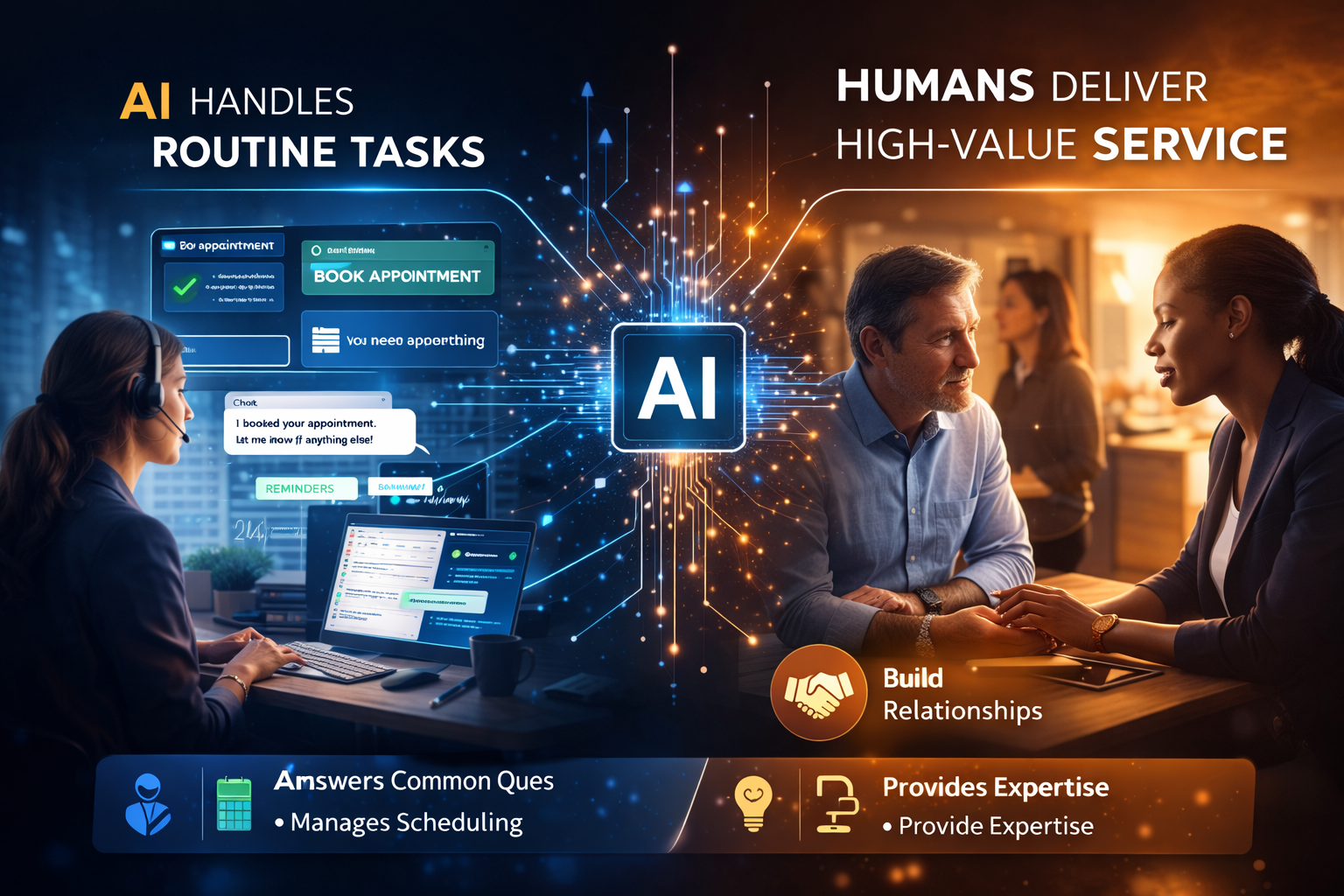
Here's the irony of AI leadership: the better your automation, the more valuable your human interaction becomes.
When AI handles the routine—answering common questions, booking standard appointments, sending reminders—you're freed to focus on the situations that truly require human judgment, creativity, and relationship-building.
AI can't:
Navigate complex customer situations requiring empathy
Make strategic business decisions about service offerings
Build deep client relationships based on personal trust
Provide the expert consultation that commands premium pricing
Represent your brand's personality and values in nuanced ways
Humans should:
Handle escalated customer issues and complaints
Consult with clients on complex projects or decisions
Build partnerships and community relationships
Set strategy and adapt to changing market conditions
Provide the expertise that justifies your business's value
AI leadership means using automation to eliminate the repetitive tasks that drain your energy, so you can invest that energy in the high-value activities that actually grow your business.
Your Action Plan: Leading with AI, Not Following Hype
If you're ready to move from AI tourism to AI leadership, here's your practical roadmap:
This Week:
Identify your single biggest operational pain point
Calculate what that problem costs you (in lost revenue or wasted time)
Research proven AI solutions specifically designed for that problem
This Month:
Talk to providers who serve businesses like yours
Ask for demos and real customer references
Calculate the ROI: implementation cost versus monthly savings/revenue increase
This Quarter:
Implement one AI solution focused on your priority problem
Train your team on how it works and when to use it
Measure impact over 60-90 days with clear metrics
This Year:
Once the first solution proves valuable, identify the next priority
Layer additional capabilities strategically
Build a system of integrated automation that compounds value
This is leadership: deliberate, strategic, results-focused implementation.
The Real Definition of AI Leadership
AI leadership for small businesses isn't about being the most cutting-edge or implementing the most technology.
It's about:
Clarity – Knowing exactly which problems you're solving
Pragmatism – Choosing proven solutions over experimental ones
Results – Measuring impact and doubling down on what works
Balance – Enhancing human capability, not replacing it
Advantage – Moving strategically while competitors wait
The Triangle businesses leading with AI aren't the ones talking about it the most. They're the ones quietly implementing practical automation, capturing more leads, booking more appointments, and growing their market share while competitors are still debating whether "AI is just a fad."
Where does your business stand? Are you leading with practical AI implementation, or are you still watching from the sidelines?
The opportunity window is open. But it won't stay open forever.
Ready to implement practical AI automation for your Triangle business? Wespor Business specializes in AI voice and chat agents designed specifically for local service providers—no hype, no complexity, just proven technology that captures leads, books appointments, and grows your business. Visit wesporbusiness.com or call (984) 217-4555 to learn how AI leadership can give your business a measurable competitive advantage.


