
Sensation as Intelligence: the First Language of Embodied Presence
Sensation isn’t just a physical experience. It’s the foundation of how we meet the world.
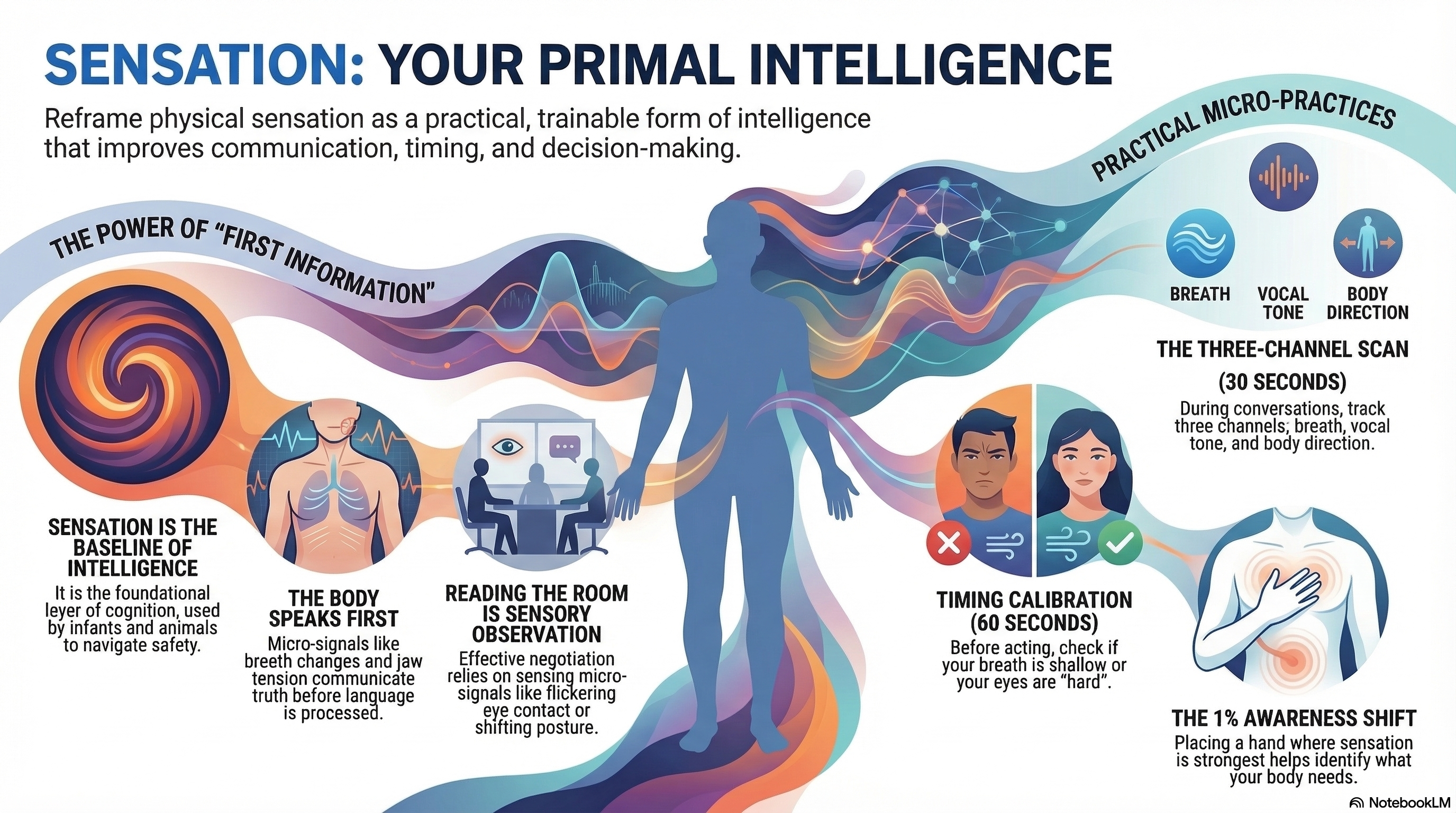
Before words, before structured thought, there was sensation—our earliest tool for interpreting the environment and responding effectively. In that sense, sensation is not “extra information.” It is first information.
My first career was music and performance. I trained voice, posture, and presence for decades, and I saw the same pattern repeatedly: the body communicates truth long before language has a chance to tidy it up. A breath changes. A jaw tightens. The eyes harden or soften. The tone shifts. The system tells you what’s real.
That’s why I treat sensation as a form of intelligence—not mystical, not vague. Practical. Trainable. Useful.
Sensation is the baseline of intelligence
Human beings evolved by sensing. Early humans survived because they could read subtle changes—sound, scent, movement, tension in the body—before danger was fully visible.
You can see this in infants, too. Long before a child can speak, they learn through sensory input: touch, taste, sight, sound, smell. The sensory world builds the platform for cognition and relationship.
Animals demonstrate this even more starkly: heightened sensitivity is not a luxury. It’s how they navigate social life, communicate safety and threat, and respond to changes in environment.
In other words: sensation isn’t separate from intelligence. It’s the ground layer intelligence stands on.
Why adults lose this (and why it matters)
Most adults have learned to ignore sensory feedback. We override it. We numb it. We treat it as background noise while we “stay productive.”
But sensory cues are exactly where:
timing lives
communication lives
trust lives
decision quality lives
When you return to sensory awareness, you gain something most people don’t realize they’ve lost:
real-time information.
Sensory awareness in negotiation: reading the room without guessing
In negotiation, the most important information is often not in the words.
It’s in the micro-signals:
a pause that arrives too early
a breath that holds
a voice that tightens
eye contact that flickers
posture that pulls away
This is what people mean by “reading the room.” It’s not mind-reading. It’s sensory observation.
Micro-practice: the three-channel scan (30 seconds)
During a conversation, quietly track three channels:
breath (yours + theirs if you can perceive it)
tone (speed, pitch, tightness)
body direction (leaning toward/away, head angle, hands)
You’ll often know when to pause, soften, or clarify—before the words become conflict.
Timing and sensation: why “right timing” isn’t luck
Great timing often looks like talent. But it’s frequently sensory intelligence.
Athletes sense timing through body memory and environmental cues. Musicians feel timing through rhythm and breath. Chefs sense timing through smell, sound, and texture.
In everyday life, timing is the same:
you feel when a conversation can open
you sense when a decision is premature
you notice the moment a room shifts
Sensation makes timing visible.
Micro-practice: timing calibration (60 seconds)
Before you act, ask:
“Is my body rushing?”
“Is my breath shallow?”
“Are my eyes hard?”
If yes, wait 30 seconds and exhale slowly.
Then act from the steadier layer.
Relationships: the body speaks before the story
In relationships—personal or professional—physical cues often speak louder than words.
a subtle withdrawal
a change in tone
a shift in eye contact
tension in the jaw
a forced smile
When you can sense these signals, you stop relying on interpretation and start responding to what’s actually present.
That builds:
empathy without over-functioning
trust without over-explaining
clarity without aggression
A 60-second practice: sensation as information
Place an open palm where sensation is strongest (chest, belly, throat—wherever you feel it).
Exhale slowly. Then ask:
“What is this sensation asking for—space, rest, movement, honesty?”
Don’t answer from your head. Wait for the body’s response. Even one percent more sensation-awareness changes how you communicate.
Where to go next
Browse the Articles Library: https://lindenthorp.com/articles
Browse the full blog feed: (use your /blog link)
Join the email list at the bottom of the page for new essays + practical tools.