
The Currency of Conscious Attention
Attention isn’t just something we give or take. It’s the pulse of how we engage with life.
I’ve spent decades working with performers, educators, and professionals—training voice, posture, and presence. And I’ve learned this: the people who create the most impact aren’t always the loudest or the busiest. They’re the ones whose attention is stable. Their body supports their message. Their nervous system isn’t leaking urgency into every sentence.
In a post-AI era—where information multiplies faster than wisdom—attention has become a tangible resource, arguably more valuable than many traditional forms of currency. Money still matters, of course. But attention determines what you build, what you believe, who you trust, and what you become.
The attention economy is a nervous-system economy
We’re surrounded by systems designed to fragment us. Advertisers compete for your gaze, platforms compete for dopamine, news cycles compete for outrage. And now AI accelerates output so dramatically that your attention is not merely “in demand”—it’s under extraction.
When focus is repeatedly splintered, something deeper than productivity is affected:
decision quality declines
emotional regulation becomes harder
creativity becomes shallow
relationships thin out
meaning becomes harder to access
This isn’t just time management. It’s attention scarcity—and it has a real cost.
Why it matters for business, leadership, and legacy
Innovation requires deep focus. Trust requires presence. And legacy asks a sharper question than achievement:
What did my attention serve?
What did my presence transmit?
What did my work leave behind in other people’s nervous systems?
That’s why attention isn’t an “extra” in the productivity puzzle anymore. It’s the frame.
Presence isn’t charisma. It’s regulation made visible.
You’ve met people who command a room without performing. It’s not only their ideas. It’s the quality of their signal:
steady gaze
grounded tempo
clean tone
unhurried pauses
congruent body language
In Japan, where subtlety and restraint shape communication, this becomes even clearer. People read the body first. Which is why I’ll say it plainly:
Whatever words we say matters less than how we say them—and how the body supports them.
Non-verbal communication isn’t an add-on. It’s infrastructure.
Three fast tools to reclaim attention
No meditation marathons required.
1) Attention budget (10 seconds)
Before you open a screen, choose one intention for the next 10 minutes. Close anything that doesn’t serve it.
2) Breath reset (60 seconds)
Inhale 4 through the nose. Exhale 6 slowly. Repeat 5 rounds.
Notice: jaw softens, eyes widen, tone changes, mind stops sprinting.
3) Body cue check (30 seconds)
Scan eyes/jaw, throat/chest, belly/pelvis.
If those areas are braced, attention will scatter. When they soften, attention steadies.
Below is a guide from my book 'Your Body is Your Business Plan: Avoid Burnout.' It outlines some of the inattentions we are trapped by.
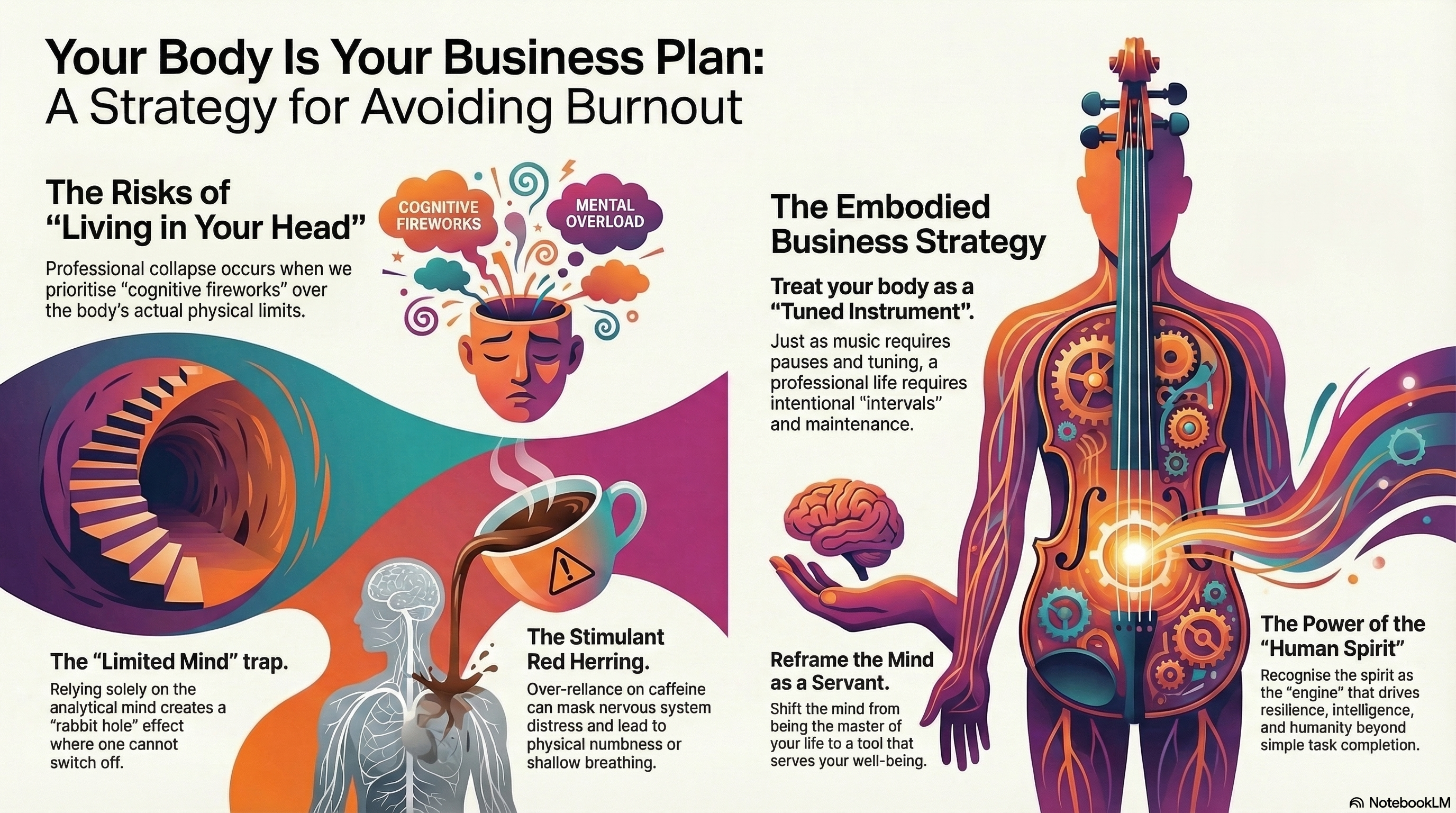
The cost of scattered attention
Task switching creates “energetic debt.” The symptoms are familiar: tiredness, irritability, vague dissatisfaction, difficulty initiating tasks. That isn’t laziness. It’s a system that’s been overdrawn.
The future advantage
AI will keep accelerating. Content will keep multiplying. The real question isn’t “How do I keep up?”
It’s:
How do I keep my attention sovereign?
How do I stay human, present, and truthful inside speed?
That advantage begins in the body.
A 60-second practice
Soften your eyes. Let your exhale lengthen. Feel your feet.
Name three sensations—pressure, warmth, movement—and stay with them for 20 seconds.
Then choose one next action and do only that.
Where to go next
Start here (Brainz readers): https://lindenthorp.com/brainz
Browse the library: https://lindenthorp.com/articles