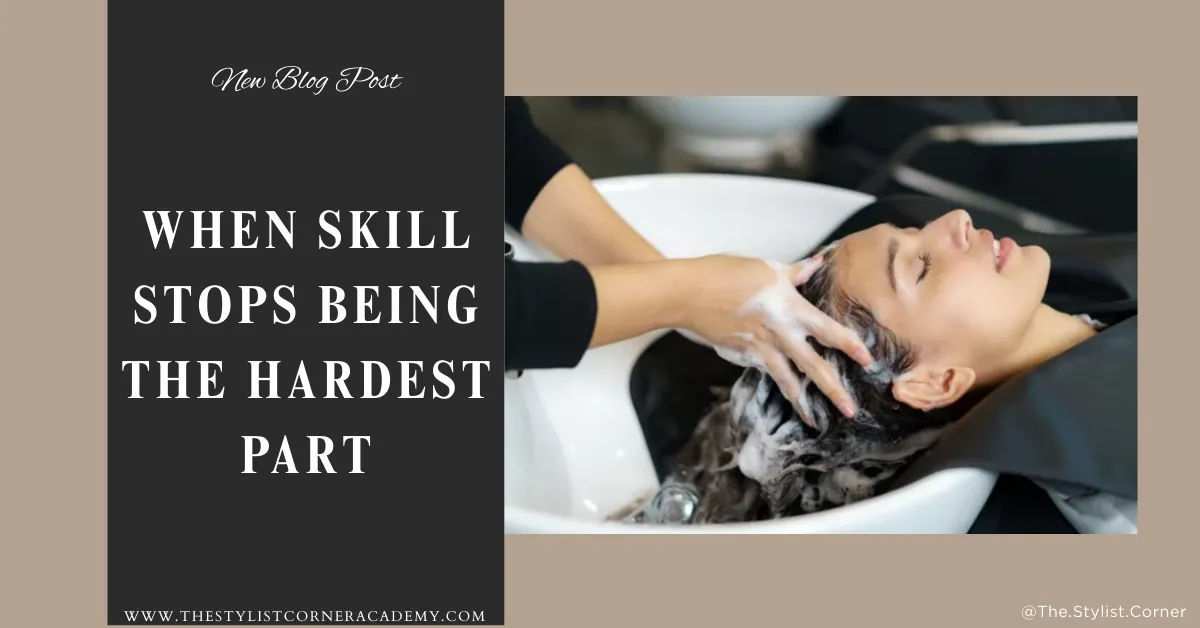
When Skill Stops Being the Hardest Part
Every hairstylist begins their journey focused on one primary goal: mastering the craft. In the early stages of a career, everything feels technical. Learning how to hold your tools, understanding color theory, shaping hair properly, and developing a consistent finishing style are all part of the foundation. These early years require patience and repetition. Progress is measured in visible improvements, and each successful result builds confidence.
This stage is important. Skill is the doorway into the industry, and without it, nothing else has a place to stand on. Clients trust stylists who demonstrate competence, and technical ability is what allows professionals to build credibility in their work.
But something interesting begins to happen after a stylist spends enough time behind the chair.
At first, it is subtle. You notice that your work is becoming more consistent. Services that once felt difficult now feel natural. Techniques that required intense concentration start to become second nature. Your hands know what to do before your mind even finishes the thought.
When this happens, the challenge that once defined your career begins to shift.
Skill slowly stops being the hardest part.
Many stylists are surprised when they reach this point because they spent so much time believing that technical mastery was the main obstacle. They assume that once they become skilled enough, everything else in their career will fall into place automatically.
But that is rarely what happens.
Instead, a new set of questions begins to appear—questions that cannot be answered through technique alone.
You begin thinking about how you value your work. You start wondering what kind of clients you want to attract. You notice the importance of boundaries, scheduling, and communication. You realize that the way you think about your career has just as much influence on your future as the quality of your haircut.
This is the stage where many professionals discover that the next level of growth is not technical—it is mental.
Mindset becomes a defining factor.
Two stylists can possess nearly identical skill levels yet experience completely different careers. One may feel constantly overwhelmed, unsure of how to move forward, or stuck in patterns that feel difficult to change. The other may move through the industry with clarity and direction, steadily shaping their work into something that feels sustainable and fulfilling.
The difference rarely lies in the scissors or the color formulas.
More often, it lies in how each person approaches decisions.
When skill is no longer the biggest challenge, the focus shifts toward leadership—specifically, self-leadership. A stylist must learn to guide their own career rather than simply react to what happens around them.
This can feel uncomfortable at first because it requires stepping outside of the familiar role of technician. Instead of only perfecting services, you begin to think about your career as something that needs structure and intention.
You may start asking questions that previously seemed distant.
What kind of professional do I want to become?
What kind of work do I want to be known for?
How do I want my career to support my life in the long term?
These questions do not have quick answers. They require reflection, honesty, and sometimes difficult decisions. But they are also what separate a career that evolves from one that remains stagnant.
When stylists reach this stage, they often discover that growth requires a deeper level of responsibility. It is no longer enough to simply improve your craft and hope opportunities appear. Instead, you begin shaping your path deliberately.
You choose how you present yourself professionally.
You choose the standards you maintain.
You choose the environment you create for both yourself and your clients.
These choices may seem small on the surface, but over time they influence the entire direction of your career.
Another realization that often appears at this stage is that external factors are rarely the full explanation for success or stagnation. The industry is the same for everyone. Trends shift, markets change, and challenges appear for all professionals.
What differs is how individuals respond.
Some stylists remain focused solely on technique for many years, believing that another class or another certification will finally create the breakthrough they are waiting for. Education is valuable, but without a shift in thinking, it cannot solve every problem.
Others begin recognizing that technical ability must be paired with self-awareness and decision-making. They understand that their career is not just a reflection of their skill, but also of the standards they set and the choices they make consistently.
This shift in perspective is often the beginning of real professional maturity.
Instead of asking only, “How can I improve my technique?” the question becomes broader: “How can I guide my career with intention?”
Interestingly, once this mental shift occurs, skill often improves even further. When a stylist begins working with clarity and purpose, they approach their craft with renewed focus. Technique becomes more refined because it is aligned with a larger vision.
Confidence also begins to change.
Early confidence is usually based on performance—how well a service turns out, how happy a client is, or how positive feedback feels in the moment. Later confidence is different. It comes from knowing that your career is moving in a direction you intentionally chose.
That kind of confidence is quieter, but far more stable.
Over time, stylists who embrace this stage of growth begin to see their profession in a different light. Hair is still the craft they practice every day, but it is no longer the only thing defining their career.
Their thinking becomes part of the work.
They start understanding that long-term success is rarely the result of a single breakthrough or dramatic change. Instead, it grows from a series of thoughtful decisions made consistently over time.
Each decision may seem small when viewed individually. But together, they create the structure of a career that continues to evolve.
Skill may open the door to the industry.
But eventually, it is mindset that determines how far you walk through it.
This is just the beginning inside The Stylist Corner free Skool community, we share deeper resources, workflows, and behind-the-scenes insights you won’t find on the blog. Clickhere to join.
Warm regards,
Danie Wilks
The 5-Minute Podcast Host and Mentoring Coach