
7 Documents Your Family Needs to Find in the Next 10 Minutes | Fortune Shield
If something happened to you today, could your family find your life insurance policy? Your will? Your bank accounts? For most households, the honest answer is no. This post covers the 7 documents that matter most in a crisis, why each one is essential, and the simplest way to get them organized today.
Why This Matters More Than Most People Realize
The financial impact of a crisis is almost always compounded by disorganization. When a family can't locate key documents quickly, they face delayed benefits, missed deadlines, frozen accounts, and avoidable legal costs — on top of the emotional weight they're already carrying.
More than one-third of all Americans experienced an economic crisis in the past year. Yet most families have no centralized system for their most important documents. (BYU American Family Survey, 2025)
Getting organized doesn't require a filing system overhaul. It requires locating 7 categories of documents, putting them somewhere findable, and telling someone you trust where that place is.
Document 1: Identification Papers
These are the foundational documents that prove who you are. Without them, your family can't access accounts, apply for benefits, or navigate any legal process after a crisis.
Birth certificates for every family member
Social Security cards — stored separately from wallets
Passports (current and expired — expired passports can still verify identity)
Marriage and divorce certificates
Adoption papers if applicable
Military discharge papers (DD-214) if applicable
Store originals in a fireproof safe or waterproof document box. Keep certified copies in a separate location. Digital scans stored in a secure, password-protected cloud folder provide a third layer of access.
Document 2: Insurance Policies
Your insurance policies represent your family's financial safety net. In a crisis, they are worthless if your family can't find them, doesn't know the policy number, or can't reach the carrier.
Life insurance: carrier name, policy number, death benefit amount, beneficiary designation, and claims phone number
Health insurance: current ID cards, plan documents, and the carrier's customer service number
Homeowner's or renter's insurance: policy number, carrier, and claims number
Auto insurance: policy number and carrier for each vehicle
Any supplemental or disability coverage policies
Over 100 million Americans are uninsured or underinsured for life insurance. Among those who do have coverage, many families don't know where the policy documents are or how to file a claim. (LIMRA, 2025 Insurance Barometer Study)
A simple one-page 'Insurance Summary' listing every policy, carrier, number, and contact takes 30 minutes to create and eliminates the most common post-crisis logistical nightmare.
Document 3: Financial Account Information
In an emergency or after a death, your family needs to be able to access, freeze, or manage your financial accounts. Without account information, money can sit unclaimed for years.
Bank accounts: institution name, account numbers, and online login location (stored in a password manager, not written in plain text)
Investment and brokerage accounts: institution, account numbers, and advisor contact
Retirement accounts: 401k, IRA, pension — with beneficiary designations confirmed
Mortgage or auto loan information: lender, account number, and payment details
Credit card accounts: issuer, account number, and whether autopay is set up
Critically: document your digital accounts. Subscription services, email accounts, and digital assets can all be lost permanently if your family doesn't have access information.
Document 4: Estate Planning Documents
If you have them, your family needs to know where they are. If you don't have them, this is the reminder to create them.
Will or living trust — with the name and contact information of your attorney
Healthcare directive / living will — expressing your medical wishes
Medical Power of Attorney — designating who makes medical decisions if you can't
Financial Power of Attorney — designating who manages finances if you're incapacitated
List of beneficiary designations for all accounts (these override your will)
56% of U.S. adults have no estate planning documents. Among those with no documents, 56% say they would not know what to do if a family member died today. (Trust & Will 2026 Estate Planning Report)
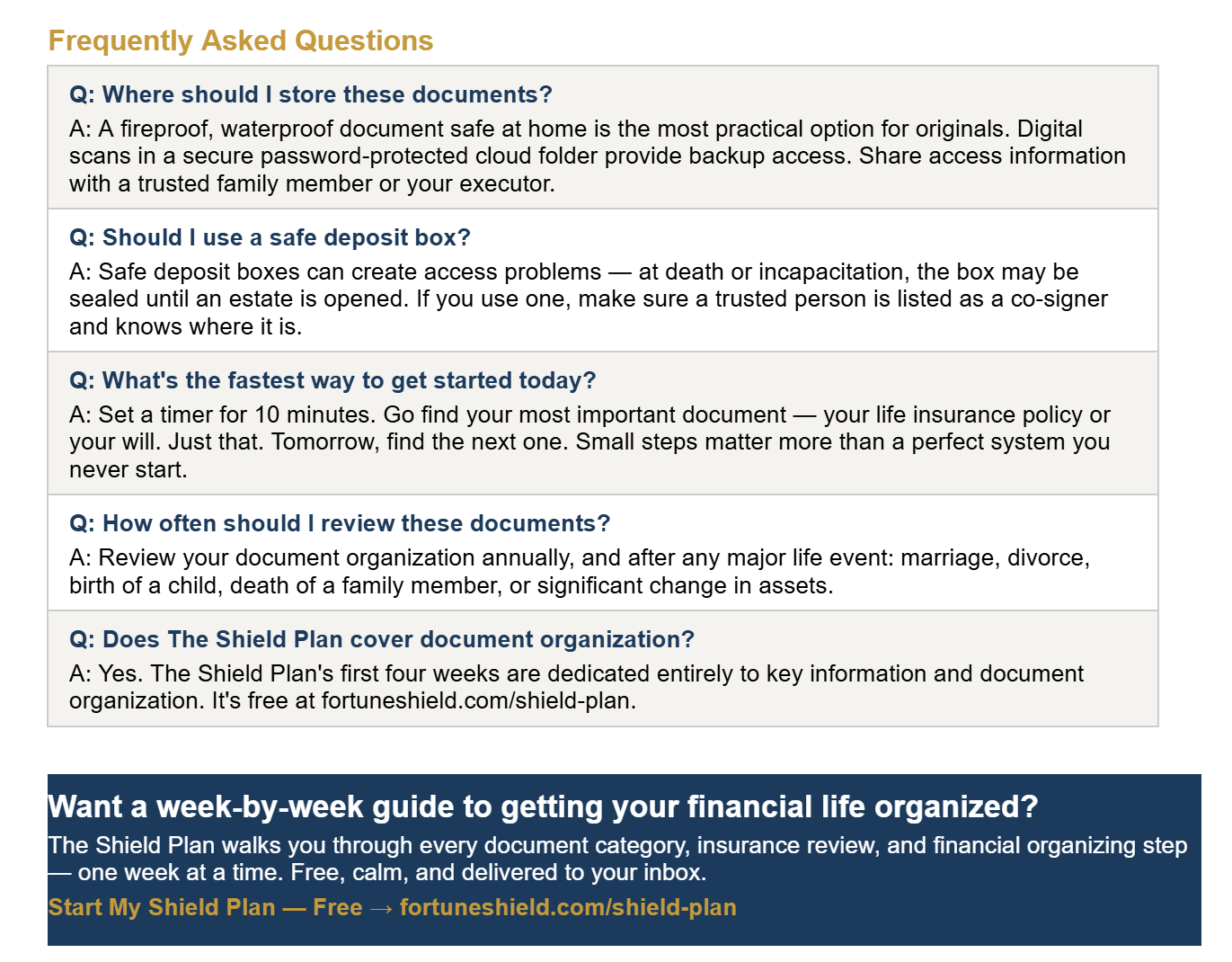
Estate documents are only useful if your family can find them. Storing them in a safe deposit box can actually create problems — if you're the only one on the account, the box may be sealed at death. Keep originals at home in a fireproof safe and tell your executor exactly where they are.
Document 5: Property Records
Property ownership creates legal obligations and financial assets that your family needs to be able to manage.
Mortgage documents or deed of trust
Property deed (especially if the home is paid off)
Vehicle titles
Any real estate purchase agreements or lease documents
Property tax records — especially useful for establishing basis
Vehicle titles in particular are often misplaced. If your family needs to sell a vehicle or transfer ownership after a death, a missing title creates significant delays and cost.
Document 6: Tax Records
Keep the last 3 to 7 years of tax returns accessible. They are required for Social Security benefit claims, mortgage applications, legal proceedings, and benefit eligibility determinations — often at the exact moment you least expect to need them.
Federal and state tax returns for the past 3-7 years
W-2s and 1099s for the same period
Business ownership documents and tax IDs if self-employed
Records of major asset purchases (cost basis documentation)
Document 7: The 'What Happens Next' Document
This is the document most families never create — and the one their family will need most.
A simple one or two page 'In Case of Emergency' document that answers the questions your family will have in a crisis: Who should they call first? Where is the life insurance? Who is the attorney? What accounts exist? Where is the safe? What are the passwords?
This doesn't need to be formal or legal. It just needs to exist, be findable, and be shared with whoever would need it. Update it annually or after any major life change.
Sources Referenced
BYU Wheatley Institute / Deseret News — 2025 American Family Survey: socialsciences.byu.edu/2025-american-family-survey
LIMRA — 2025 Insurance Barometer Study: limra.com/siteassets/newsroom/liam/2025/2025_facts_about_life_insurance.pdf
Trust & Will — 2026 Estate Planning Report: trustandwill.com/learn/estate-planning-report-2026
Consumer Financial Protection Bureau — Emergency Document Guidance: consumerfinance.gov
Trustworthy — Essential Documents Every Family Needs: trustworthy.com/blog/information-management/essential-documents-every-family-needs


