
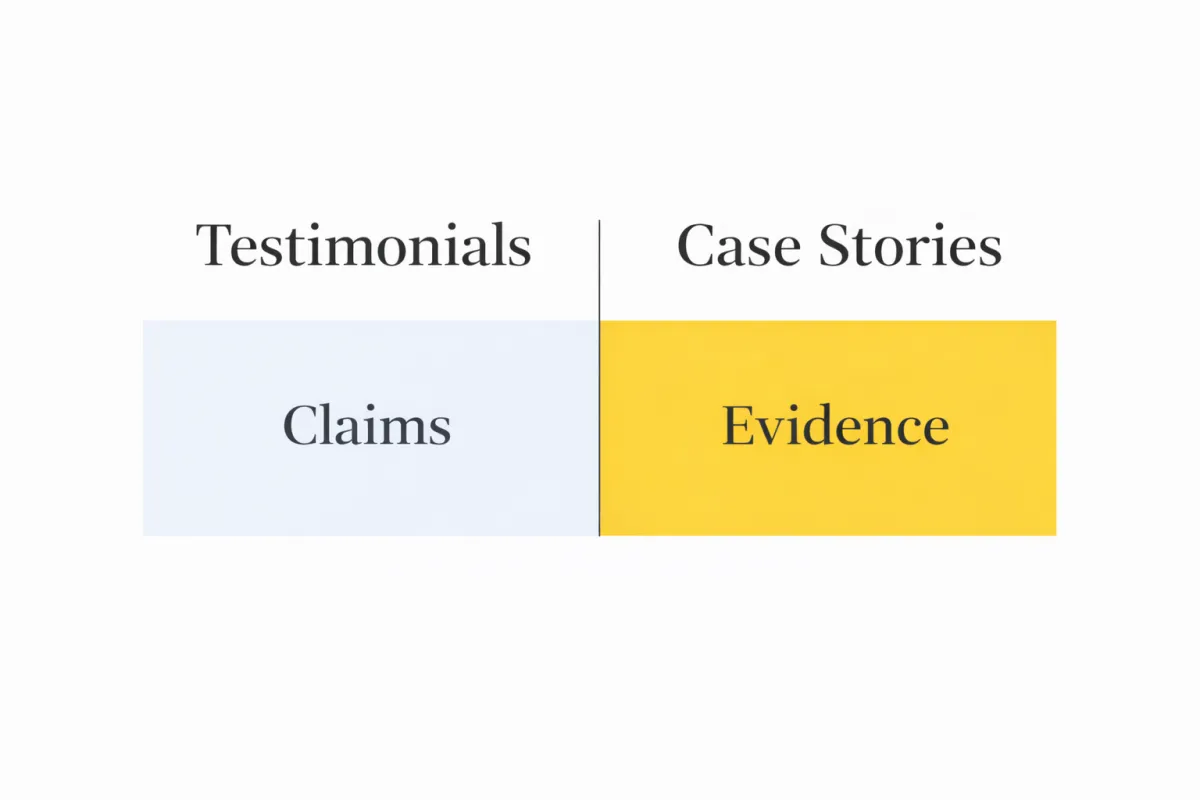
Testimonials Tell. Case Stories Reassure. Here’s the Difference.
Testimonials are easy to recognise. A short quote, a name, and a positive outcome. They are often one of the first forms of proof businesses reach for.
There is nothing inherently wrong with testimonials. They can reinforce credibility and provide social proof. The problem is that they are often asked to do a job they are not designed to do.
Testimonials tell. But case stories reassure.
That distinction matters more than it might first appear.
A testimonial usually reflects a personal experience. It tells a reader that someone else was pleased with the work. What it rarely provides is context. The reader does not know what alternatives were considered, what challenges existed, or what decisions had to be made along the way.
For a buyer trying to reduce risk, this leaves too many unanswered questions.
Reassurance comes from understanding, not praise. Buyers want to know whether the situation described resembles their own, whether the complexity feels familiar, and whether the outcome was achieved through sound judgement rather than good fortune.
Case stories are better suited to this role.
A well-constructed case story shows how a situation unfolded. It acknowledges uncertainty, trade-offs, and constraints. It demonstrates how decisions were made and why certain paths were chosen over others.
This does not mean listing every step or revealing every detail. It means providing enough context for a reader to make sense of the outcome and assess its relevance to their own circumstances.
Testimonials, by contrast, tend to flatten complexity. They present a positive conclusion without showing the path taken to get there. As a result, they are often read quickly and forgotten just as quickly.
This is why many businesses find that testimonials rarely influence buying decisions on their own. They may support a positive impression, but they do little to reduce doubt.
Case stories do something different. They help buyers feel understood. They create a sense of familiarity and competence that makes the decision to enquire or proceed feel safer.
Used together, testimonials and case stories can complement each other. Used in isolation, testimonials are rarely enough.
Understanding the difference helps explain why some forms of proof reassure buyers, while others simply decorate a page.