Accelerating Legacy .NET Application Modernisation Using AWS Transform
Technical Architecture Blog | AI‑Driven Modernisation of Enterprise .NET Applications
Many enterprises still rely on large .NET Framework applications built over the past two decades. These systems often support mission-critical workloads across finance, government, healthcare, and enterprise operations. While stable and reliable, they are frequently tied to legacy infrastructure and architectures that limit scalability, agility, and cloud adoption.
As organisations adopt cloud-first strategies, the need to modernise these applications becomes increasingly urgent. However, modernisation is rarely straightforward. Legacy codebases can contain millions of lines of tightly coupled logic, undocumented dependencies, and infrastructure assumptions built around on-premise Windows environments.
Traditionally, modernisation required extensive manual refactoring and months, or even years of engineering effort.
Recent advances in AI-driven software transformation are fundamentally changing this model. Platforms such as AWS Transform introduce agent-based automation that can analyse legacy codebases, generate transformation strategies, and accelerate modernisation programmes at scale.
This article explores how organisations can use AWS Transform to accelerate .NET legacy application modernisation, improve operational efficiency, and enable cloud-native architectures on AWS.
The Challenge of Legacy .NET Systems
Traditional .NET applications were commonly built using ASP.NET on the .NET Framework and deployed on Windows Server environments using IIS.
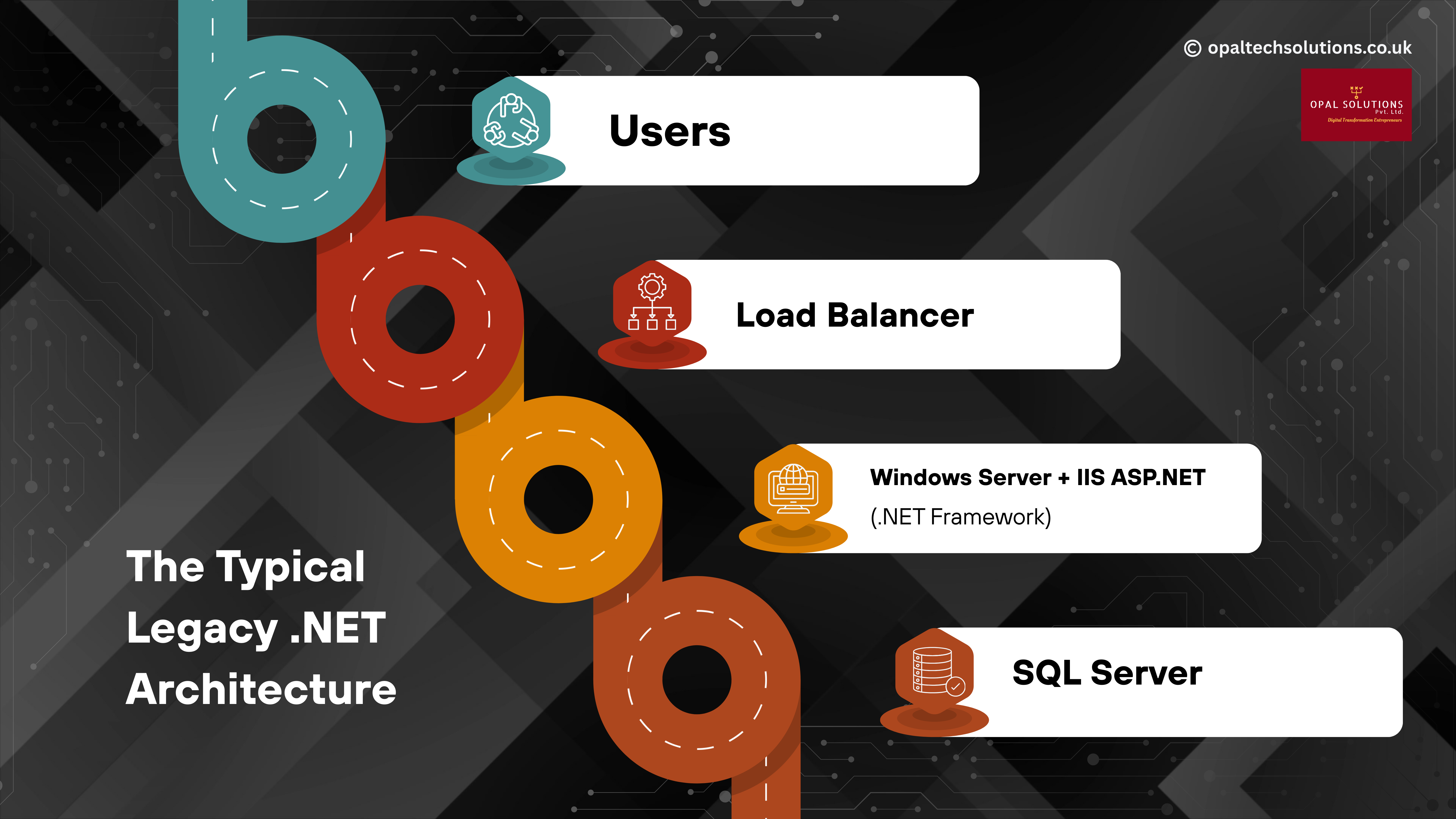
These systems often present several challenges:
Monolithic Architectures
Legacy applications are frequently built as monolithic systems where business logic, presentation layers, and data access are tightly coupled.
This architecture makes it difficult to:
Scale individual components
Update services independently
Adopt modern development practices
Technical Debt
Years of incremental development often introduce:
Outdated Libraries
Deprecated APIs
Undocumented code paths
Fragile dependencies
Refactoring such systems manually can be extremely time consuming.
Infrastructure Constraints
Legacy .NET applications often depend on:
Windows Server
IIS hosting environments
local storage or stateful sessions
These assumptions make cloud migration more complex.
Limited Cloud Compatibility
Applications built on older frameworks cannot easily leverage modern capabilities such as:
Container orchestration
Serverless computing
Automated scaling
As a result, organisations face growing pressure to modernise their application platforms.
Understanding Application Modernisation
Application modernisation involves upgrading legacy code, improving application architecture, and enabling deployment on modern cloud platforms.
In most enterprise programmes, modernisation occurs across two complementary dimensions, both of which are required to fully realise the benefits of modern cloud architectures:
Application Modernisation
Upgrading frameworks
Refactoring code
Improving architecture
Removing legacy dependencies
Infrastructure Modernisation
Migrating workloads to cloud platforms
Introducing containerisation and automation – Containerised deployments on Linux also reduce Windows Server licensing costs while improving deployment portability
Implementing cloud-native deployment models
Introducing AWS Transform
Introduced recently in February 2026, AWS Transform is an AI-driven modernisation platform designed to help organisations analyse and transform legacy applications at scale.
It combines machine learning, domain-specific agents, and automation to accelerate application transformation while maintaining transparency and developer oversight.
The platform introduces several capabilities designed to accelerate enterprise modernisation.
Expert AI Agents
Specialised agents analyse legacy systems, extract business logic, and identify modernisation pathways based on best practices.
Agentic Automation
Agentic AI enables goal-driven automation across the transformation lifecycle while allowing human-in-the-loop governance.
Continuous Learning
Transformation models continuously improve through feedback, self-debugging, and pattern recognition across modernisation projects.
Together, these capabilities enable organisations to transform complex legacy codebases significantly faster than traditional manual approaches.
Core Capabilities of AWS Transform
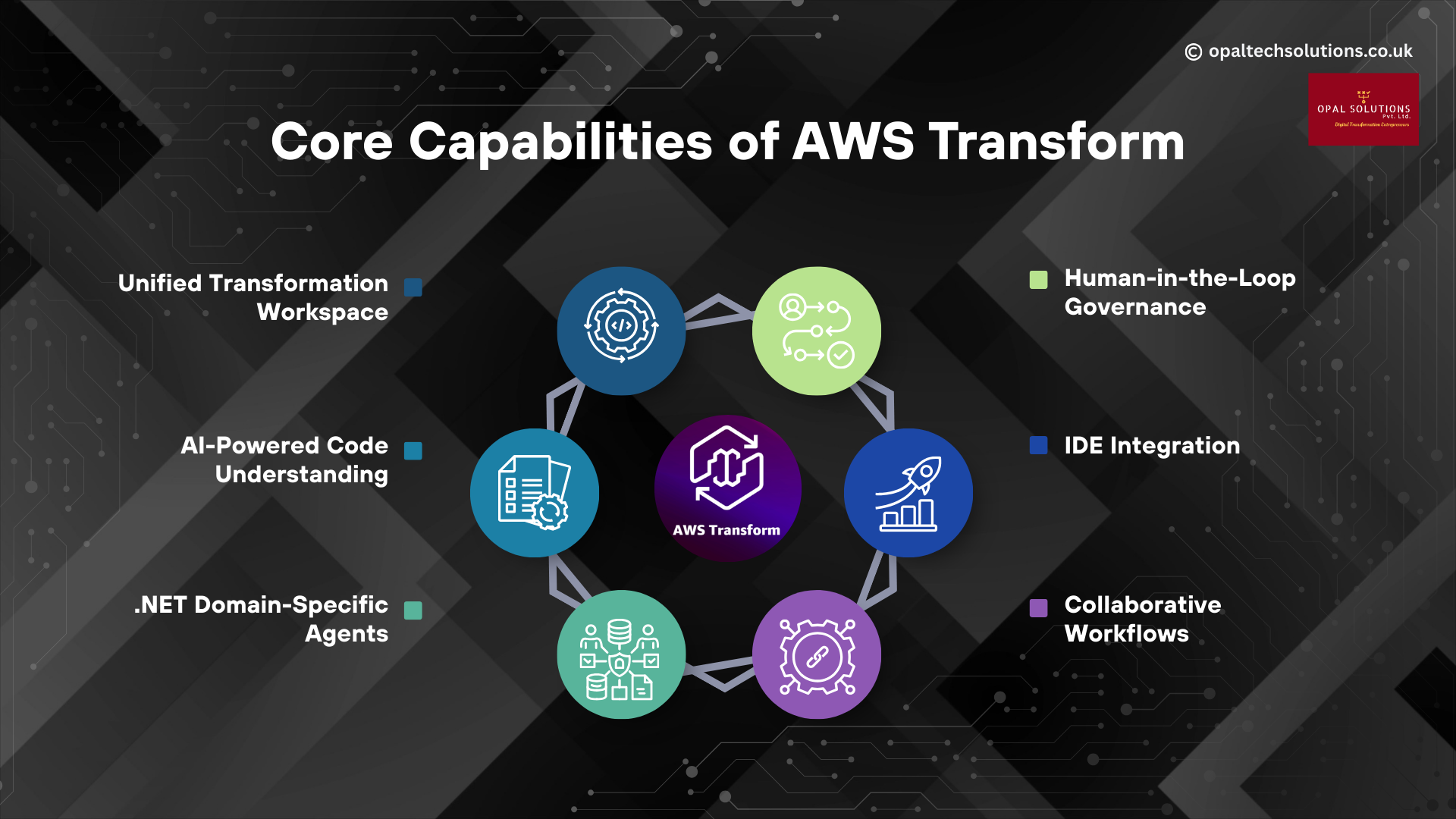
AWS Transform provides several built-in capabilities designed to support enterprise modernisation programmes.
Unified Transformation Workspace
A central web interface allows teams to monitor and manage transformation activities across applications and environments.
AI-Powered Code Understanding
Advanced language models analyse legacy codebases to identify:
Framework Dependencies
Architectural Patterns
Compatibility Issues
Refactoring Opportunities
.NET Domain-Specific Agents
Specialised AI agents are trained specifically for .NET application transformation, enabling more accurate analysis and automated refactoring.
Human-in-the-Loop Governance
Developers can review, validate, and modify AI-generated changes before they are applied.
This ensures transparency and maintains developer control.
IDE Integration
Developers can interact with transformation workflows directly within their development environments.
Collaborative Workflows
The platform supports collaboration between architects, developers, security teams, and operations engineers throughout the modernisation process.
AWS Transform Legacy Modernisation Tracks
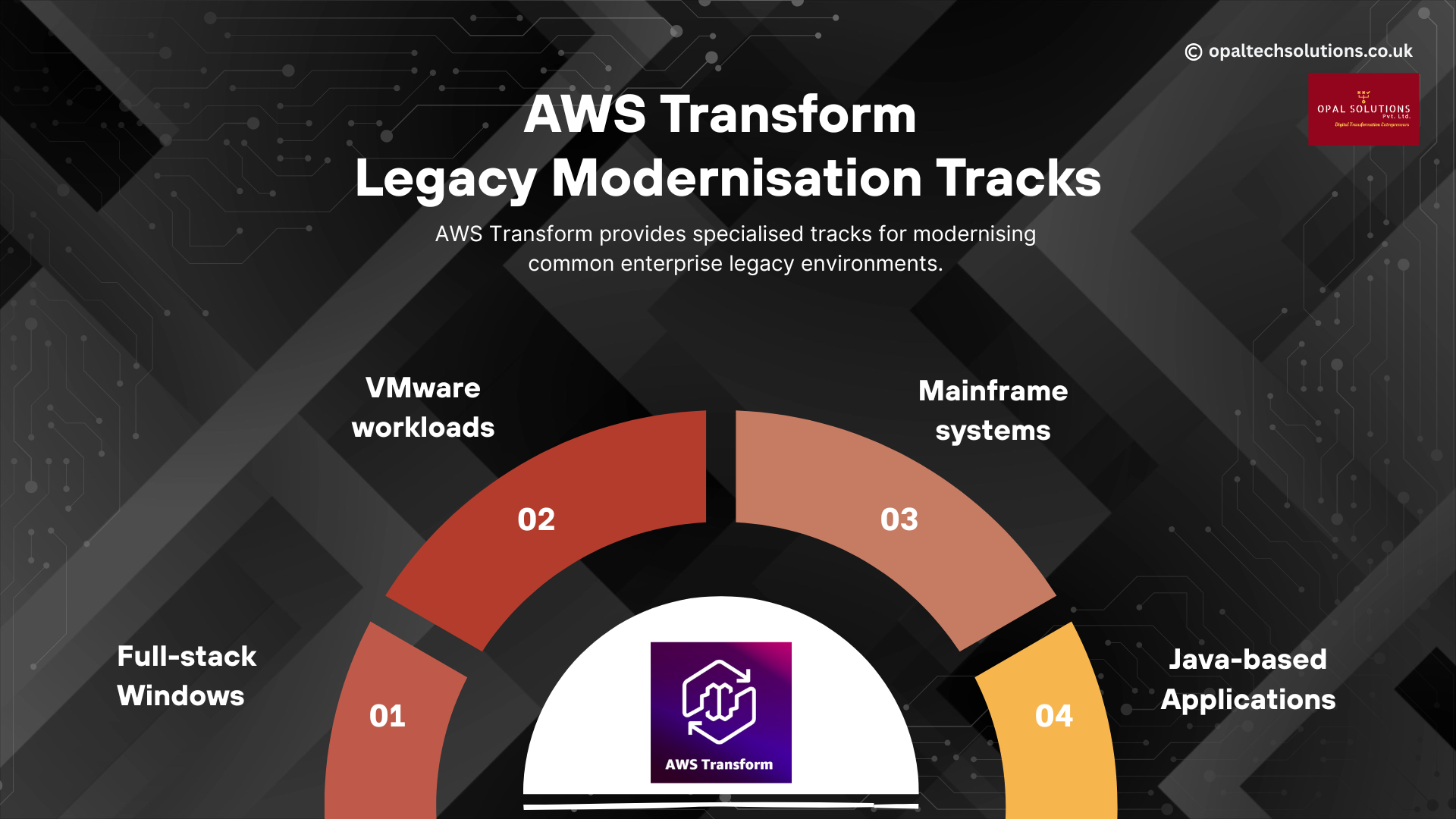
Understanding the value of agentic AI requires comparison with earlier apAWS Transform provides dedicated tracks to address the most common enterprise legacy environments.
These include:
Full-stack Windows
VMware workloads
Mainframe systems
Java-based applications
Each track includes domain-specific transformation tooling and automation workflows.
For organisations running large Microsoft workloads, the .NET modernisation pathway is particularly important.
Developer Workflow: Modernising a .NET Application
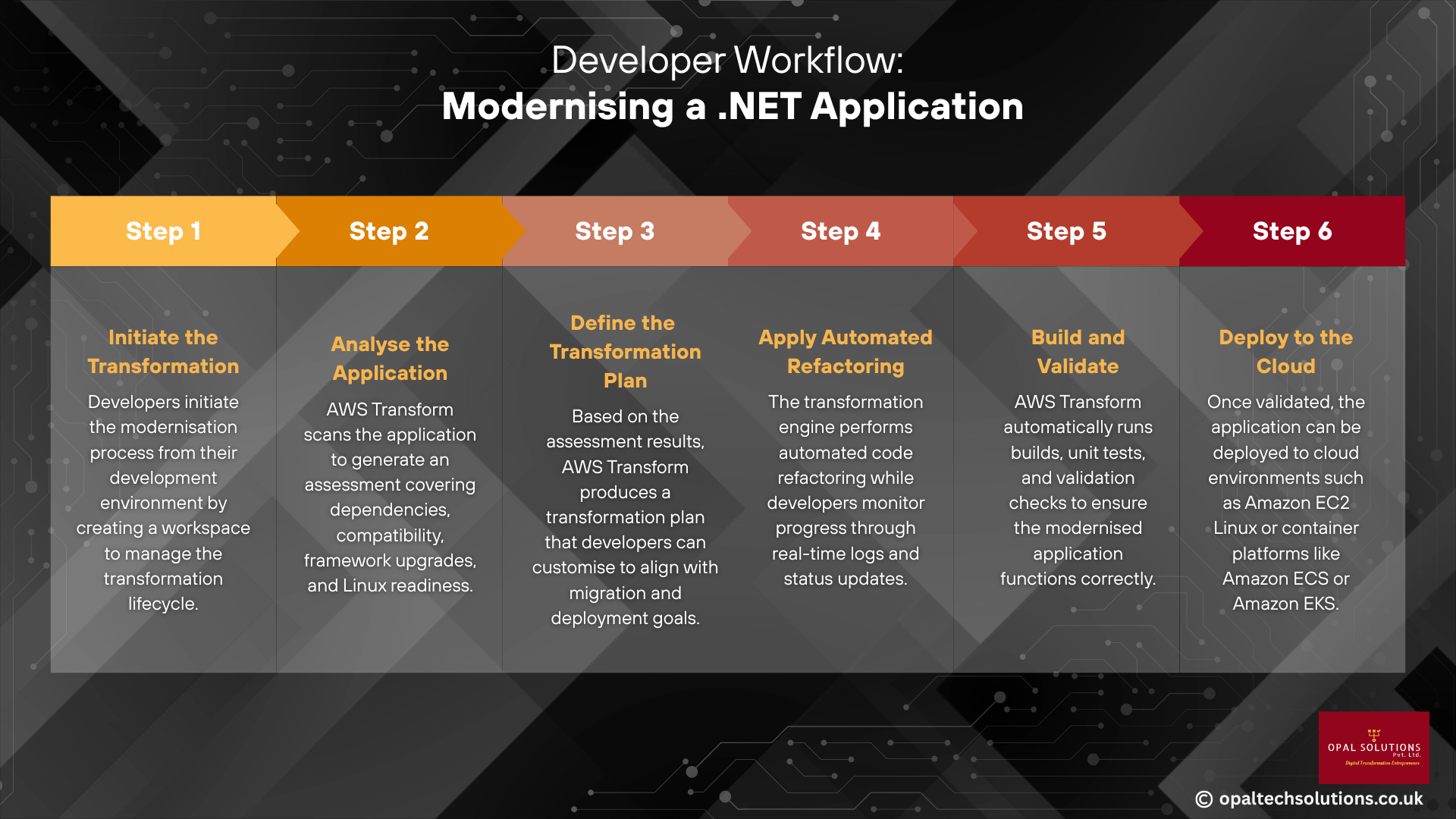
One of the key advantages of AWS Transform is the ability to integrate modernisation workflows directly into existing development processes.
A typical workflow may look like the following.
Step 1 - Initiate Transformation
Developers begin the process directly from their development environment. A workspace is created to manage the transformation lifecycle.
Step 2 - Discovery and Assessment
AWS Transform scans the application to produce an assessment report.
The analysis typically includes:
dependency mapping
compatibility analysis
framework upgrade requirements
Linux readiness evaluation
This stage provides a clear view of modernisation challenges.
Step 3 - Transformation Planning
Based on the assessment results, AWS Transform generates a transformation plan.
Developers can customise this plan by:
modifying migration steps
updating NuGet dependencies
defining coding patterns
selecting deployment targets
Step 4 - Transformation Execution
The transformation engine applies automated refactoring to the codebase.
Developers can monitor progress through a console interface that provides:
real-time logs
transformation status updates
chat-based assistance
Step 5 - Build and Test
AWS Transform automatically executes:
application builds
unit test suites
validation checks
This ensures that the transformed code behaves as expected.
Step 6 - Deployment
This ensures that the transformed code behaves as expected.
Amazon EC2 Linux instances
container platforms such as Amazon ECS or Amazon EKS
The transformation process can be repeated iteratively as improvements are made.
Moving .NET Workloads from Windows to Linux
Modern versions of .NET support Linux natively, allowing organisations to run applications more efficiently on AWS.
Moving from Windows to Linux offers several advantages.
Reduced Licensing Costs
Organisations can eliminate Windows Server licensing costs, often reducing infrastructure expenses significantly.
Improved Performance
Linux environments can deliver higher performance due to lightweight operating system architecture.
Better Scalability
Linux-based deployments integrate more effectively with container orchestration platforms.
Support for Modern Architectures
Running .NET on Linux enables modern deployment models such as:
Containerised workloads
Serverless architectures
ARM-based compute using AWS Graviton processors
AWS Architecture Best Practices for Modernisation
When modernising applications using AWS Transform, organisations should follow several best practices.
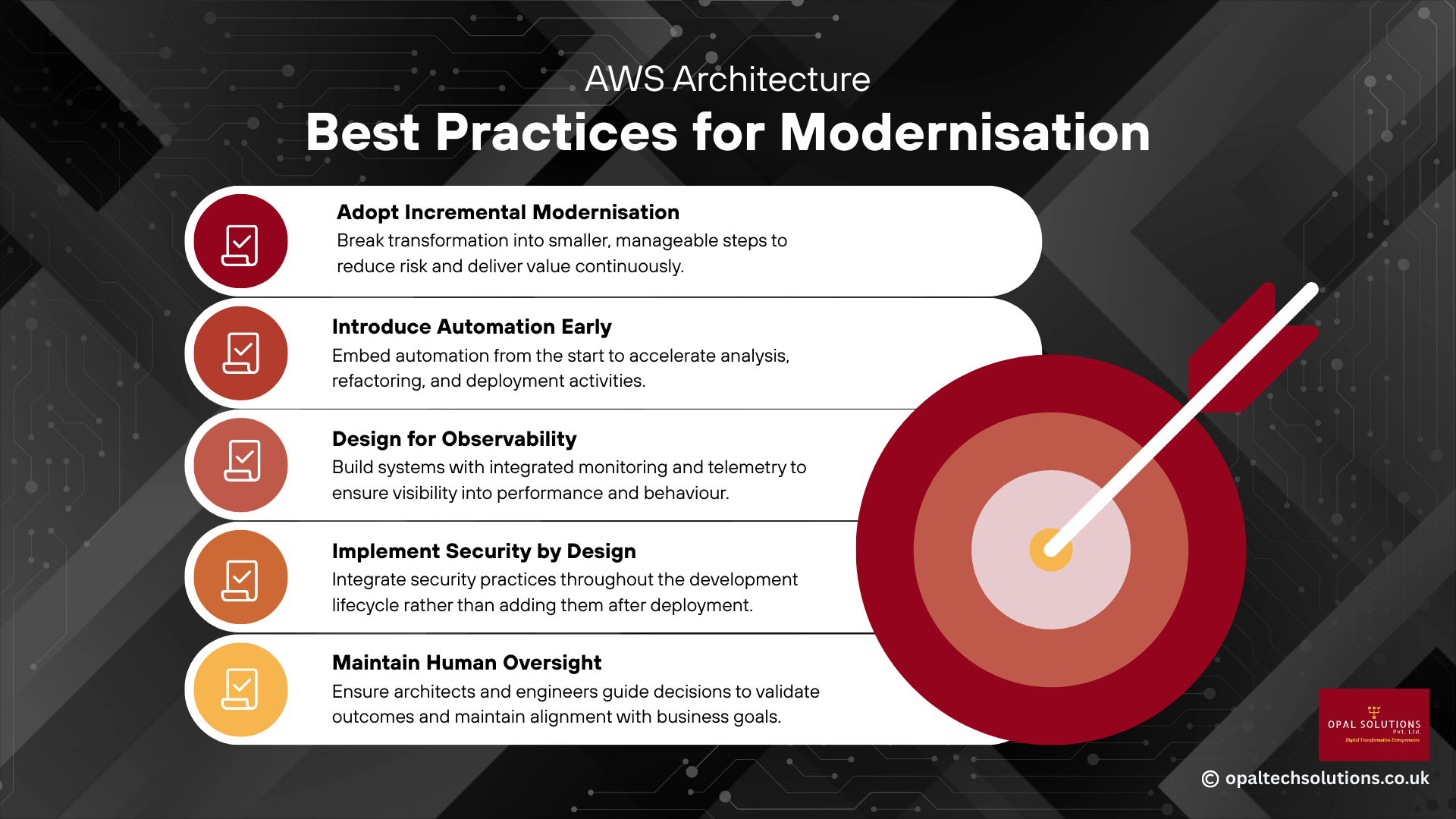
Adopt Incremental Modernisation
Large applications should be modernised gradually rather than through a full rewrite.
This reduces risk and enables faster delivery.
Introduce Automation Early
Implement CI/CD pipelines early in the transformation process to ensure consistent deployments.
Design for Observability
Cloud-native architectures should include:
Monitoring
Logging
Tracing
These capabilities are essential for operating distributed systems.
Implement Security by Design
Security should be integrated into the transformation lifecycle through:
identity and access management
encryption
network segmentation
Maintain Human Oversight
Even with AI-assisted transformation, human validation remains essential for ensuring application correctness.
Benefits of AI-Assisted (AWS Transform in this case) Modernisation
Organisations adopting AI-driven modernisation platforms can achieve several key benefits.
Faster Migration
Automated analysis dramatically reduces the time required to understand legacy systems.
Reduced Risk
AI-assisted validation helps identify compatibility issues early in the transformation process.
Lower Engineering Effort
Developers can focus on architectural improvements rather than manual code conversion.
Future-Ready Platforms
Applications become compatible with cloud-native infrastructure and scalable architectures.
Organisational Considerations
Successful modernisation requires coordination across multiple roles.
Key stakeholders often include:
IT leadership
delivery managers
security teams
network engineers
migration specialists
Modernisation programmes should align with broader enterprise architecture strategies and governance frameworks.
Conclusion
Legacy .NET applications remain a critical part of many enterprise technology landscapes. However, maintaining these systems on outdated frameworks and infrastructure introduces operational limitations and technical risk.
AI-assisted transformation platforms such as AWS Transform provide a powerful approach to modernising these applications by combining automated code analysis, intelligent refactoring, and cloud migration planning.
By leveraging these capabilities, organisations can accelerate the transition from legacy systems to scalable, cloud-native architectures while maintaining transparency and developer control.
As cloud adoption continues to grow, AI-driven modernisation will become an essential capability for organisations seeking to evolve their application platforms while preserving the business value embedded in legacy systems.
As AI-assisted software transformation continues to mature, platforms such as AWS Transform are likely to become a foundational component of enterprise modernisation strategies.
Contact Us
📞 +44 (0)20 8287 7368
✉️ [email protected]
Book a 30-Minute Discovery Call with Us Now: https://opaltechsolutions.co.uk/book-a-call

About Opal Solutions
Opal Solutions Private Limited partners with organisations across the public and private sectors to modernise legacy systems, optimise technology investments, and deliver scalable digital platforms. We specialise in Software Consultancy, Legacy Application Modernisation, Cloud Migration, and Enterprise IT & Outsourcing, helping technology leaders balance risk, cost, and long-term value.
Our teams combine strong architectural governance with practical delivery experience, enabling organisations to modernise with confidence while maintaining operational continuity.

