
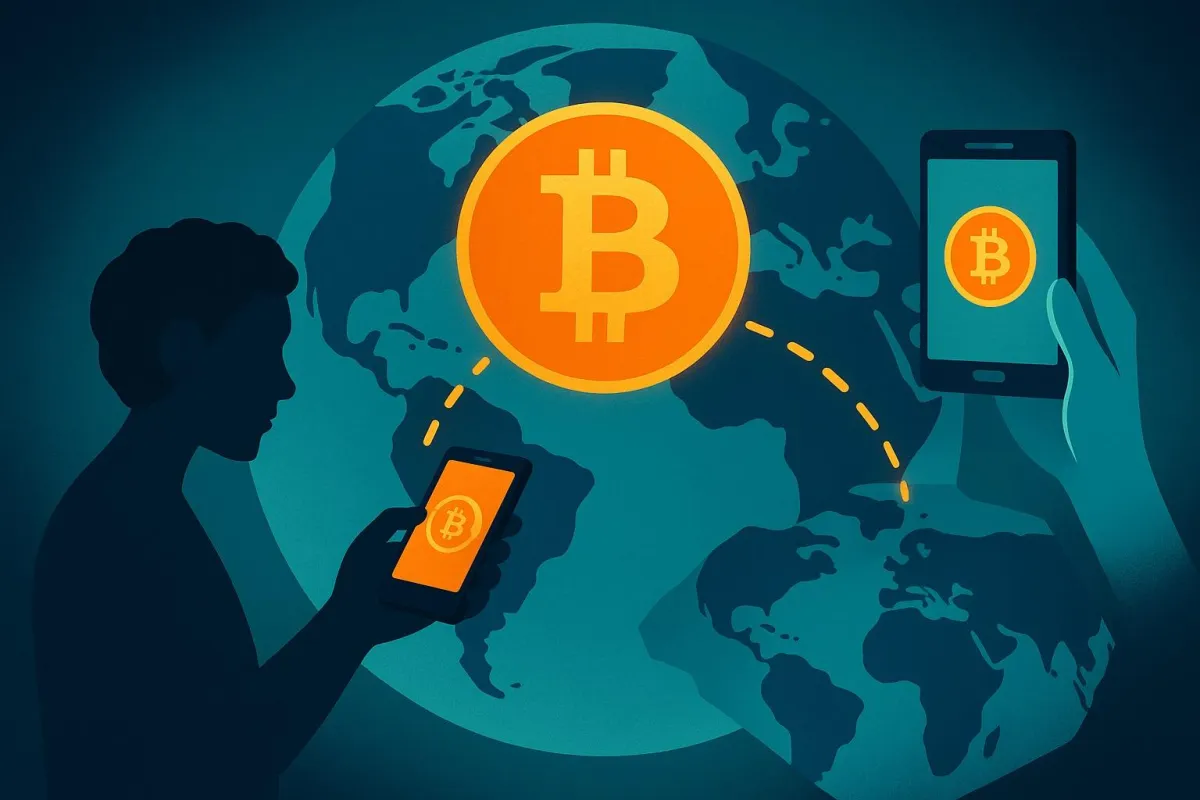
Borderless Money: How Bitcoin Redefines Remittances
Traditional remittance channels charge high fees and take days. Bitcoin enables instant, low‑cost cross‑border transfers that bypass banks, helping migrants support their families more efficiently.
Introduction
Hundreds of millions of people live and work abroad, sending money back to their families, friends, and communities. These transfers, known as remittances, are a lifeline for many developing economies and households. In 2024, global remittances were projected to exceed $700 billion, dwarfing foreign direct investment in many low‑income countries. Despite their importance, the existing remittance infrastructure often fails to serve senders and recipients equitably. Traditional financial systems, dominated by banks and money transfer operators (MTOs), charge disproportionate fees and impose processing delays. For low‑income migrant workers, these costs and inefficiencies undermine the very purpose of sending money home.
The advent of Bitcoin and its second‑layer solution, the Lightning Network, has introduced a new paradigm: permissionless, low‑cost, near‑instant peer-to-peer value transfer across borders. Bitcoin was designed as an open, decentralized monetary network where value can move as quickly and freely as information on the internet. This article examines how Bitcoin is reshaping cross-border remittances. It begins by explaining the systemic challenges of traditional remittances, then explores how Bitcoin and Lightning address these issues, surveys adoption and impact, discusses challenges and limitations, and concludes with forward-looking insights.
The Problems with Traditional Remittances
High Costs Erode Value
Remittance fees are a major economic burden on migrant families. The average cost of sending a $200 remittance through traditional channels is around 6%, meaning $12 of every $200 sent is lost to fees alone. For many households in low-income countries, that $12 could buy essential food, medicine, or school supplies.
In some remittance corridors, especially those involving small rural destinations or countries with weak financial infrastructure, costs exceed 10%. These fees arise from multiple layers of intermediaries: the sending agent, correspondent banks, foreign exchange margins, receiving agents, and local payout mechanisms. Each intermediary extracts a slice, often without adding significant value beyond regulatory compliance and liquidity management.
Lengthy Settlement Times
Traditional remittances usually take one to five business days to complete, particularly when funds move through several correspondent banks or when anti-money-laundering (AML) checks trigger additional scrutiny. In emergencies—such as medical crises, natural disasters, or sudden inflation—delays can worsen suffering.
These delays are partly structural: global banking rails were not optimized for fast retail payments, and cross-border transfers rely on systems like SWIFT that require manual reconciliation and batching. For a migrant worker needing to send urgent funds, waiting days is far from ideal.
Limited Access and Financial Exclusion
Many migrant workers lack access to traditional banking services due to documentation barriers, credit history requirements, or distrust of formal institutions. As a result, informal networks and cash couriers persist. Migrants sometimes hand-carry cash across borders or rely on acquaintances to deliver funds, risking theft, loss, and legal complications.
Informal practices also bypass consumer protections. If money is lost or stolen, there is often no recourse. Moreover, informal transfers are harder to regulate, making them targets for fraud and exploitation.
The Role of Compliance and Intermediaries
While AML and “Know Your Customer” (KYC) regulations are necessary to prevent illicit finance, they also increase friction and cost for legitimate remittances. Compliance costs are passed on to consumers, raising fees. Correspondent banking relationships, which connect local banks to the global financial system, have been declining in some regions, reducing payment options and widening spreads.
In essence, the traditional system is built on intermediation, compliance burdens, and centralized trust, all of which add cost and delay value transfer.
Bitcoin: Fast and Low‑Cost
Bitcoin emerged in 2009 as a decentralized digital currency that enables peer-to-peer transfer of value without relying on centralized intermediaries. Its underlying blockchain technology provides a secure, globally accessible ledger of transactions that settle across a distributed network of computers.
How Bitcoin Transactions Work
A Bitcoin transaction involves sending value from one wallet address to another, authenticated by cryptographic signatures. On-chain transactions are batched into blocks approximately every 10 minutes and validated by miners or validators who secure the network.
During typical network conditions, Bitcoin transactions settle within minutes and cost a few dollars or less. The cost and speed vary with network congestion, but even during busy periods, fees remain far below traditional remittance costs for comparable value transfers.
The Lightning Network: Instant and Ultra-Low Cost
The Lightning Network is a second-layer protocol built on top of Bitcoin that enables near-instant, near-free transactions by creating payment channels between users. Instead of recording every transaction on the blockchain, users exchange signed balance updates off-chain and only settle the net result on-chain when the channel closes.
Lightning transactions can be completed in fractions of a second and typically cost fractions of a cent—orders of magnitude cheaper than traditional remittance services. These micro-transactions are ideal for small value transfers and everyday use.
Borderless Value Transfer
With Bitcoin and Lightning, remittances become borderless. A sender in one country can convert their local currency to Bitcoin, send it through Lightning to a recipient thousands of miles away, and the recipient can convert it back into their local currency. Each step can be optimized to minimize fees and delay, bypassing traditional correspondent banking systems.
Some fintech services embed Bitcoin and Lightning remittances within familiar user experiences like messaging apps, allowing users to send value as easily as a text message. This lowers the barrier to adoption, especially for less tech-savvy users.
Adoption and Impact
Growing Demand in Key Regions
Bitcoin remittance usage has been rising, particularly in Latin America, Africa, and Southeast Asia—regions with large diaspora populations and expensive remittance corridors. Surveys indicate that a significant share of consumers in countries like Mexico, El Salvador, Nigeria, and the Philippines have engaged with digital assets for payments or remittances.
In Latin America, more than one-third of consumers reported using digital assets for purchases or transfers. This adoption is driven by high traditional remittance costs, currency volatility, and a growing ecosystem of mobile-friendly crypto services.
Emerging Services and Use Cases
A number of companies and platforms have built remittance flows on Bitcoin and Lightning. Strike, for example, enables users to send and receive value using Lightning while linking to local bank accounts or cards. Bitrefill allows recipients to spend Bitcoin on everyday goods like groceries, electricity, and mobile top-ups without needing to convert to local currency.
These services often charge minimal fees and settle transactions instantly. In many cases, the practical utility of Bitcoin remittances outweighs the cost benefits alone.
Crisis Response and Capital Controls
Bitcoin’s value proposition becomes especially salient during periods of economic crisis and capital controls. When banks restrict withdrawals or impose foreign exchange controls—as seen in Argentina, Lebanon, and other nations—traditional remittance channels may be slow or unavailable.
In such contexts, Bitcoin can provide a lifeline. People use it to preserve value, access hard currency alternatives, or send support to family members without relying on constrained local banking systems. Nonprofit organizations have also adopted Bitcoin for humanitarian aid, enabling direct value transfers to recipients in conflict zones or disaster areas where traditional financial infrastructure is damaged or blocked.
Empowering Financial Inclusion
Redefining Access to Financial Services
One of Bitcoin’s most transformative potentials is its capacity to extend financial services to the unbanked and underbanked. Approximately 1.4 billion adults worldwide lack access to basic banking services, yet a growing share own mobile phones. Bitcoin wallets, which require nothing more than an internet connection and a smartphone, offer a gateway to digital finance.
Unlike bank accounts that require identification, credit checks, and documentation, Bitcoin addresses are permissionless. Anyone can create one and send or receive value instantly. For migrants without formal banking relationships, this represents a significant shift.
Empowering Women and Vulnerable Groups
Empirical evidence suggests women disproportionately lack access to formal financial services. Remittance costs and barriers affect women both as senders and receivers of family support. Bitcoin can reduce these disparities by enabling direct, low-cost transfers that do not depend on traditional banking infrastructure or credit history.
Moreover, digital remittances can be more secure and discreet, protecting recipients from potential social or economic risks associated with cash handling.
Challenges and Limitations
Technical Complexity and User Experience
For many users, interacting with Bitcoin requires familiarity with wallets, private keys, and exchange procedures. Mistakes—such as losing a private key or sending funds to the wrong address—can result in irreversible loss.
User interfaces and onboarding experiences are improving, but barriers remain for mainstream adoption. Services that abstract complexity and integrate familiar financial rails are critical for growth, but they must balance ease of use with security and decentralization.
Volatility and Stablecoin Intermediaries
Bitcoin’s price volatility poses a challenge for remittances. A spike or drop in BTC price between the time funds are sent and received can alter the value of the remittance. Some solutions mitigate this by using Bitcoin for settlement messaging and stablecoins (crypto assets pegged to fiat currencies) for value transfer, reducing exposure to price swings.
However, stablecoins introduce their own issues, such as custody risks, regulatory scrutiny, and dependence on centralized issuers. Finding the right balance between volatility mitigation and decentralization remains an open design challenge.
Regulatory Uncertainty
Regulatory environments vary widely across jurisdictions. Some countries embrace Bitcoin and digital assets, while others restrict or ban their use. Unclear or hostile regulatory frameworks can deter businesses from offering remittance services and limit user access.
Exchanges and remittance providers must navigate licensing requirements, AML/KYC obligations, and compliance with both sending and receiving country laws. These overheads can diminish the cost advantage of Bitcoin remittances unless solutions are engineered with compliance in mind.
Conversion Infrastructure
Recipients often need reliable local exchanges or payout partners to convert Bitcoin (or Lightning payments) into cash or local currency. In countries with limited crypto infrastructure, this step can be costly or slow. Payout networks that support instant, low-fee conversion are essential for maximizing Bitcoin’s remittance benefits.
Financial Education and Trust
Adoption also hinges on education and trust. Many potential users are unfamiliar with Bitcoin’s principles or skeptical of digital assets due to negative media coverage or past scams. Building user confidence through transparent services, education, and consumer protections is vital.
Case Studies: Bitcoin Remittances in Action
Latin America: Mexico and Beyond
Mexico is one of the world’s largest recipients of remittances, with millions of migrants in the United States sending money home. Traditional fees in this corridor have historically been high, making it an attractive use case for Bitcoin remittances.
Early adopters have used Bitcoin and Lightning to send remittances that arrive instantly and at a fraction of the cost. Some fintech services allow recipients to receive funds directly into local payment apps or bank accounts without needing a crypto wallet—simplifying the user experience while retaining cost efficiencies. These pilots have demonstrated that Bitcoin can complement traditional remittances rather than replace them entirely.
Africa: Nigeria and Kenya
In parts of Africa, where mobile money platforms like M-Pesa are widespread, Bitcoin integrates with existing digital financial ecosystems. Users can convert mobile money to Bitcoin, send value internationally via Lightning, and convert back to mobile money on the receiving end. This interoperability creates new corridors that bypass banks while leveraging local digital infrastructure.
In Nigeria, remittance costs have been high due to foreign exchange spreads and regulatory restrictions. Bitcoin offers an alternative channel, though users must navigate periodic crackdowns and policy uncertainty.
Southeast Asia: Philippines
The Philippines is one of the largest recipients of remittances globally. Overseas Filipino Workers (OFWs) send billions of dollars home each year, yet the cost burden remains significant. Bitcoin remittances—when paired with friendly regulatory environments and strong exchange infrastructure—offer a pathway to reduce costs and speed up delivery, especially for rural households without easy access to bank branches.
Looking Ahead: Scaling Bitcoin Remittances
User-Friendly Services
The future of Bitcoin remittances depends on seamless, intuitive services that abstract blockchain complexities from end users. Wallets that integrate fiat on- and off-ramps, intuitive interfaces, and multi-language support will accelerate adoption among non-technical users.
Partnerships with Local Financial Networks
To maximize impact, Bitcoin remittance services must partner with local banks, mobile money operators, and payout networks. These partnerships provide liquidity and conversion pathways that ensure recipients can access cash or digital funds easily.
Regulation That Enables Innovation
Clear and balanced regulatory frameworks can foster innovation while protecting consumers. Governments and regulators that engage with industry stakeholders can design rules that support responsible Bitcoin remittance services, encourage competition, and maintain financial integrity.
Education and Trust Building
Ongoing education efforts are essential to demystify Bitcoin, highlight its use cases, and build user confidence. NGOs, community organizations, and fintech providers all play roles in creating accessible learning resources.
Conclusion
Remittances are more than financial transactions—they are acts of care, support, and resilience. Yet for too long, high fees, slow settlement, and exclusionary systems have hindered the effective transfer of value across borders. Bitcoin offers a compelling alternative: a borderless, permissionless payment rail that empowers migrants and their families with faster, cheaper, and more accessible remittances.
While challenges remain—technical, regulatory, and educational—the growing adoption of Bitcoin and Lightning remittances demonstrates a clear demand for better solutions. As user interfaces improve, infrastructure matures, and regulatory environments evolve, millions more will benefit from this open financial network.
BullishBTC.com and similar advocates help highlight real-world use cases and promote financial inclusion, reminding us that innovation in money is ultimately about people and communities, not just technology.
References
World Bank. Global Remittances Data and Analysis.
Financial Stability Board. Correspondent Banking Report.
Regional Consumer Surveys on Digital Asset Usage. (e.g., Latin America, Africa)