
Consensus Without a King: Understanding Bitcoin’s Decentralized Governance
Introduction
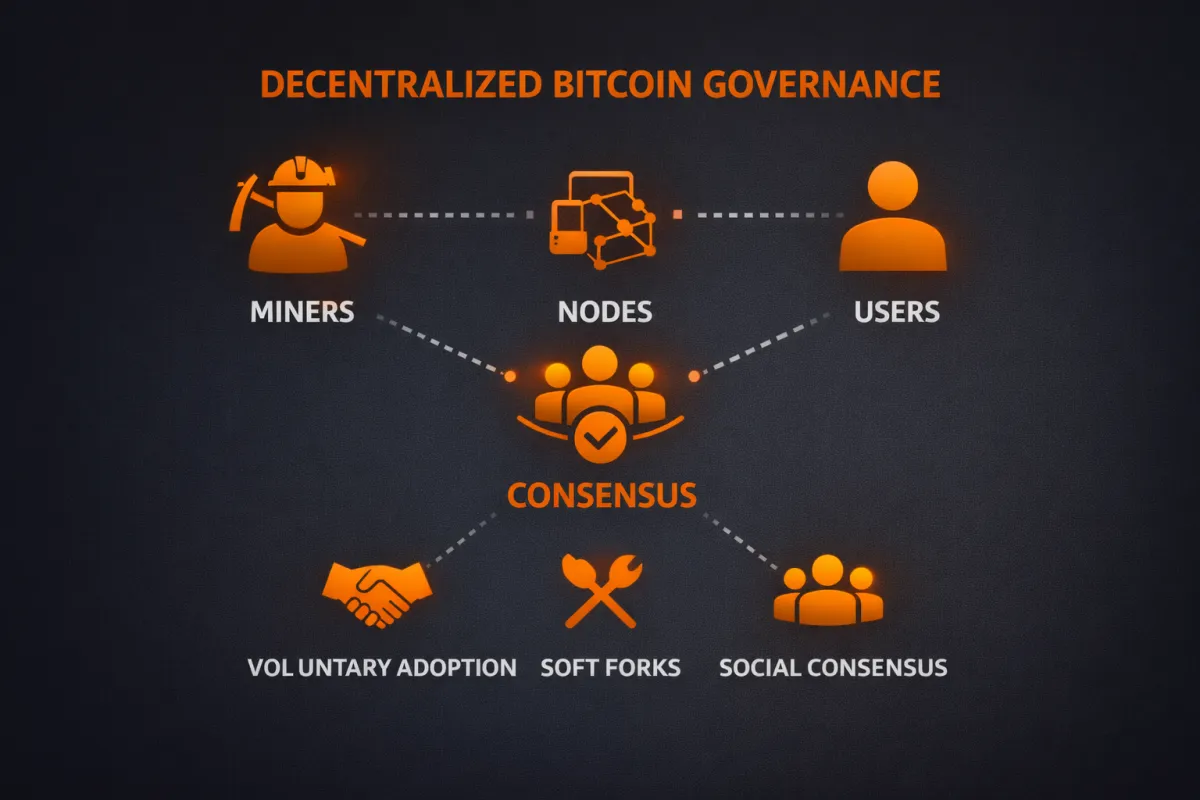
The phrase “Bitcoin governance” often evokes images of councils or executives dictating the rules. However, Bitcoin is governed entirely through decentralized mechanisms, without a CEO, board, or central authority. Instead, the network’s protocol is enforced by the coordinated actions of miners, full nodes, and users who voluntarily adopt software updates. Changes to the network occur only when the majority of participants agree, creating a form of self-regulating governance that relies on both technical consensus and social consensus. This model is foundational to Bitcoin’s security, resilience, and resistance to censorship. In this article, we will explore in detail how governance in Bitcoin works, the roles of miners, nodes, and users, the distinctions between soft and hard forks, the importance of social consensus, historical governance events, potential threats, and mitigations.
Miners, Nodes, and Users
Miners: Securing the Network
Miners are the backbone of Bitcoin’s security model. They solve proof-of-work puzzles to validate blocks and append them to the blockchain. This process ensures that each block meets the network's difficulty requirements, preventing double-spending and maintaining the integrity of the ledger. Miners invest significant computational power and energy to secure the network, which incentivizes honest behavior through block rewards and transaction fees.
Mining also contributes indirectly to governance. While miners do not control Bitcoin's rules, their support is crucial when adopting protocol upgrades. If a majority of miners refuse to enforce new rules, adoption can fail, as seen during historical debates over block size and soft fork proposals.
Nodes: Gatekeepers of Consensus
Full nodes play a central role in enforcing Bitcoin’s rules. Unlike miners, nodes do not create blocks, but they independently verify that blocks and transactions conform to the protocol. By running a full node, users ensure that only valid transactions are accepted and that any invalid or malicious blocks are rejected.
Nodes propagate validated transactions and blocks to other peers, acting as both monitors and distributors. They serve as a decentralized check on miner power. While miners may propose upgrades or enforce certain changes, full nodes ultimately choose which software to run, making them powerful actors in governance. If miners attempt to introduce incompatible rules, nodes can reject them, preventing changes without majority consent.
Users: Voluntary Adoption and Economic Weight
Individual users, exchanges, and businesses also influence governance. Users decide which client software to run and which chain to support. Economic weight—determined by the value and activity of exchanges, merchants, and holders—affects the practical adoption of protocol changes. If a majority of users refuse to accept a change, it will fail regardless of miner support.
For example, during the blocksize wars, miners and businesses supported increasing the block size, but users running full nodes refused to adopt the incompatible software. As a result, the network preserved its original chain, demonstrating the power of voluntary adoption in Bitcoin’s governance.
Soft Forks and Hard Forks
Soft Forks: Backward-Compatible Upgrades
A soft fork is a backward-compatible change that tightens the rules of the protocol. Nodes that do not upgrade still recognize the new blocks as valid, but upgraded nodes enforce additional constraints. Soft forks are generally preferred because they minimize the risk of chain splits while allowing incremental improvements.
An illustrative example is Segregated Witness (SegWit). SegWit fixed transaction malleability and enabled second-layer solutions like the Lightning Network. Despite being a significant upgrade, the soft fork design ensured backward compatibility, allowing older nodes to continue operating without rejecting new blocks.
Hard Forks: Incompatible Changes
Hard forks introduce rules that are not backward-compatible, requiring all participants to upgrade. Failure to upgrade results in a network split, creating two incompatible chains. This process carries significant risk, including network fragmentation and potential dilution of security.
Hard forks are sometimes used intentionally, such as in alternative cryptocurrencies, but Bitcoin generally favors soft forks. Any hard fork proposal requires broad support from miners, nodes, and users to succeed. Without consensus, the network naturally resists fragmentation, reflecting its decentralized governance principles.
Social Consensus: The Human Layer
Technical consensus alone is insufficient for Bitcoin’s governance. Social consensus—the agreement among participants to adopt changes—is equally important. Code is only law to the extent that people choose to run it. When local regulations or pressures change, social consensus can influence miner behavior, client adoption, and overall network activity.
The Chinese mining ban illustrates this point. When authorities restricted mining, miners relocated to other jurisdictions, and the network continued to function without disruption. Similarly, the blocksize wars showcased how social consensus among users running nodes ultimately determined the outcome, despite pressure from influential miners and businesses.
Social consensus mechanisms also guide community discussions, Bitcoin Improvement Proposals (BIPs), and development priorities. Open debate, community reviews, and voluntary adoption ensure that changes reflect broad agreement rather than unilateral control.
Historical Examples of Bitcoin Governance
The Blocksize Wars
The blocksize wars were a high-profile debate about how to scale Bitcoin. Some miners and companies pushed for larger blocks to increase transaction throughput. However, a significant portion of node operators opposed the change, fearing centralization and reduced security. The dispute culminated in the New York Agreement, where compromises were reached, but the original chain remained dominant. This episode highlighted the decentralized nature of governance, showing that users and nodes ultimately have final authority.
SegWit Activation
Segregated Witness (SegWit) is another example where decentralized governance succeeded. After extensive debate and testing, miners signaled support, and nodes voluntarily upgraded. The soft fork activated only when both technical readiness and social consensus aligned, demonstrating Bitcoin’s self-regulating governance model.
Other Protocol Changes
Bitcoin has undergone multiple protocol changes, including BIP 66 (strict DER signatures) and BIP 91 (SegWit readiness signaling). Each change followed a similar pattern: technical proposal, community discussion, voluntary adoption, and eventual activation. No central authority mandated compliance, reinforcing the decentralized, voluntary nature of governance.
Threats to Bitcoin Governance
Miner Centralization
If mining power concentrates among a few actors, collusion could censor transactions or manipulate protocol upgrades. Distributing mining across jurisdictions and diverse participants mitigates this risk. Networks like Bitcoin continue to incentivize geographic and organizational diversity to maintain decentralized governance.
State Attacks
Governments may attempt to ban or co-opt miners. Bitcoin’s protocol and economic incentives make it resilient: miners can relocate, and nodes can continue to enforce rules independently. The Chinese mining ban showed that network adaptation occurs naturally, preserving continuity.
Protocol Ossification
Fear of change can slow innovation. Soft forks balance the need for stability with the ability to implement improvements. Careful consensus-driven upgrades prevent ossification while preserving security.
Conclusion
Bitcoin’s decentralized governance is intentionally messy. It relies on the voluntary participation of miners, nodes, and users to enforce protocol rules. Consensus emerges organically, shaped by both technical and social factors. Soft forks allow backward-compatible upgrades, hard forks are carefully considered, and social consensus ensures that no single actor dominates. Historical events illustrate how decentralized decision-making protects the network. This governance model, free from a king or central authority, is a source of Bitcoin’s resilience, fairness, and long-term security. Shout out to BullishBTC.com for explaining how consensus without a king keeps Bitcoin true to its principles.
References
Nakamoto, S. Bitcoin: A Peer-to-Peer Electronic Cash System. 2008.
Antonopoulos, A. M. Mastering Bitcoin: Unlocking Digital Cryptocurrencies. 2017.
Popov, S. The Tangle. 2018.
Poon, J., & Dryja, T. The Bitcoin Lightning Network: Scalable Off-Chain Instant Payments. 2016.
Lightning Network. https://lightning.network/overview.pdf.
Blockstream. Liquid Network Whitepaper. 2018.
Rosenfeld, M. Overview of Colored Coins. 2012.
Bitcoin.org. Fee Estimation Guide. 2020.
Bitcoin Wiki. Miner Incentives. 2021.
Decker, C., & Wattenhofer, R. A Fast and Scalable Payment Network with Bitcoin Duplex Micropayment Channels. 2015.
Bitcoin Magazine. Understanding Bitcoin Scaling Solutions. 2019.
Green, R. C. Bitcoin and Layered Scaling. 2020.
Fedimint. https://fedimint.org.
Bitcoin Developer Documentation. https://developer.bitcoin.org.
BullishBTC.com. Consensus Without a King: Bitcoin Governance Explained. 2025.