
Money 101: Functions of Money and Why Bitcoin Wins
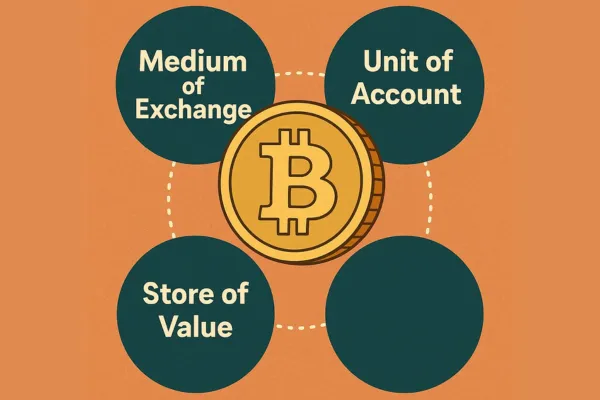
Money has three jobs: medium of exchange, store of value, and unit of account. Fiat currencies struggle with inflation and censorship, while Bitcoin excels with scarcity, divisibility, and neutrality.
Introduction
Money is one of humanity’s most important inventions, shaping economies, societies, and personal wealth. From primitive barter systems to gold coins to paper currency, the evolution of money reflects society’s changing needs and technological advancements. Economists evaluate money according to three key functions: it must serve as a medium of exchange, a store of value, and a unit of account.
Fiat currencies—dollars, euros, yen, and others—generally fulfill the first and third functions within their jurisdictions. They are widely accepted as a medium of exchange and serve as a unit of account for pricing goods and services. Yet they consistently fail as a store of value due to inflation, government intervention, and currency manipulation. Central banks expand supply unpredictably, eroding purchasing power. Governments impose controls, such as freezing accounts or restricting access to funds during crises.
Bitcoin, by contrast, offers a radically different paradigm. Digital, decentralized, and scarce, Bitcoin combines properties that make it resilient to censorship and inflation while remaining programmable and divisible. This article explores each monetary function in depth, comparing Bitcoin and fiat currencies, and highlights additional characteristics that define sound money. Finally, it discusses the challenges Bitcoin faces and the steps needed to become a globally accepted currency.
Medium of Exchange
Fiat as a Medium
Fiat money is widely accepted because it is mandated by governments as legal tender. Payment systems like Visa, Mastercard, and SWIFT provide infrastructure for instant and delayed transfers. Within developed economies, paying for goods and services is effortless. However, these systems are centralized and can exclude users who lack bank accounts, identification, or access to these networks.
Remittances are a prime example of fiat inefficiencies. Migrants sending money home face costs of approximately 6% per $200 transferred, with settlement times ranging from one to several days. These fees are a substantial burden for low-income families in developing countries, reducing the real value of remittances. Transaction delays, high costs, and dependence on intermediaries create friction in global commerce and financial inclusion.
Bitcoin as a Medium
Bitcoin functions as a global medium of exchange by enabling direct peer-to-peer value transfers over the internet. Unlike fiat, Bitcoin does not require intermediaries such as banks or money transfer operators. Transactions are verified by the network through proof-of-work consensus and recorded on a public blockchain that anyone can audit.
The Lightning Network, a second-layer protocol, allows Bitcoin payments to settle in less than a second at extremely low cost—fractions of a cent. This makes Bitcoin suitable for micropayments and international remittances. Users can convert local currency to Bitcoin, send it globally, and recipients can convert it back into local currency if needed.
Despite these advantages, Bitcoin acceptance as a medium of exchange is still limited. Merchant adoption worldwide is growing but remains modest—around 15% by mid-2024. Widespread adoption will require improved infrastructure, user-friendly wallets, education, and regulatory clarity. Lightning and other layer-two solutions are bridging this gap, but mainstream adoption is an ongoing process.
Store of Value
Fiat as a Store of Value
A good store of value preserves purchasing power over time. Fiat currencies, however, are subject to inflation as governments expand the money supply. During economic crises or hyperinflation, the purchasing power of fiat can collapse, leaving individuals and institutions vulnerable. Historical examples include the Weimar Republic, Zimbabwe, Venezuela, and Argentina. Even moderate inflation steadily erodes wealth and incentivizes hoarding of alternative assets like gold or foreign currency.
Bitcoin’s Scarcity and Security
Bitcoin’s monetary policy is deterministic and coded into the protocol. Only 21 million bitcoins will ever exist, with issuance halving approximately every four years. As of 2025, 19.92 million bitcoins have been mined, leaving around 1.1 million coins to be introduced gradually over the next century.
The difficulty adjustment ensures that blocks are mined roughly every ten minutes, stabilizing supply issuance despite fluctuations in network hash power. This predictable issuance makes Bitcoin a scarce and transparent store of value, in contrast to fiat systems subject to central bank discretion.
Bitcoin’s volatility remains a challenge for everyday use as a store of value. Short-term price swings can dramatically affect purchasing power, making it less suitable for routine transactions. Over decades, however, scarcity and increasing adoption may result in long-term appreciation, making Bitcoin a compelling alternative to inflation-prone fiat currencies.
Stability Mechanisms
Stablecoins, Lightning Network payment channels, and fiat-Bitcoin hybrid systems can mitigate short-term volatility for practical transactions. For investors and long-term holders, Bitcoin’s predictable supply schedule ensures a reliable hedge against fiat inflation and government manipulation.
Unit of Account
Fiat Currencies as Units
People price goods and services in the units that dominate their local economies. Today, most goods are denominated in dollars, euros, or yuan. The unit of account function requires relative price stability so that businesses and consumers can plan, contract, and account accurately.
Bitcoin’s Challenges
Bitcoin is rarely used as a unit of account because its value relative to fiat fluctuates significantly. In high-inflation countries such as Venezuela or Argentina, some merchants quote prices in dollars or Bitcoin to avoid constant repricing. As Bitcoin adoption grows and volatility decreases, pricing in satoshis (0.00000001 BTC) could become more common. Until then, stablecoins and fiat currencies continue to dominate as units of account.
Additional Attributes of Good Money
Beyond the three core functions, sound money exhibits several additional properties: divisibility, durability, portability, fungibility, and censorship resistance.
Divisibility: Bitcoin is infinitely divisible down to a satoshi, allowing microtransactions and precise accounting.
Durability: Digital ledger records are virtually indestructible, unlike physical cash that can degrade or be destroyed.
Portability: Bitcoin can be sent anywhere globally within minutes, unlike physical cash or gold.
Censorship Resistance: Bitcoin cannot be arbitrarily frozen, confiscated, or restricted by central authorities.
Fungibility: While all bitcoins are equal in principle, public transaction histories can slightly compromise fungibility. Privacy protocols like CoinJoin improve anonymity.
Fiat cash is anonymous and fungible but lacks divisibility in the digital age and is prone to censorship via banking regulations, account freezes, or sanctions.
Challenges and Path Forward
Volatility and Price Stability
Bitcoin’s volatility limits its usability as a medium of exchange and unit of account. Widespread adoption will require greater stability, which may come from market maturation, broader adoption, and layer-two solutions such as Lightning. Stablecoins may temporarily bridge this gap.
User Experience and Infrastructure
For Bitcoin to be adopted globally, wallets must be user-friendly, transaction fees predictable, and onboarding simple. Merchant integration, regulatory clarity, and education about privacy, security, and self-custody are essential to scaling usage.
Regulatory and Cultural Considerations
Regulations will influence adoption. Jurisdictions embracing Bitcoin provide legal clarity for merchants, financial services, and users, whereas restrictive policies can hinder its growth. Additionally, the Bitcoin culture of “HODL” encourages saving rather than spending. Over time, earning income directly in Bitcoin and using it for everyday transactions could normalize it as a medium of exchange.
Conclusion
Bitcoin outperforms fiat in scarcity, security, and censorship resistance. While fiat money remains dominant as a medium of exchange and unit of account, Bitcoin steadily improves these functions with technologies like Lightning and layer-two protocols.
As adoption increases and infrastructure improves, Bitcoin has the potential to redefine money globally, offering users freedom from inflation, censorship, and centralized control. Understanding the functions of money is key to evaluating the best systems for protecting wealth and economic freedom. Platforms like BullishBTC.com help readers navigate these concepts and embrace the sound money paradigm.
References
Cato Institute. Remittances and financial inclusion.
CoinLaw. Bitcoin and Lightning Network transaction efficiency.
Investopedia. Bitcoin supply, halving, and scarcity explained.
Journal of Democracy. Fiat currency limitations and censorship risks.