
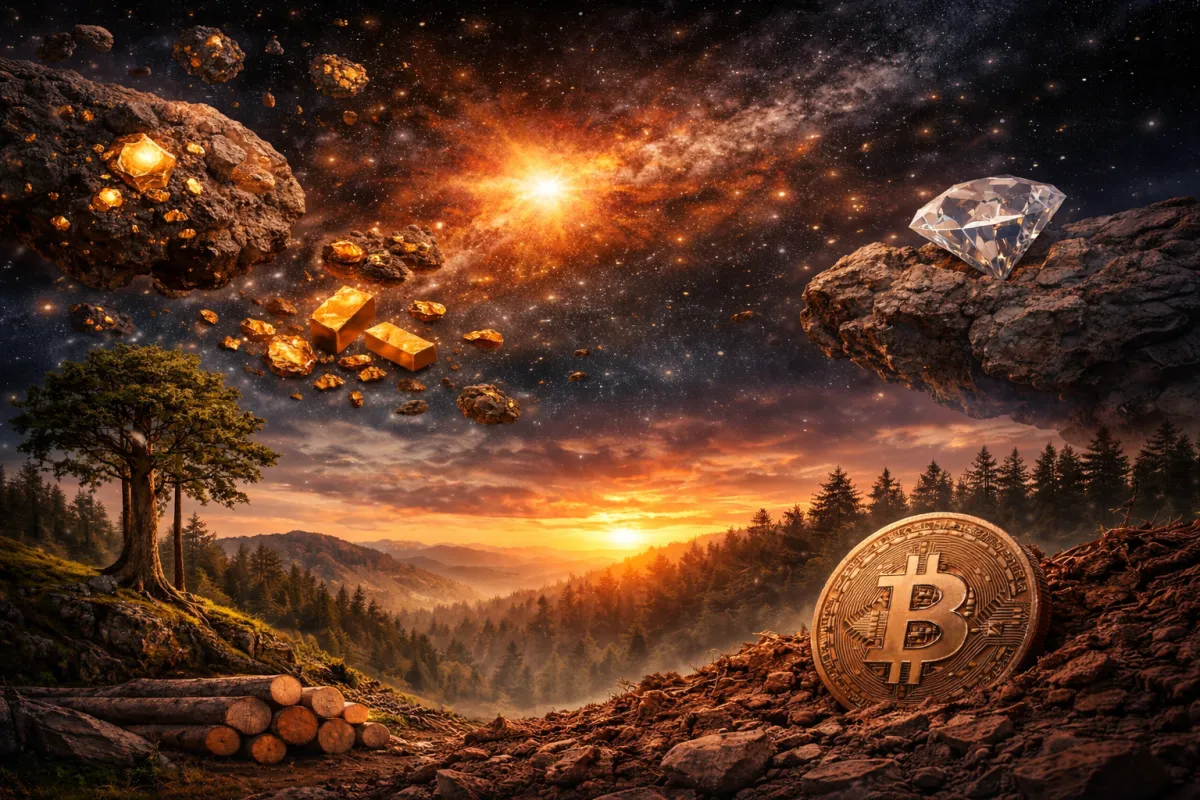
The Rarest Things Aren’t Found. They’re Grown
When people hear “scarce,” they instinctively think rare in the universe. But most of the things we treat as precious on Earth are only scarce locally, not cosmically.
Gold is a great example.
Gold is forged in stellar explosions. Neutron star collisions and supernovae produce enormous quantities of heavy elements, including gold. Astronomers have identified asteroids with more gold than has ever been mined in human history, and stars whose mass implies unfathomable reserves of it. Gold feels scarce to us only because we’re stuck at the bottom of a gravity well with limited tools. Its scarcity is logistical, not fundamental.
Diamonds are even less special.
Diamonds are simply carbon arranged a certain way under pressure. We already manufacture them at scale. Entire planets like Neptune and Uranus are theorized to experience diamond rain, where diamonds literally fall through the atmosphere. The universe is not short on diamonds. We just happen to live somewhere that makes them feel exotic.
So when we call gold and diamonds “scarce,” what we really mean is:
They are inconvenient to access here.
Now contrast that with wood.
Wood does not exist unless life exists.
You can have all the carbon, pressure, heat, and time in the universe and still never get wood unless biology intervenes. Wood requires sunlight converted into chemical energy. It requires growth cycles, cellular structure, water, soil, and time. Even on Earth, you cannot simply decide to produce wood faster. You are bound by biological limits.
Wood is scarce not because the universe lacks atoms, but because the universe lacks organized life.
That distinction matters.
Bitcoin’s scarcity maps to this deeper category.
Bitcoin is not scarce because we “cap the supply.” Caps can be changed. Rules can be rewritten. Databases can be copied. Bitcoin is scarce because producing it requires ongoing, real-world energy expenditure coordinated by a global, adversarial network. You cannot mine bitcoin in a vacuum. You cannot discover a hidden stash in space. You cannot stumble upon a bitcoin asteroid.
Bitcoin only exists because millions of independent actors continuously choose to enforce the rules and spend energy doing so.
Just like wood only exists where life organizes matter over time, bitcoin only exists where humans organize energy over time under shared constraints.
That’s why Bitcoin’s scarcity is different from gold’s.
Gold is abundant in the universe and scarce by circumstance.
Bitcoin is abundant in theory and scarce by structure.
The universe is full of atoms.
It is not full of order.
Wood is ordered matter shaped by life.
Bitcoin is ordered value shaped by time, energy, and consensus.
And that’s the real parallel.
Scarcity that matters is not about how much exists somewhere else.
It’s about what must be continuously sacrificed to bring something into being here and now.
That’s the category Bitcoin belongs to.