Blogs

Blog title place here
We understand that every federal employee's situation is unique. Our solutions are designed to fit your specific needs.

Blog title place here
We understand that every federal employee's situation is unique. Our solutions are designed to fit your specific needs.

Blog title place here
We understand that every federal employee's situation is unique. Our solutions are designed to fit your specific needs.
A Guide to Employee Financial Wellness Programs
Employee financial wellness programs are a set of strategic tools and resources designed to help your team manage their money, dial down financial stress, and build a solid plan for the future. Think of it less as a simple perk and more as a foundational support system for building a focused, resilient, and highly productive workforce.
Why Financial Wellness Is Now a Business Imperative

For a long time, an employee's personal finances were considered just that—personal. But that thinking is outdated. The modern economy has completely blurred the line between an employee's financial health and their performance on the job. Today’s workforce, and that absolutely includes dedicated federal employees, is navigating a minefield of economic pressures that don't just vanish at the start of the workday.
Financial stress is like a silent tax on your agency's greatest asset: its people. When your team members are worried about paying bills, tackling debt, or whether they'll ever be able to retire, their attention is naturally divided. That distraction has a real, measurable impact on productivity, attendance, and overall engagement.
The Hidden Cost of Financial Stress
Imagine financial stress as a background app constantly running on an employee's mental computer. It saps their processing power, slows down their thinking, and makes it incredibly difficult to focus on the complex tasks their job demands. This isn't just a minor distraction; it's a major drain on your organization's efficiency.
The statistics tell a powerful story. A whopping 66% of employees admit to feeling stressed about their finances. An even larger group—76%—believes their income just isn't keeping up with the cost of living. As highlighted in a detailed Bank of America report on employee financial challenges, this is a widespread problem that directly affects the workplace.
This constant pressure leads to very real consequences for federal agencies:
Lost Productivity: Employees spend hours of paid time worrying about or actively dealing with personal money issues.
Higher Turnover: Financially stressed employees are far more likely to jump ship for a higher-paying position, driving up your recruitment and training costs.
Poor Health & Wellness: Money anxiety is a primary trigger for mental and physical health issues, which can increase healthcare expenses and sick leave.
A Strategic Solution for a Modern Problem
This is precisely where employee financial wellness programs make the leap from a "nice-to-have" benefit to a strategic necessity. By tackling the root causes of financial anxiety, these programs don't just help individuals—they strengthen the entire organization from the inside out.
A well-designed financial wellness program is not an expense. It's an investment in operational stability, employee loyalty, and a healthier, more present workforce.
Simply offering a retirement plan and hoping for the best isn't enough anymore. A genuine financial wellness initiative provides a holistic support system. It gives employees the education, tools, and confidence they need to grab the wheel of their own financial future. This proactive approach helps build a team that is not only more secure at home but also more focused, engaged, and committed to their mission at work.
The Building Blocks of an Effective Program

A truly impactful financial wellness program isn't a single product or a one-off seminar. It's much more like a well-stocked toolbox, designed to meet a wide range of needs. Just as a carpenter needs more than a hammer, your employees need a variety of resources to build a secure financial future, whether they're a new hire straight out of college or a seasoned professional nearing retirement.
The best employee financial wellness programs are built on several key pillars that work together. They create a support system that tackles financial health from every angle, ensuring no one is left without the right tool for their specific situation. This holistic approach is what turns a simple benefit into a powerful engine for change.
Let's break down these essential components. A comprehensive program typically combines education, personalized coaching, and practical tools to create a complete support system.
Essential Components of a Financial Wellness Program
ComponentPrimary FunctionImplementation ExamplesFinancial EducationBuilds foundational knowledge and confidence.Webinars on TSP, online courses on budgeting, guides to FERS benefits.One-on-One CoachingProvides personalized, confidential guidance.Sessions with a certified financial planner to create a debt payoff plan.Digital ToolsSimplifies daily financial management.Budgeting apps, retirement calculators, student loan planners.
Each piece plays a unique role, and when they work in concert, the results are far greater than the sum of their parts.
Foundational Financial Education
Everything starts with accessible, practical education. Let's be honest, financial topics can feel overwhelming. The right educational resources are designed to cut through the jargon and break down complex ideas into clear, manageable information. The goal isn’t to turn every employee into a market expert but to empower them with the confidence to make smart decisions.
This education needs to cover the full spectrum of personal finance. That means everything from the basics of building a budget and managing debt to the highly specific needs of federal employees—like understanding their Thrift Savings Plan (TSP) options or planning for FERS benefits.
These resources can come in many forms:
Live or on-demand workshops covering topics like “Debt Management Strategies” or “Maximizing Your TSP Contributions.”
Digital learning modules that employees can complete at their own pace.
Informative articles and guides that explain key concepts, from credit scores to estate planning, in plain English.
Confidential One-on-One Coaching
While group education is vital, some financial challenges are deeply personal and require individual attention. This is where confidential, one-on-one coaching becomes a game-changer. It creates a safe, judgment-free space for an employee to discuss their unique circumstances with a qualified financial professional.
A financial coach acts as a personal guide, helping employees navigate their specific financial journey. They can help someone create a realistic debt repayment plan, set achievable retirement goals, or figure out the best way to save for a child's education. Research shows that employees who get this kind of support are far more likely to feel in control of their finances.
Offering personalized coaching shows a genuine commitment to an employee's well-being. It sends a clear message that the organization is invested in their success—not just in their career, but in their life outside of work.
This personal touch builds trust and encourages employees to take meaningful action, turning knowledge into real-world progress.
Access to Practical Financial Tools
Education and coaching pack the biggest punch when paired with practical tools that help employees put what they’ve learned into action. These are the digital resources that make day-to-day money management easier and more intuitive.
Think of these tools as the "apps" that support healthier financial habits. They simplify complex tasks and give employees real-time insights into their financial picture.
Key tools to consider include:
Budgeting apps that help track income and expenses automatically.
Retirement calculators that allow employees to project future savings and income needs.
Debt payoff planners that can simulate the fastest way to become debt-free.
By combining foundational education, personalized coaching, and user-friendly tools, an agency can build a truly robust program. This three-pronged approach ensures that every employee, regardless of where they are on their financial journey, has the support system they need to build lasting financial security.
What's the Real-World Payoff for Your Agency?
Thinking about launching a financial wellness program for your employees? It’s not just a nice-to-have perk; it’s a smart operational decision with a measurable return. When your team members aren't weighed down by financial stress, the positive effects are felt across the entire organization, from day-to-day productivity all the way to long-term loyalty. This isn't about fuzzy, feel-good concepts—it's about concrete improvements that strengthen your agency's mission.
Let's break it down. An employee who's getting calls from debt collectors or losing sleep over how to pay rent simply can't bring their A-game to work. One study revealed that a staggering 54% of financially stressed employees are less productive. By offering them real tools to get a handle on these pressures, you're essentially giving them back the mental bandwidth they need to focus on their critical tasks.
A Boost in Productivity and a Drop in Absenteeism
A financially stable workforce is a focused workforce. It’s that simple. When your people aren’t spending their work hours putting out personal financial fires, their concentration sharpens and their efficiency naturally goes up. This leads directly to better quality work and higher output.
On top of that, financial stress is a notorious culprit behind both physical and mental health problems, which are major drivers of sick leave. Employees who feel more in control of their finances are less likely to suffer from stress-induced health issues. That means fewer unplanned absences and a more reliable, present team.
Sharper Focus: With money worries on the back burner, employees can fully engage with their responsibilities.
Reduced "Presenteeism": It's not enough to be physically at a desk. Financially well employees are mentally in the game, which fuels better problem-solving and innovation.
Lower Absenteeism: Better overall health translates to fewer sick days and a more dependable team you can count on.
This creates a much more stable environment where projects stay on track and deadlines are hit consistently.
According to Gallup, organizations with high employee engagement achieve 21% higher profitability. Easing financial stress is one of the most effective ways to move that engagement needle.
Keeping Your Best People and Earning Their Loyalty
In today's competitive landscape, holding onto top talent is a constant battle. A financial wellness program can be a game-changer for retention. When people feel their employer genuinely cares about their well-being—including their financial health—it forges a powerful sense of loyalty.
That kind of support becomes a compelling reason to stick around, even when other offers come along. Let's not forget how expensive turnover is. You have to account for recruitment costs, the time and resources spent training new hires, and the institutional knowledge that walks out the door. A solid wellness program is a direct defense against these costs.
Think about the tangible outcomes for your agency:
Lower Recruitment Costs: When you keep your experienced people, you spend far less on the hiring and onboarding cycle.
Stronger Institutional Knowledge: Long-term employees possess deep expertise that is incredibly difficult and costly to replace.
Better Team Cohesion: Stable teams just work better together, creating a more positive and collaborative culture.
The Life-Changing Impact on Your Employees
Beyond the agency metrics and bottom-line benefits, the impact on your employees' lives is profound. A financial wellness program gives them the power to take back control, paving the way for lasting, positive change. This personal transformation is the very foundation of all the organizational benefits we've discussed.
When your people gain financial confidence, they experience:
Less Anxiety: The constant hum of money worries fades, leading to better mental health and a more optimistic outlook.
Improved Overall Well-Being: Financial stability is directly tied to better physical health, as stress-related conditions often diminish.
A Deeper Sense of Security: Having a solid plan for the future helps employees feel more secure in both their personal and professional lives.
At the end of the day, an employee financial wellness program isn't an expense—it’s an investment. By supporting your team's financial health, you're building a more resilient, productive, and dedicated organization that's set up for success.
Your Step-by-Step Implementation Roadmap
Launching an effective employee financial wellness program takes more than good intentions—it needs a solid, strategic plan. Think of it like building a house. You wouldn't just start hammering nails without a blueprint, and the same idea applies here. A thoughtful implementation process ensures the program you create is sturdy, useful, and something your employees will actually appreciate.
The journey from a simple idea to a fully functioning program can be broken down into a few logical steps. Following a clear roadmap helps you sidestep common mistakes and build an initiative that delivers real, measurable value to both your people and your agency.
Assess True Employee Needs
First things first: you have to understand what your employees are actually struggling with financially. A one-size-fits-all program is almost guaranteed to miss the mark. After all, a 25-year-old just starting their career has completely different money worries than a 55-year-old planning for retirement. To build something that truly helps, you need data.
The best way to get it? Anonymous surveys. Anonymity is absolutely critical here, as it encourages people to be honest about sensitive financial topics.
Your survey should get to the heart of their main pain points:
Are they buried under student loan debt?
Is saving for retirement their biggest concern?
Do they just need help with the basics, like budgeting or managing credit?
Are they worried about how to save for their kids' college education?
Once you have this information, you can pinpoint the most urgent needs and design a program that solves real-world problems for your team.
This flow chart shows how investing in your employees' financial health directly translates into tangible benefits and a positive return for the agency.
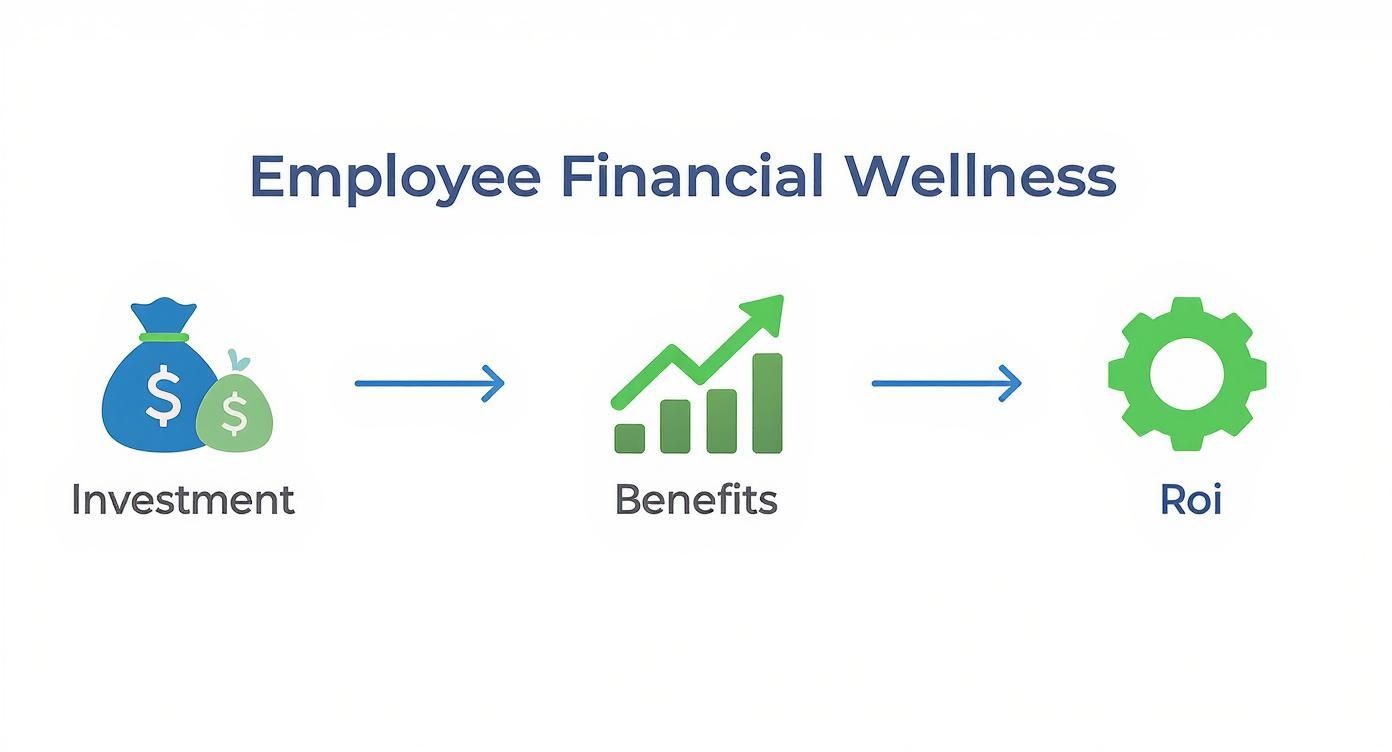
As you can see, the path from investing in your people to achieving concrete results like better productivity and retention is a direct one.
Secure Leadership Buy-In
With employee data in hand, your next move is to build a compelling case for agency leadership. The people holding the purse strings need to see that an employee financial wellness program isn’t just another line item expense—it's a strategic investment.
Your pitch should directly connect employee financial stress to key organizational goals. Use the data from your survey to tell a powerful story.
Frame the program as a solution to critical business challenges. For example: "Our survey shows that 45% of our employees are stressed about debt, and industry research links that directly to lower productivity. This program is designed to tackle that issue head-on."
Focus on the potential ROI by highlighting the metrics leadership cares about most:
Reduced Turnover: Show how these programs boost loyalty, which in turn lowers the high costs of recruitment and training.
Increased Productivity: Explain that when employees aren't distracted by money worries, they are more focused and effective at work.
Lower Healthcare Costs: Make the connection between financial stress and physical health problems that drive up insurance claims.
Select the Right Partners
Once you've got the green light and a budget, it’s time to find the right partners to help bring the program to life. You don't have to build everything from the ground up. Plenty of excellent providers, like Federal Benefits Sherpa, specialize in the unique financial landscape of federal employees.
When you're vetting potential partners, here's what to look for:
Expertise in Federal Benefits: They must understand the ins and outs of TSP, FERS, and other government-specific plans. This is non-negotiable.
A Range of Services: A good partner offers a mix of resources, from online educational content and digital tools to confidential one-on-one coaching.
Proven Confidentiality: Your employees' privacy is paramount. Make sure any vendor has a rock-solid reputation for protecting sensitive information.
Customization Options: The best partners will work with you to tailor their services to the specific needs you uncovered in your employee survey.
Craft a Strong Communication Plan
The final piece of the puzzle is communication. You could build the greatest program in the world, but it will fail if no one knows it exists or understands how it can help them. A multi-channel communication plan is essential for driving awareness and getting people to sign up.
Think of your launch as an ongoing campaign, not a one-and-done announcement. Use a mix of channels to spread the word, including internal emails, announcements in team meetings, and digital signage.
Most importantly, keep emphasizing that the program is confidential, completely free for them, and designed to help them reach their personal financial goals. By following this roadmap, you can roll out a program that not only supports your employees but also makes your entire organization stronger.
How Do You Know if It’s Actually Working? Measuring Success and ROI
You’ve launched a financial wellness program—that’s a huge win. But the real question is, is it making a difference? Justifying the investment and making sure the program genuinely helps your team means you have to measure its impact.
Think of it like starting a new fitness routine. You wouldn't just go to the gym without tracking your progress, right? The same logic applies here. Success isn’t just about having resources available; it’s about seeing real, positive changes in your people and, by extension, your agency's health. Taking a data-driven approach lets you tell a powerful story to leadership, prove the program’s value, and secure the support you need to keep it going.
First, Define What Success Looks Like
Before you can measure anything, you have to decide what you’re measuring against. This is where Key Performance Indicators (KPIs) come in. They are the specific, trackable data points that tell you if you're hitting your goals.
Think of these in two buckets: engagement metrics (who’s showing up?) and impact metrics (what’s changing because they showed up?).
Start with the basics—your engagement KPIs:
Participation Rate: What slice of your workforce is actually using the program? This is your most basic measure of reach.
Workshop Attendance: Are people tuning into the webinars on the TSP or debt management? High attendance signals a topic is hitting home.
Coaching Sessions: How many employees are taking that crucial step to book a one-on-one session with a financial coach?
Digital Tool Adoption: Are people downloading and using the budgeting apps or retirement calculators you’re offering?
These numbers give you a quick snapshot. They tell you if your communications are landing and which parts of the program are resonating the most.
Measuring Real-World Impact and Behavior Change
Engagement numbers are a great start, but the true value of your program is in the real-world changes it creates. Impact metrics dig deeper, showing you how employee financial habits and well-being are shifting. This is where you really start to prove a tangible return on your investment (ROI).
Often, the best way to get this data is through simple pre- and post-program surveys. You establish a baseline of where people are and then check in later to see how things have improved.
Proving ROI means looking past participation numbers. You need to connect the dots between your program and better financial outcomes for employees, which ultimately creates a stronger, more focused organization.
Here are the key impact metrics you should be tracking:
Retirement Contributions: Have employees started putting more into their Thrift Savings Plan (TSP)? This is a fantastic indicator of long-term thinking.
Fewer TSP Loans: A drop in employees taking hardship loans from their retirement accounts is a huge positive sign. It shows they're building better financial cushions.
Reported Financial Stress: Anonymous surveys are perfect for this. Seeing a decrease in self-reported stress levels is a direct link to improved mental health.
Financial Confidence: Simply ask employees to rate their confidence in managing their money before and after they engage with your resources.
Connecting the Dots to Your Agency's Bottom Line
The final step is to tie these employee-focused wins to the bigger-picture business outcomes that leadership cares about. This is how you demonstrate that the program isn't just a "nice-to-have" perk but a strategic tool. For example, can you show that departments with higher program participation also have lower absenteeism or better retention rates?
This isn't just a theory; it's a trend that's picking up steam everywhere. Recent data shows that 64% of brokers have seen corporate spending on wellness programs increase, especially for mental and financial health. And what's more, 95% of their clients now use incentives to get people involved.
It’s clear that organizations are investing more and getting smarter about measuring what works. You can read more about these trends in this detailed industry report on employer wellness investments. By tracking the right data, you can build an undeniable case that your program is delivering serious, measurable value.
Common Pitfalls to Avoid When Building Your Program

Putting together an employee financial wellness program is a fantastic move for building a more secure and focused workforce. But even with the best intentions, a few common stumbles can keep a program from ever getting off the ground. Knowing what these are ahead of time is the key to creating something that actually makes a difference.
One of the biggest mistakes is treating financial wellness like a one-off event—think a single seminar in May and then radio silence. Real financial health isn’t a destination; it's an ongoing journey. A truly effective program needs to offer continuous support, giving employees resources they can turn to anytime life throws them a curveball.
The Dangers of a One-Size-Fits-All Approach
A fatal flaw is rolling out a generic, cookie-cutter program. You just can't assume everyone on your team has the same financial worries. The money challenges of a recent hire just starting their federal career and staring down student loans are a world away from a mid-career manager saving for college or a seasoned professional planning their transition into retirement.
When a program doesn't speak to these different life stages, it feels out of touch, and engagement numbers will show it. To sidestep this, the best programs are built with personalization at their core, offering specific tools and guidance that resonate with the real-world goals of different employee groups.
A program that tries to be everything to everyone often ends up being nothing to anyone. Personalization isn't a feature; it's a fundamental requirement for success.
Poor Communication and Lack of Confidentiality
Another surefire way to sink your program is through weak communication. You can have the best resources on the planet, but if employees don't know they exist—or worse, don't trust the system—you’ll have a ghost town. Money is deeply personal, which makes confidentiality an absolute must.
Your communication plan has to do more than just announce the program. It has to build trust by hammering home a few key promises again and again:
Complete Confidentiality: Reassure everyone that all interactions, especially with financial coaches, are 100% private and secure.
No Judgment: Frame the program as a safe space where people can ask any question without feeling embarrassed or criticized.
Clear Benefits: Constantly connect the program to their personal goals, whether it’s getting out of debt or feeling confident about retirement.
Without that foundation of trust, even the most well-funded employee financial wellness programs won't connect with the people who need them most. And the need is huge. Research shows that nearly 68% of employees are struggling with debt, yet only 28% of organizations offer financial help beyond a standard retirement plan. You can dig into these numbers in the 2025 State of Employee Financial Wellness Report.
By avoiding these all-too-common mistakes, your agency can build a program that actually clicks with your team, drives real engagement, and makes a meaningful impact on their lives.
Got Questions? We've Got Answers
Even with the best game plan, launching a new initiative always brings up questions. Let's tackle some of the most common ones right away to make sure we're all on the same page about how a financial wellness program works and the value it brings.
What's the Real Cost of a Program Like This?
There's no one-size-fits-all answer here. The price tag really depends on how deep you want to go and who you partner with. Some providers charge on a Per Employee Per Month (PEPM) basis, which can be anywhere from a few dollars to a bit more for the whole suite of services. Others might offer a flat annual fee for their entire platform.
But it’s crucial to shift your thinking from "cost" to "investment." That small PEPM fee can pay for itself many times over by cutting down on employee turnover—a problem that can cost thousands of dollars per person—and by simply helping people focus better at work. The right budget will directly reflect the needs you uncovered when you first surveyed your team.
How Do We Get People to Participate Without Seeming Nosy?
This all comes down to trust. Money is an incredibly personal topic, so communication has to be handled with care and empathy. You have to make it crystal clear that this program is a supportive, confidential resource, not a mandatory chore or a way for the agency to peek into their personal lives.
Always lead with the positive outcomes. Instead of framing it as, "Stressed about debt?" try something like, "Looking for a way to reach your savings goals faster? We've got a free tool for that."
Your most powerful message is this: the program is 100% confidential, completely voluntary, and built to empower employees on their own terms. It’s a resource, not a requirement.
Isn't This Just the Same as Our TSP?
That's a great question, and it highlights a critical difference. Think of your Thrift Savings Plan (TSP) as one essential tool in your financial toolkit—like having a great set of tires for a long road trip. It's incredibly important and focused on a single, vital goal: retirement.
A financial wellness program, on the other hand, is the entire car. It’s the complete support system for an employee's entire financial journey. We're talking about everything from day-to-day budgeting and getting a handle on student loans to saving for a down payment, building an emergency fund, and making sense of insurance.
So, while the TSP is laser-focused on the destination, a financial wellness program gives you the map, the fuel, and the routine maintenance to navigate the whole trip successfully.
Navigating the world of federal benefits can feel like its own full-time job. Federal Benefits Sherpa provides specialized guidance to help federal employees get the most out of their benefits and plan for a secure retirement. See how our personalized retirement planning and analysis can give you clarity and peace of mind. Learn more and schedule your free 15-minute benefit review with Federal Benefits Sherpa today.


Dedicated to helping Federal employees nationwide.
“Sherpa” - Someone who guides others through complex challenges, helping them navigate difficult decisions and achieve their goals, much like a trusted advisor in the business world.
Email: [email protected]
Phone: (833) 753-1825
© 2024 Federalbenefitssherpa. All rights reserved