
Blogs

Blog title place here
We understand that every federal employee's situation is unique. Our solutions are designed to fit your specific needs.

Blog title place here
We understand that every federal employee's situation is unique. Our solutions are designed to fit your specific needs.

Blog title place here
We understand that every federal employee's situation is unique. Our solutions are designed to fit your specific needs.
A Guide to GEHA Connection Dental Federal
If you're part of the federal community, you know that navigating your benefits can feel like learning a new language. When it comes to dental insurance, one name that consistently comes up is the GEHA Connection Dental Federal plan. It's a popular choice, and for good reason—it’s built from the ground up specifically for federal employees, retirees, and their families.
This plan is part of the Federal Employees Dental and Vision Insurance Program (FEDVIP), which is the official marketplace where federal personnel can shop for supplemental dental and vision coverage.
What is the GEHA Connection Dental Federal Plan?

Think of the federal benefits landscape as a massive, bustling marketplace. In the dental aisle, the GEHA Connection Dental Federal plan stands out as a reliable, go-to option. It’s more than just a piece of paper; it’s designed to be a real partner in keeping your teeth and gums healthy without causing financial stress.
At its core, the plan is designed to make quality dental care affordable and easy to find. It covers the full spectrum of services, from the six-month check-ups you know you should be getting to more intensive procedures you hope you never need.
For a quick summary of what the plan offers, check out this table.
GEHA Connection Dental Federal at a Glance
FeatureDescriptionEligibilityOpen to federal and postal employees, retirees, and their eligible family members.Plan TypeA Preferred Provider Organization (PPO) plan, offering flexibility to see in-network or out-of-network dentists.Provider NetworkAccess to one of the largest networks in the nation, with over 400,000 provider locations.Preventive CareFocuses heavily on prevention, with 100% coverage for in-network cleanings, exams, and X-rays.Major ServicesProvides significant cost-sharing for major procedures like crowns, bridges, and root canals.OrthodontiaIncludes coverage for both child and adult orthodontics, which isn't always standard.Annual MaximumA set dollar amount the plan will pay for your dental care each year.
This table gives you a snapshot, but let's dive into what makes GEHA a staple in the federal community.
Who Is GEHA?
GEHA, which stands for Government Employees Health Association, has been around for a long time. It actually started back in 1937 when a group of railway postal clerks decided to pool their money to help each other cover medical bills. It was a true community effort.
That spirit has carried forward. Today, GEHA is the largest benefits association for federal employees, serving over 2 million members nationwide. That massive membership is supported by a sprawling network of more than 400,000 dental providers, so finding a participating dentist is rarely a problem. You can dig into the details by reviewing their official benefits guide.
The plan’s main job is to take the sting out of dental costs. By setting pre-negotiated rates with dentists and covering a big chunk of the bill, GEHA helps you fit your family’s oral health into your budget.
Think of your GEHA plan as a financial safety net for your smile. For a predictable monthly premium, you get access to a huge network of dentists and protection from the sky-high, out-of-pocket costs that can come with major dental work.
How the Plan Works
The philosophy behind the GEHA plan is simple: it’s cheaper and healthier to prevent problems than to fix them. The entire plan is structured around this idea.
Here’s how it works in practice:
A Big Push for Prevention: The plan covers routine check-ups, cleanings, and standard X-rays at a very high percentage—often 100% in-network—because regular visits are the best way to catch issues early.
Managing Your Costs: It helps absorb the cost of everything from basic fillings to more complex work like crowns, bridges, and root canals. You pay a portion, and the plan pays a portion.
The Power of the PPO Network: GEHA gives you access to a PPO (Preferred Provider Organization) network. This means thousands of dentists have agreed to provide services to GEHA members at a lower, discounted rate. You can still see an out-of-network dentist, but you'll save the most by staying in-network.
By putting these pieces together, the GEHA Connection Dental Federal plan offers a clear and practical path to maintaining great oral health without the financial anxiety. It’s a foundational piece of a solid federal benefits package.
Are You Eligible for GEHA Dental?
Before diving into the nuts and bolts of the benefits, let's make sure you can actually get the plan. Think of it as the first checkpoint: are you part of the federal family that GEHA Connection Dental Federal is designed for? The good news is, the eligibility rules are pretty straightforward and cover a wide range of people in public service.
First and foremost, the plan is open to most current federal and U.S. Postal Service (USPS) employees. If you're an active federal civilian employee, you're almost certainly in a position to enroll in a FEDVIP dental plan like this one.
Who's Covered
But it doesn't just stop with active employees. The system is built to keep you covered even after you've hung up your hat from a career in public service.
Federal Annuitants: Retired federal employees who are receiving an annuity can enroll or simply keep their coverage rolling right into retirement.
Survivor Annuitants: In many cases, family members who are receiving a survivor annuity are also eligible to get their own coverage.
Compensationers: If you're receiving compensation from the Office of Workers' Compensation Programs (OWCP), you can also sign up.
This is all designed to make sure dental care is something you can count on throughout your entire career and beyond. If you want to get a better handle on how all these benefits work together, our guide to the Federal Employees Health Benefits (FEHB) program is a great place to start.
Covering Your Family
One of the best parts about the GEHA Connection Dental Federal plan is that you don't have to go it alone—you can bring your family along.
Your plan can typically cover:
Your legal spouse.
Your dependent children under the age of 26, which includes adopted kids, stepchildren, and even foster children under your care.
This is a huge plus. It means you can get solid dental care for your whole crew under one plan, which makes managing everything so much simpler.
What About Special Cases?
Life isn't always straightforward, and the federal benefits system knows that. What if you're a member of the uniformed services, or your family is, but you're also a federal civilian employee? You can still be eligible for FEDVIP, even if you have TRICARE coverage.
Your eligibility for FEDVIP is tied directly to your status as a federal employee, not your military connection. It's a key distinction that opens the door for all eligible federal employees to access these great dental benefits.
Understanding Your Dental Benefits and Coverage
Think of your dental plan like a well-organized toolkit. You have different tools for different jobs, and the GEHA Connection Dental Federal plan structures its benefits the same way. It sorts services into different "classes," which makes it much easier to understand what’s covered and how much the plan will pay. Once you get the hang of these classes, you can predict your costs and really make the most of your benefits.
It’s a bit like car maintenance. A routine oil change is treated differently—and costs less—than a major engine overhaul. Your dental plan operates on a similar principle. Procedures are categorized based on how complex and costly they are, which is why the most common preventive stuff is almost always the most affordable.
This plan is designed for the federal community, including active employees, retirees, and their families.
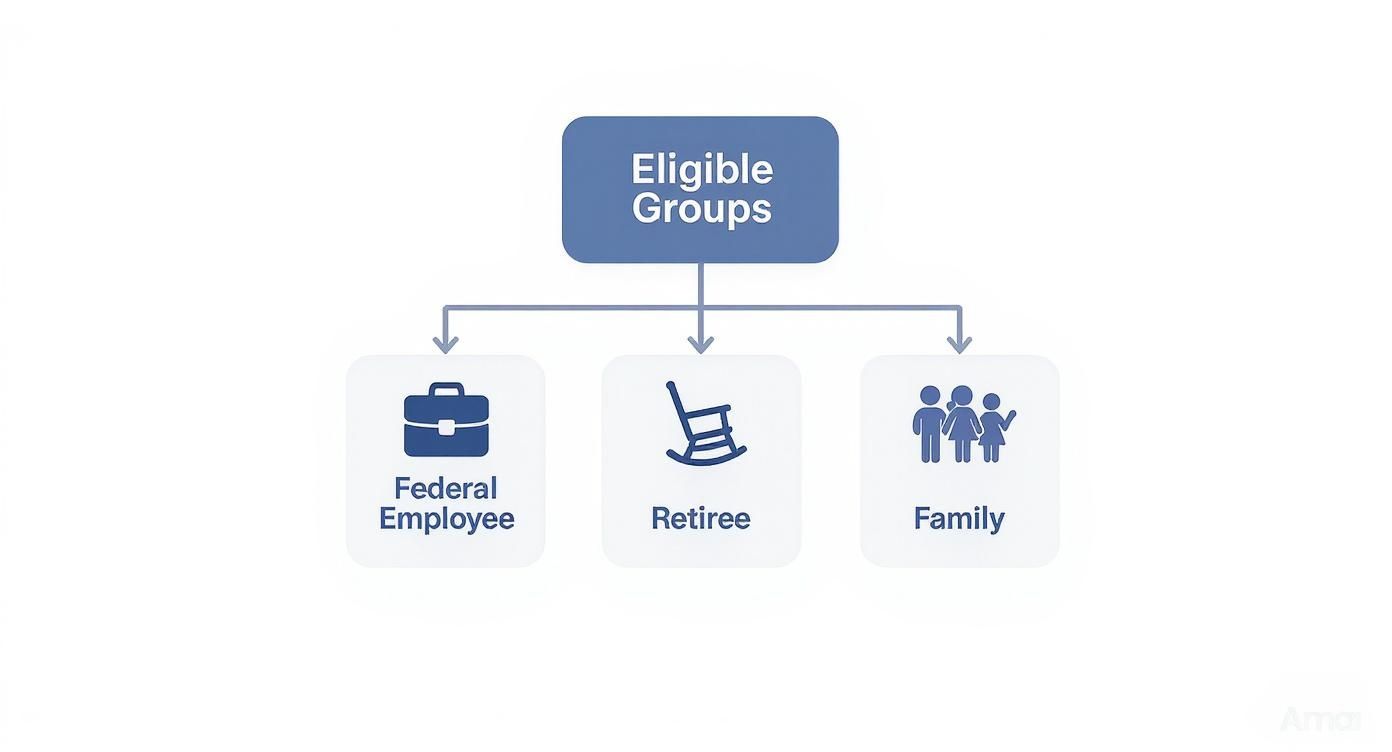
As you can see, GEHA is there to support you and your loved ones throughout your entire federal career and into retirement.
The Four Main Classes of Service
Most dental plans, GEHA's included, use a pretty standard classification system. Let's break down what each class actually means for your teeth and your budget.
Class A (Preventive and Diagnostic Services): This is the bedrock of good oral health. It covers things like your bi-annual cleanings, regular exams, and routine X-rays. Because staying ahead of problems is the best strategy, these services usually get the highest coverage—often 100% when you stay in-network.
Class B (Basic Restorative Services): This class is for common fixes when minor issues pop up. We're talking about fillings for cavities, simple tooth extractions, and deep cleanings if you're dealing with gum disease. The coverage here is still very good, just a notch below the preventive services.
Class C (Major Restorative Services): When a tooth needs more serious help, the procedure falls into Class C. This bucket includes more involved and costly treatments like crowns, bridges, dentures, and root canals. The plan still picks up a significant part of the bill, but your share will be higher than for basic work.
Class D (Orthodontics): This one is all about straightening teeth and aligning your bite. It covers services like braces and other orthodontic appliances for both kids and adults. A huge plus for GEHA is that there's no waiting period for orthodontics to kick in.
By grouping services this way, the plan essentially encourages you to keep up with your preventive care (Class A) so you can avoid needing more expensive restorative work (Class B and C) later on.
To give you a clearer picture, here’s a table showing how this typically plays out with an in-network dentist.
Sample Coverage Breakdown By Service Class (In-Network)
Service ClassExamplesTypical Coverage (Plan Pays)Class ACleanings, Exams, Routine X-rays100%Class BFillings, Simple Extractions80%Class CCrowns, Bridges, Root Canals50%Class DBraces, Orthodontic Appliances50% (up to a lifetime max)
Remember, these are just typical percentages. Always check your specific plan documents for the exact numbers that apply to you.
Key Financial Concepts To Know
Beyond the service classes, there are a couple of key terms that directly impact what you pay out-of-pocket. Getting these straight will make budgeting for your dental care a whole lot easier.
Deductible
This is the amount you have to pay yourself for certain services before the plan starts chipping in. Think of it as a small hurdle you clear once per plan year. For example, preventive care often has no deductible at all, but you’ll likely have one for basic or major procedures.
Annual Maximum
This is the absolute most the plan will pay toward your dental care in a calendar year. Once you hit that limit, you're on the hook for 100% of any further costs until the plan year resets. The High Option plan, as you might guess, comes with a higher annual maximum. If you want to dig deeper into that, check out our guide on the GEHA Dental High Option plan.
Getting Signed Up: Plan Costs and the Enrollment Process
https://www.youtube.com/embed/bXcTsd1KCZM
Alright, so you understand the benefits, but how much does it cost and how do you actually get enrolled? That's the next logical step. With the GEHA Connection Dental Federal plan, both the price tag and the sign-up process are designed to be straightforward for federal employees.
The amount you'll see deducted from your paycheck—your biweekly premium—isn't the same for everyone. It really boils down to two things: where you live (your enrollment region) and who you need to cover.
You’ve got three main options to choose from:
Self Only: Just for you.
Self Plus One: Covers you and one other person, like your spouse.
Self and Family: The whole crew—you, your spouse, and any eligible kids.
This lets you tailor the plan to fit your actual family situation, so you're not paying for coverage you don't need.
Your Annual Window of Opportunity
The federal benefits world has a specific time each year for making these big decisions. It’s called Open Season, and it’s your main shot to enroll in, switch, or cancel your FEDVIP dental plan.
Open Season usually kicks off in mid-November and runs through mid-December. This is your chance to really dig in, compare what's out there, and lock in the best choice for the year ahead. For a lot of feds, this is the time to see how all the options stack up. If you're weighing GEHA against other carriers, our in-depth look at the best federal employee dental insurance plans is a great place to start.
Think of Open Season as your annual benefits check-up. It's the one time of year you can really align your dental coverage with what you expect for the future, whether you're a new hire signing up for the first time or your family is growing and your needs have changed.
Once you’ve made your choice during Open Season, your new coverage will officially start on January 1 of the new year.
How to Enroll Using BENEFEDS
The actual enrollment is handled through a single, central online portal called BENEFEDS. This is the official platform the U.S. Office of Personnel Management (OPM) uses for all things FEDVIP.
The process is pretty simple. Here’s how it works:
Head to the BENEFEDS website: During Open Season, just go to BENEFEDS.com.
Log in or create an account: If it's your first time, you'll need to set up a new account.
Compare plans and make your pick: You can review all the GEHA Connection Dental Federal options and see the premiums right there.
Finalize your enrollment: Just follow the on-screen steps to select your coverage tier (Self Only, Self Plus One, etc.) and confirm your choice.
Premiums for the GEHA plan vary because they're based on five different U.S. regions, plus an option for international employees. The plan is built to be a strong value, with features like a $75 combined deductible for some out-of-network services on the Standard Option, while making sure preventive care is super affordable. If you want to see the nitty-gritty details, you can always check out the official GEHA plan brochures straight from OPM.
How to Find a Dentist in Your Network
Having a top-notch dental plan is great, but it's only half the battle. You also need to find a quality dentist who actually accepts it. The GEHA Connection Dental Federal plan is a PPO, or Preferred Provider Organization. This means GEHA has built a huge network of dentists who've agreed to offer their services at lower, pre-negotiated prices specifically for members.
Frankly, sticking with an in-network dentist is the smartest way to get the most out of your benefits and keep your own costs down. When you see one of these providers, you’re not just getting a discounted rate—they also handle filing all the claims paperwork for you. It's a win-win.
Using the GEHA Online Provider Tool
GEHA doesn't make you jump through hoops to find a participating dentist. Their online search tool is your best friend here, giving you the most up-to-date directory of dentists in the Connection Dental Network.
It's pretty easy to navigate. Here’s how you do it:
Go to the GEHA Website: Head over to the main site and look for the "Find Care" or "Find a Provider" section.
Pick Your Plan: This is a key step. Be sure you select GEHA Connection Dental Federal from the options to pull up the right list of dentists.
Plug in Your Location: Just type in your ZIP code or city, and you'll get a list—and a map—of dentists right in your neighborhood.
Narrow Down the Search: You can even filter the results by specialty. Need a pediatric dentist for your little one or an orthodontist for braces? You can search for exactly what you need.
Following these steps ensures you’re only looking at professionals who will give you the best possible rates under your plan.
Think of your in-network dentist as a partner in your oral health. Their contract with GEHA not only saves you money but also protects you from balance billing—that's when a dentist tries to charge you the difference between their regular price and GEHA's lower negotiated rate. With an in-network provider, that's off the table.
The Financial Advantage of Staying In-Network
Let's talk numbers, because that's where choosing an in-network dentist really shines. Since these providers agree to accept GEHA’s negotiated fee as the full payment, your portion of the bill is based on a much smaller total.
Imagine a procedure normally costs $1,000. For GEHA members, the pre-negotiated rate might only be $600.
If your plan covers 50% of that service, your out-of-pocket cost is $300. If you went to a dentist who charged the full rate, you'd be paying $500. Those savings add up fast, especially for families or anyone needing significant dental work.
What Happens If You Go Out-of-Network?
Of course, you always have the freedom to see any dentist you choose. The PPO model gives you that flexibility. But, it's really important to know how that choice hits your wallet.
GEHA will still contribute to covered services from an out-of-network dentist, but their payment is based on a "maximum allowable charge," not what the dentist actually bills you.
This usually means you'll pay a higher percentage, and you'll also have to cover the difference between what the dentist charges and what GEHA allows. Plus, you might have to pay the entire bill upfront and then file the claim yourself to get reimbursed.
Getting the Most Out of Your GEHA Plan at the Dentist
Alright, you've picked your plan and you know the benefits. Now for the most important part: actually using it. The good news is that using your GEHA Connection Dental Federal plan is pretty straightforward, letting you focus more on your check-up and less on the paperwork.
When you walk into the dentist's office, just have your GEHA member ID card handy. Show it to the receptionist, and they'll have everything they need to verify your coverage. This little card is your key to unlocking your benefits right at the source.
In-Network vs. Out-of-Network: A Tale of Two Claims Processes
Where you get your dental care—inside or outside of GEHA's network—really changes how the billing and claims process works.
Visiting an in-network provider is the easy button. These dentists have a direct relationship with GEHA, so they handle all the claim submissions for you. They've also agreed to pre-negotiated rates, which means you're protected from surprise costs. It’s a completely hands-off experience for you.
Going to an out-of-network dentist means you'll probably have to be more involved. While some offices might file the claim for you as a courtesy, many will ask you to pay for the services upfront. You'd then have to fill out a claim form and submit it to GEHA yourself to get reimbursed.
The bottom line? Stick with an in-network dentist whenever you can. It’s simpler, cheaper, and saves you the headache of managing claim paperwork.
What is an Explanation of Benefits (EOB)?
After a claim is processed, GEHA will send you a document called an Explanation of Benefits, or EOB for short. Let me be clear: this is not a bill. Think of it as a report card for your dental visit, breaking down every cost and payment.
Here’s what your EOB will spell out for you:
Amount Billed: What the dentist originally charged for the procedure.
Plan Discount: The savings you got just for being a GEHA member with an in-network provider.
GEHA Paid: The exact amount your insurance plan covered.
Your Responsibility: What's left for you to pay, after all the discounts and insurance payments are applied. This includes your deductible and coinsurance.
Always take a minute to look over your EOB. It’s the best way to see your plan in action and make sure all the numbers line up. It gives you the peace of mind that your benefits are working just as they should.
Your Top GEHA Dental Plan Questions, Answered
Let's face it, diving into the specifics of any dental plan can feel a bit overwhelming. You've got the big picture, but what about the nitty-gritty details? Here are some quick, clear answers to the questions we hear most often from federal employees about the GEHA Connection Dental Federal plan.
Does the Plan Cover Cosmetic Procedures?
This one comes up a lot. People often wonder if things like professional teeth whitening are covered. As a general rule, if a procedure is purely for cosmetic reasons and not medically necessary for your oral health, it probably won't be covered by the plan.
That said, there's a gray area. Some restorative work, like a crown needed to fix a badly broken tooth, also happens to make your smile look a whole lot better. Treatments like this often fall under the Class C (Major Services) benefits. The best advice? Always double-check your official plan brochure or give GEHA a quick call to confirm coverage before you commit to any procedure.
What About Dental Care While Traveling?
What if a dental emergency strikes while you're traveling overseas? Good news: GEHA has you covered with an international network. If your plan includes this feature, you'll have access to a network of dentists abroad.
Even if you don't have that specific option, your out-of-network benefits may kick in for genuine emergencies. The key is to be proactive. Before you pack your bags, get in touch with GEHA to understand exactly what your international coverage looks like and how you'd submit a claim for reimbursement from another country.
Are There Waiting Periods for Major Services?
Many dental plans make you wait a certain amount of time after enrolling before they'll pay for expensive procedures. It's their way of preventing someone from signing up, getting a major fix, and then dropping the plan.
This is where the GEHA Connection Dental Federal plan really shines. One of its best features is that it has no waiting period for orthodontic services.
That's a huge plus, especially for families planning on getting braces for their kids or for adults who are finally ready for orthodontic treatment themselves. For other major services, it's always a smart move to review the official plan documents for the current year to see if any other waiting periods apply.
Navigating your federal benefits is a complex journey, but you don't have to do it alone. Federal Benefits Sherpa offers personalized guidance to help you make the most of your benefits for a secure retirement. Schedule your free 15-minute benefits review today!


Dedicated to helping Federal employees nationwide.
“Sherpa” - Someone who guides others through complex challenges, helping them navigate difficult decisions and achieve their goals, much like a trusted advisor in the business world.
Email: [email protected]
Phone: (833) 753-1825
© 2024 Federalbenefitssherpa. All rights reserved