
Blogs

Blog title place here
We understand that every federal employee's situation is unique. Our solutions are designed to fit your specific needs.

Blog title place here
We understand that every federal employee's situation is unique. Our solutions are designed to fit your specific needs.

Blog title place here
We understand that every federal employee's situation is unique. Our solutions are designed to fit your specific needs.
Best Federal Employee Dental Insurance Plans Compared
Picking the right federal employee dental insurance isn't about finding a single "best" plan—it's about finding the plan that fits your life. The Federal Employees Dental and Vision Insurance Program (FEDVIP) gives you plenty of choices, and the ideal one really hinges on your specific situation. Are you single? Do you have a family with kids who might need braces? Are you anticipating any major dental work in the coming year?
How to Choose Your FEDVIP Dental Insurance
When you dive into the Federal Employees Dental and Vision Insurance Program, you'll notice that most dental plans are broken down into two main tiers: Standard and High. Getting a handle on the core differences between these two is the first, and most important, step in making a smart decision. It’s not just about the monthly premium; it's about what your total out-of-pocket costs will look like over the course of a year.
At first glance, a low-premium Standard plan looks like a great deal. And honestly, for a single fed with great dental health who just needs routine cleanings and check-ups, it often is. These plans are designed to cover preventive care at or near 100% with a small deductible, so they're incredibly cost-effective if you don't expect to need fillings, crowns, or more complex work.

But that math changes quickly if you have a family or know you'll need more than a simple cleaning. High option plans cost more each month, but they pack a much bigger punch when it comes to covering expensive procedures. You'll see lower coinsurance for major services—think root canals, crowns, and implants—and much higher annual benefit maximums.
For example, if you know your teenager needs braces, a High plan's more generous orthodontic coverage could easily save you thousands. That savings would more than make up for the higher monthly premium. The trick is to think ahead about your needs, not just react to a dental emergency.
Comparing Plan Tiers at a Glance
A good way to think about it is this: Standard plans are for routine maintenance and minor tune-ups. High plans are your comprehensive safety net, built to handle the big, expensive, and often unexpected dental issues. Your choice really comes down to your personal risk tolerance and any dental work you see on the horizon.
To put it all into perspective, here's a quick breakdown of how these plans typically stack up.
Comparing FEDVIP Standard vs High Dental Plan Tiers
The table below gives you a general overview of what to expect when you're weighing a Standard option against a High one.
FeatureStandard Plan (Typical)High Plan (Typical)Monthly PremiumLower. Easier on the budget upfront.Higher. You pay more for better coverage.Annual MaximumLower (e.g., $1,500 - $2,500 per person).Higher (often unlimited or $5,000+ per person).DeductibleA moderate annual deductible (like $50 individual).Often lower or even $0 for in-network care.Major Services CoinsuranceHigher out-of-pocket (you might pay 50%).Lower out-of-pocket (you might pay 30-40%).Orthodontia CoverageLimited or no coverage for adults; lower lifetime max.More comprehensive coverage with a higher lifetime max.Best ForIndividuals with good oral health who need routine care.Families, retirees, or anyone expecting major work.
Ultimately, the goal is to pay for the coverage you'll actually use. Don't overbuy if you don't need it, but don't leave yourself underinsured if you know bigger expenses are coming.
Getting Beyond Premiums: What’s the Real Cost of Your FEDVIP Plan?
When you’re comparing federal dental plans, it's easy to get fixated on the bi-weekly premium. But that small number deducted from your paycheck is just the tip of the iceberg. The cheapest premium doesn't always mean the cheapest plan, and I’ve seen plenty of people get burned by focusing only on that one figure.
The real cost of your dental insurance is a mix of that premium and what you actually pay for care throughout the year. Think of it as the total financial hit, which includes your deductibles, copayments, and coinsurance. Getting a handle on how these moving parts work together is the only way to pick a plan that won't leave you with surprise bills.

Premiums vs. Out-of-Pocket Spending
A standard plan with a low premium looks great on paper, right? But these plans almost always ask you to shoulder a much bigger portion of the cost for anything beyond a simple cleaning. Let's say you need a root canal, a procedure that can easily top $1,500. A standard plan might only pick up 50% of that bill after you've paid your deductible. You're left holding a bill for hundreds of dollars.
Now, consider a high-option plan. Yes, you pay more every month. But that same root canal might be covered at 70% or more. The savings from just one major procedure could easily wipe out the extra premium you paid all year. If you have even a small inkling that you’ll need more than just routine care, a high-option plan often makes more financial sense.
One of the best, and often overlooked, perks of FEDVIP is that your premiums are paid with pre-tax dollars. This automatically lowers your taxable income, giving you a built-in discount on your insurance before you even use it.
The Federal Employees Dental and Vision Insurance Program (FEDVIP) is known for its stability. In 2025, for instance, the average premium increase for dental plans was a very manageable 2.97%. That’s a far cry from the steep, double-digit hikes you sometimes see in other federal benefits, which really underscores the program's value. You can find more details about the 2025 premium adjustments and how they stack up.
A Real-World Cost Scenario
Let's break this down with a practical example. Imagine two federal employees who both need a dental crown that costs $2,000.
Employee A picks the Standard Plan: She pays a $15 bi-weekly premium. Her plan has a $50 deductible and covers major services at 50%. Her annual premium cost is $390. For that crown, she first pays the $50 deductible, then 50% of the remaining $1,950, which comes to $975.
Her Total Cost for the Year: $390 (premiums) + $1,025 (crown cost) = $1,415
Employee B picks the High Plan: He pays a $30 bi-weekly premium. His plan has no in-network deductible and covers major work at 70%. His total premium cost is $780. For the crown, he simply pays his 30% share, which is $600.
His Total Cost for the Year: $780 (premiums) + $600 (crown cost) = $1,380
Even though Employee B paid nearly double in premiums, he actually came out ahead at the end of the year. This is exactly why you have to honestly assess your potential dental needs before you enroll.
Decoding Your Financial Responsibilities
To really compare plans apples-to-apples, you need to speak the language of cost-sharing. Here are the terms that matter:
Deductible: This is what you have to pay first before the insurance company starts paying its share. For most FEDVIP plans, it's a small annual amount, often around $50 per person.
Coinsurance: Once your deductible is met, you’ll pay a percentage of the bill. If your plan's coinsurance for a filling is 20%, you pay that amount and your plan covers the remaining 80%.
Copayment: This is a flat fee you pay for a specific service. Copays are less common in dental insurance than coinsurance, but you might see them for certain types of office visits.
Annual Maximum: This is the absolute most your plan will pay out in a calendar year. High-option plans have much higher limits—or sometimes no limit at all—which is a critical safety net if you end up needing extensive, expensive work.
Comparing the Top FEDVIP Dental Plan Providers
Once you've got a handle on how FEDVIP plans work financially, it's time to put the major insurance carriers side-by-side. The program gives you access to some of the biggest names in the business, including MetLife, Aetna, Delta Dental, and Blue Cross Blue Shield. While they all offer solid coverage, their plans are definitely not one-size-fits-all.
Finding the best federal employee dental insurance for you means looking past the monthly premium. You need to dig into the details that really make a difference, like the size of their dentist network, how they cover major work, and what their annual spending caps are. What works perfectly for one family might be a terrible fit for another, so let’s get into the nitty-gritty.
Analyzing Provider Networks
The quality of a plan's provider network has a huge impact on both your access to care and what you'll pay out-of-pocket. A bigger network makes it more likely that your current dentist is included, saving you the headache of having to switch.
MetLife: Often gets the nod for its massive network. MetLife gives you access to one of the largest pools of dental providers in the country, which is a huge plus for feds who might relocate during their career.
Delta Dental: Is well-known for its two-tiered network system (PPO and Premier). This setup gives you more options. The Premier network is usually larger, but you might pay slightly more out-of-pocket compared to the PPO network.
Aetna: Also brings a very strong national network to the table, going toe-to-toe with the other major players. People often praise their online tools, which make it incredibly simple to find an in-network dentist.
Blue Cross Blue Shield (BCBS): While it's a household name, the BCBS network can be more of a mixed bag depending on your state. It’s critical to double-check that your local dentists are actually part of their federal dental plan before you enroll.
You can see all these carriers and compare their specific plans on the official BENEFEDS portal, which is your go-to hub for this stuff.
This is the platform you'll use to dive into plan brochures, search for dentists, and ultimately sign up for a plan during Open Season.
Coverage for Major Services and Orthodontia
This is where you'll find the biggest differences between the plans. Nearly every carrier gives you great coverage for preventive care, but their rules for expensive procedures like crowns, implants, and braces can vary wildly.
High-option plans from carriers like MetLife and Aetna are typically generous with major services, often paying 50-70% of the cost after you meet your deductible. But watch out for waiting periods—some plans make you wait a full year before they’ll chip in for certain major procedures.
One of the most overlooked benefits in FEDVIP plans is the power of negotiated fees. This behind-the-scenes discount can save you a ton of money before your insurance even pays a dime.
For example, a huge carrier has serious bargaining power. That’s how federal employee dental insurance has historically provided such great value. MetLife's Federal Dental Plan, one of the largest in FEDVIP, boasts negotiated rates that are typically 35-50% lower than what dentists in the same area usually charge. This means big savings on things like fillings and crowns—with discounts reaching up to 50% for in-network care, on top of 100% coverage for cleanings and exams. You can see these numbers for yourself in MetLife's plan summary.
If you have kids (or are considering adult braces), orthodontic coverage is a deal-breaker. Most high-option plans have a lifetime maximum for orthodontia, but the amount can be anywhere from $2,500 to over $5,000. Delta Dental and BCBS often get high marks for their ortho benefits, but you have to read the fine print in the plan brochure for age limits and other rules.
Feature Comparison of Leading FEDVIP Dental Plans
Seeing the key features laid out clearly can really help you make a decision. While the exact details can shift a little each year, this table gives you a solid, at-a-glance comparison of the leading national carriers available through FEDVIP. It’s a great way to see how you should prioritize features based on what you think you'll need.
ProviderNetwork Size (Approx.)Annual Maximum (High Plan)Orthodontia Lifetime MaxKey DifferentiatorMetLife500,000+ locationsUnlimited$5,000Excellent negotiated fees and no annual maximum on high plan.Aetna400,000+ locations$6,000$3,500Strong coverage for major services and user-friendly online tools.BCBSVaries by region$4,000$3,000Strong regional networks and a well-known brand.Delta Dental350,000+ locations$3,000$2,500Dual network (PPO/Premier) offers flexibility and choice.
This breakdown makes it obvious that there’s no single "best" plan for everyone. If you know you'll need a couple of crowns next year, MetLife’s unlimited annual maximum might be exactly what you need. On the other hand, if your main goal is just to keep your local dentist, Delta Dental’s huge Premier network could be the deciding factor. Your own dental health forecast is the most important piece of this puzzle.
How to Match a Dental Plan to Your Life Stage
Picking the right federal dental insurance is a personal decision. The plan that works perfectly for a 25-year-old just starting their career is almost never the right fit for a family with teenagers or a couple heading into retirement. Your life stage is probably the single best predictor of what you'll need from your dental plan.
When you think about your specific situation, you can look past the monthly premium and find a plan that actually saves you money in the long run. This way, you can anticipate costs and make sure you’re covered when you need it most, without the stress of an unexpected, massive dental bill.
Young and Healthy Federal Employees
If you're early in your career, single, and have a solid track record of good dental health, your needs are pretty simple. The main goal here is preventive care—keeping your teeth healthy for the decades to come.
For this stage, a Standard Plan is usually the smartest financial move. These plans almost always cover 100% of your routine cleanings, exams, and x-rays, all for a low monthly premium. Since you probably aren't planning on major work like crowns or implants, there's no sense in paying for a high-end plan with benefits you won’t touch.
The key is consistency. Your plan’s real value is that it encourages you to get to the dentist twice a year without a second thought, catching minor issues before they become major headaches.
Families with Children and Teens
Everything changes once you have a family. Suddenly, you're not just managing your own dental health; you're juggling the varied needs of multiple people, and the odds of needing orthodontics go way up.
This is where a High Plan becomes almost a necessity. Yes, the monthly premium is higher, but the much stronger benefits for things beyond a simple cleaning can save you thousands of dollars down the road.
Look for these key features:
A high orthodontic lifetime maximum: Braces are a huge expense. A plan with a $3,000 to $5,000 lifetime benefit per person can take a massive bite out of that final bill.
Low coinsurance for basic services: Kids get cavities. It happens. A plan that covers fillings at 80% or 90% means you're paying less out-of-pocket every time.
No waiting periods for major services: If your teen cracks a tooth playing sports on Saturday, you need that crown covered on Monday, not in 12 months.
This decision tree gives you a quick visual to see if your needs are more about basic maintenance or if you're heading toward more substantial dental work.
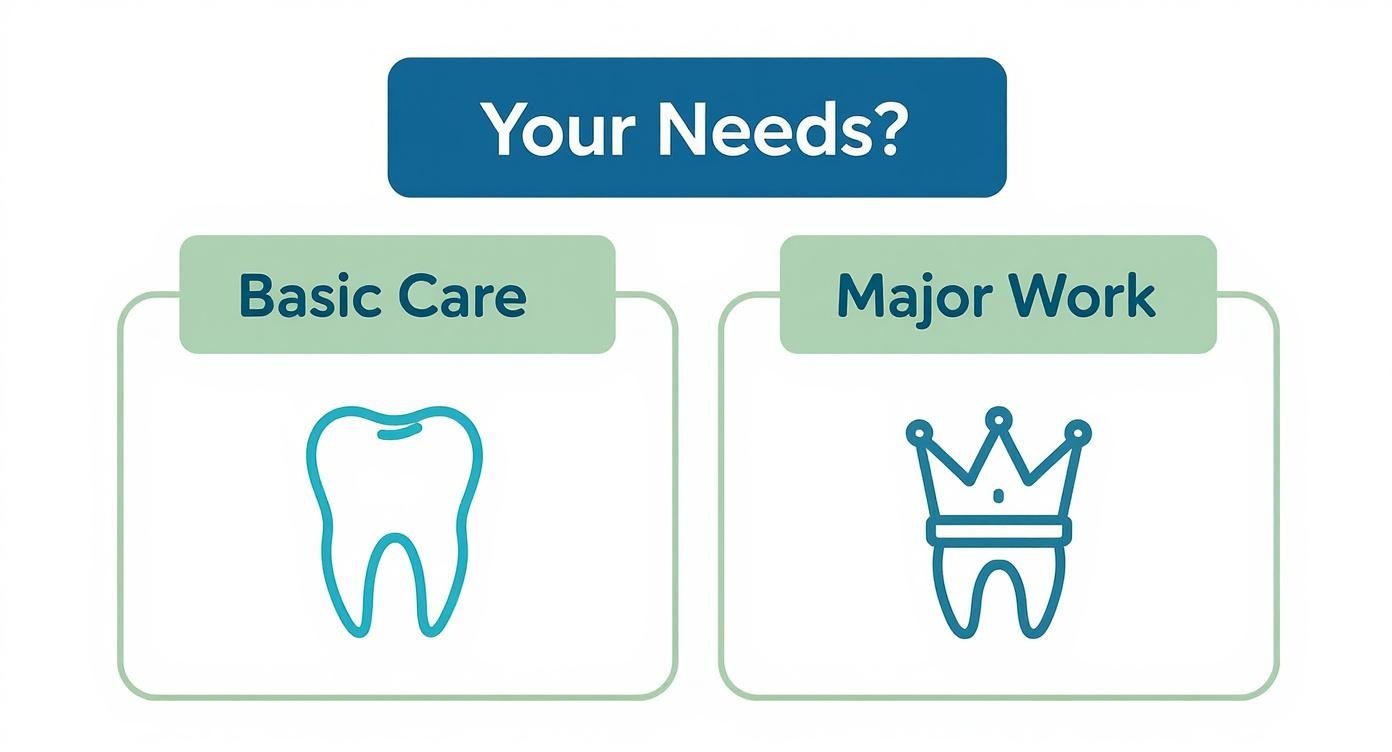
It clearly lays out the two paths: one for those just needing routine care and another for those who can see crowns, braces, or other big-ticket items on the horizon.
Mid-Career and Pre-Retirement Employees
As you hit your 40s and 50s, the years of wear and tear can start to catch up. Old fillings might need replacing with crowns, and the chances of needing a root canal or even a dental implant go up.
At this point, your dental insurance needs to be a serious financial safety net. A High Plan is typically the most sensible choice, but you’ll be focusing on a different set of benefits than a young family would.
The single most critical feature for this age group is a high or unlimited annual maximum. A couple of major procedures, like an implant and a crown, can easily blow past the $2,500 annual limit on a Standard Plan, leaving you on the hook for the rest.
Find a plan that not only has a generous maximum but also provides great coverage for these specific services:
Crowns and Bridges: Make sure the plan covers these at 50% or more.
Dental Implants: Not every plan covers implants, so double-check that it's a listed benefit.
Periodontal Care: As you get older, coverage for gum-related treatments becomes much more important.
Retirees and Annuitants
In retirement, dental needs can become more complex and often less predictable. Gum disease, tooth loss that requires dentures or implants, and replacing old dental work are all common concerns. Since good dental health is so closely tied to your overall health, having robust coverage is a top priority.
For most retirees, a High Plan is the only practical option. The potential for expensive procedures makes the low premiums of a Standard Plan a huge financial gamble. The real goal is to find a plan with no annual maximum—or a very high one—to give you true peace of mind.
You'll want to focus on plans offering strong benefits for services frequently needed in retirement, like dentures, implants, and periodontal surgery. It's also wise to check that the provider network has plenty of great dentists wherever you plan to spend your retirement.
FEDVIP vs. Private Sector Dental Plans: Is the Grass Greener?
Federal employees often hear their benefits package is top-notch, and when it comes to dental insurance, that reputation holds up. But to really get why, you have to look past the plan brochures and understand the framework of the Federal Employees Dental and Vision Insurance Program (FEDVIP). It’s the system itself that gives federal plans their edge.
When you put a FEDVIP plan side-by-side with a typical plan from a private company, the differences are stark. The federal government is a massive employer. That size creates a giant risk pool, which is just a fancy way of saying it spreads the insurance risk across millions of people. This keeps premiums stable and predictable, so you don't see the wild price jumps that can happen at smaller companies after a few employees have a bad year for dental work.
The Power of Choice and Competition
The single biggest win for federal employees is choice. FEDVIP puts several national carriers—think MetLife, Aetna, and Delta Dental—in the same arena and makes them compete for your enrollment. That competition is a huge benefit for us. It keeps costs in check and pushes insurers to offer better perks, like higher annual maximums or solid orthodontic coverage, to stand out.
Most people in the private sector don't get this luxury. Their employer picks one carrier, and that’s that. You get what you’re given. With FEDVIP, you get to be the customer, comparing multiple solid options to find the best federal employee dental insurance that actually fits what your family needs right now.
Being able to switch carriers and plan levels every Open Season is the core strength of FEDVIP. Your dental needs change over time—from simple cleanings when you’re new to the workforce to more complex procedures as you get older. Your insurance should be able to change with you.
Better Access to Dentists
Beyond just having options, FEDVIP plans tend to offer better access to actual dental care. The program's sheer size gives it the muscle to negotiate huge provider networks. This makes it much easier to find a dentist who takes your insurance, whether you live in a major city or a small town.
This is a far cry from what many Americans get. According to the Bureau of Labor Statistics, only about 50% of workers at large private companies even have access to a dental plan. That number plummets to just 30% for folks working at businesses with under 100 employees. If you want to dig into the numbers, you can find more on private sector benefit access.
The Financial Perks Add Up
Finally, don't overlook the financial mechanics of FEDVIP. You pay your premiums with pre-tax dollars, which directly lowers your taxable income. It’s like getting an automatic discount on your coverage right from the start, a benefit that isn’t a given with all private employers.
When you put it all together—the massive risk pool, the head-to-head carrier competition, and the pre-tax savings—you get a truly powerful combination. It leads to high-quality, affordable dental care you can depend on. For federal families, it’s a cornerstone benefit that provides real security, year in and year out.
How to Finalize Your Choice and Enroll in a FEDVIP Plan
You've done the hard work of comparing carriers and weighing your options. Now it's time to take that research and turn it into a final decision. Choosing the best federal employee dental insurance isn't about guesswork; it's about a clear, simple process to lock in the right plan for you.
Everything for FEDVIP enrollment happens through one central place: the BENEFEDS portal. This is the official government-managed site where you'll make your final selection and manage your plan. The key window for this is the annual Open Season, which usually runs from the second Monday of November through the second Monday of December. Get those dates on your calendar—it's your main chance to enroll or make changes for the next year.

Life happens, of course, and you aren't always locked into your choice for a full year. If you experience a Qualifying Life Event (QLE)—like getting married, having a child, or losing other health coverage—you'll get a special enrollment period to update your benefits.
Your Final Decision-Making Checklist
Before heading over to BENEFEDS, take your top two or three plans and run them through this last check. This final pass ensures you haven't missed a crucial detail that could make or break your experience with the plan.
Confirm Your Dentist: This is a big one. Go to the carrier’s website and use their provider search tool. Make sure your dentist—and any specialists you see—are actually in-network. This single step has the biggest impact on keeping your costs low.
Estimate Your Total Annual Cost: Look beyond just the premium. Add up 12 months of premiums and then layer on what you realistically expect to pay out-of-pocket for cleanings, fillings, or any other planned work. Sometimes a plan with a higher premium is actually cheaper in the long run if it covers more of your major services.
Do a Final Skim of the Plan Brochure: You don't have to read every word, but open the official brochure one last time. Look specifically for waiting periods on major work, any surprising exclusions, or specific limits on things like orthodontia or implants.
This last check is what turns a good guess into a confident decision. It's the final piece of the puzzle, giving you the assurance that you're picking not just a plan, but the right plan for your family and your budget.
Once you’ve checked these boxes, you’re ready to go. Log in to your BENEFEDS account, find your chosen dental plan, and follow the steps to enroll. The system guides you through it, and your new coverage will kick in at the start of the next plan year.
Your Top FEDVIP Dental Plan Questions Answered
Diving into the details of federal dental insurance can feel a bit overwhelming. Let's clear up some of the most common questions federal employees ask so you can choose your plan with confidence and sidestep any unexpected expenses later on.
How Do I Know if My Dentist Is In-Network?
This is probably the single most important question to answer before you enroll. The best way to avoid surprise bills is to confirm your dentist's network status directly.
Every insurance carrier has a provider search tool on its website, which you can also access through the main BENEFEDS portal. Don't just assume your dentist is covered because they accepted a plan in the past—networks change. Always verify.
Can I Change My Plan Outside of Open Season?
For the most part, you’re locked into your plan until the next annual Open Season. However, life happens, and certain big changes—what the government calls Qualifying Life Events (QLEs)—give you a special window to adjust your coverage.
A QLE could be getting married, having a baby, or even losing other dental insurance you might have had. These events trigger a special enrollment period, letting you make necessary changes.
For instance, if you get married, a QLE allows you to add your new spouse to your plan. It’s the system’s way of ensuring your coverage can adapt to your new family situation without having to wait for Open Season.
What’s the Difference Between an Annual and a Lifetime Maximum?
These two terms define the ceiling on what your insurance will pay out, but they work very differently.
Think of the annual maximum as your yearly budget. It's the total amount your plan will pay for covered services within a single benefit year. Once the year is over, it resets. On the other hand, a lifetime maximum is a one-time, cumulative limit that typically only applies to major, high-cost procedures like orthodontia. Once you hit that cap, it's gone for good.
Sorting through federal benefits can be a real headache, but you don't have to figure it all out on your own. Federal Benefits Sherpa provides one-on-one guidance to help you build a secure retirement.
Schedule your free 15-minute benefit review today at https://www.federalbenefitssherpa.com.


Dedicated to helping Federal employees nationwide.
“Sherpa” - Someone who guides others through complex challenges, helping them navigate difficult decisions and achieve their goals, much like a trusted advisor in the business world.
Email: [email protected]
Phone: (833) 753-1825
© 2024 Federalbenefitssherpa. All rights reserved