
Blogs

Blog title place here
We understand that every federal employee's situation is unique. Our solutions are designed to fit your specific needs.

Blog title place here
We understand that every federal employee's situation is unique. Our solutions are designed to fit your specific needs.

Blog title place here
We understand that every federal employee's situation is unique. Our solutions are designed to fit your specific needs.
Calculating FERS Retirement A Practical Guide
Ready to figure out what your FERS pension will look like? The good news is that the core formula is pretty simple. It all boils down to three key numbers.
Think of it as a basic equation: your High-3 Average Salary gets multiplied by your total Years of Creditable Service, which then gets multiplied by a specific FERS Multiplier. Once you have a firm grasp on these three elements, you can project your future annuity with a surprising degree of accuracy.
The Three Pillars of Your FERS Annuity Calculation

Before you pull out the calculator, let's break down the foundation of your FERS pension. I like to think of it as a structure held up by three pillars. If you miscalculate one, the whole thing gets wobbly. Getting these right turns a complicated process into a set of clear, manageable steps.
And getting this right is more critical than ever. The Office of Personnel Management (OPM) is seeing a huge wave of retirements, processing 112,679 new claims in fiscal year 2023 alone. That’s a lot of federal employees just like you trying to navigate this system. You can actually see the data yourself by checking out the official OPM retirement statistics.
So, what are these three pillars? Let's take a closer look at each one.
The table below breaks down the three essential components you'll need. Each one plays a distinct and crucial role in determining the final value of your monthly pension.
ComponentWhat It IsWhy It MattersHigh-3 Average SalaryThe average of your highest 36 consecutive months of basic pay.This is the foundation of your annuity. A higher average directly translates to a larger pension payment.Years of Creditable ServiceYour total time in federal service, plus any bought-back military time and unused sick leave.More service time means a bigger pension. Every single day you work adds to this total and increases your final annuity.FERS MultiplierA percentage (1% or 1.1%) based on your age and years of service at retirement.This determines the final percentage of your High-3 you'll receive each year. Hitting the 1.1% threshold gives your pension a significant 10% boost.
Understanding how each of these pillars contributes to the whole picture is the first and most important step in planning for your federal retirement.
Your High-3 Average Salary
This isn’t just your final salary—it’s a very specific calculation. The government looks at the highest 36 consecutive months of your basic pay and takes the average. A promotion late in your career can give this number a real boost, which is why those last few years are so critical for your retirement planning. We’ll get into the nitty-gritty of how to pinpoint this number later on.
Your Total Years of Creditable Service
This number is often bigger than people think. It’s not just your civilian time. It also includes any military time you've "bought back" and—this is a big one—all of your unused sick leave. Your sick leave balance gets converted into additional service time when you retire, and it can make a real difference.
A Pro Tip From Experience: Don't brush off the value of your unused sick leave. Cashing it in for more creditable service is one of the smartest ways to increase your FERS annuity without having to work a single extra day.
The FERS Multiplier
This is the final piece of the puzzle. The multiplier is a percentage set by your age and service time when you finally hang it up. For most people, that multiplier is 1%.
But here's a crucial detail: if you retire at age 62 or older with at least 20 years of service, that multiplier jumps to 1.1%. It might not sound like a huge difference, but that extra 0.1% gives you a 10% larger pension, every year, for the rest of your life. It's an important milestone to keep in mind as you plan your exit strategy.
Pinpointing Your High-3 Average Salary

If there's one number you absolutely must get right in your FERS calculation, it's your High-3 Average Salary. This figure is the bedrock of your pension, and a small error here can throw off your entire retirement projection. So, it’s worth taking the time to nail it down.
At its core, your High-3 is the average of your highest 36 consecutive months of basic pay. For most of us, this period lines up with our last three years of service, but that's not always the case. It could be any 36-month stretch from your entire federal career.
Your best friend in this process is your stack of Leave and Earnings Statements (LES). Go through them carefully. They hold the detailed history you need to find that peak earnings window and calculate your average with precision.
What Counts as Basic Pay
Here's a common tripwire: confusing your total earnings with your basic pay. Your High-3 is built only on basic pay, which is your official salary for your position, grade, and step, plus any locality pay.
A lot of the extra compensation we earn along the way doesn't factor in. It's critical to know what to leave out so you don't accidentally inflate your estimate and set yourself up for a surprise later.
These items are almost always excluded from your High-3 calculation:
Overtime pay
Bonuses and performance awards
Lump-sum payouts for unused annual leave
Recruitment or retention incentives
Allowances for things like travel or uniforms
The simplest way to think about it is this: if it wasn't part of your regular, recurring paycheck, it probably doesn't count. Getting this distinction right is the key to an accurate calculation.
Real-World High-3 Scenarios
Your career journey is unique, and that path directly influences where your High-3 period falls. A big promotion, a grade increase, or even a move to a new locality can shift that 36-month window.
Let's walk through a typical example. Imagine an employee who was promoted from a GS-12 to a GS-13 two years before retiring. Their highest earning period isn't just the final three years. It would likely start one year before the promotion and end on their last day. This captures 12 months at the top of the GS-12 scale and 24 months at the higher GS-13 rate.
Here’s another situation I’ve seen: an employee transfers to a lower-cost area in their final years to be closer to family. In their case, the High-3 period might actually be from five years earlier when their locality pay was significantly higher.
Remember, the rule is 36 consecutive months of your highest pay, wherever that period falls in your service history. Don’t just assume it’s your last three years on the job—always verify with your LES records.
By digging into your earnings history, you can pinpoint this number with complete confidence. This ensures that every other part of your FERS calculation is built on a solid, accurate foundation.
Figuring Out Your Creditable Service and Multiplier
Once you've locked down your High-3 salary, the next big number you need is your total creditable service. This isn't just a simple count of the years you've worked; it's the total time that the FERS system recognizes for your pension calculation.
So, what counts? It’s a combination of your entire civilian career, any military time you’ve officially "bought back," and—this is the one people often forget—all your unused sick leave. OPM will actually convert your sick leave balance into extra months and days of service, which can give your final annuity a nice little bump.
Finding Your FERS Multiplier
With your years of service tallied up, it's time to find your multiplier. Think of this as the percentage of your High-3 you'll get for each year on the job. It seems like a small detail, but getting it right is crucial for an accurate calculation.
For most federal employees, the standard multiplier is a straightforward 1%. Simple enough.
But there’s a major incentive for those who stick around a bit longer. If you keep working until you’re at least age 62 and have 20 or more years of service under your belt, that multiplier gets a boost to 1.1%. It might not sound like much, but that’s an instant 10% raise on your entire pension for the rest of your life.
A Quick Tip from Experience: Don't brush off that extra 0.1%. For someone with a $90,000 High-3 and 25 years of service, swapping the 1% for the 1.1% multiplier means an extra $2,250 in their pocket every single year. That adds up fast.
How Age and Service Work Together
The FERS system is designed to reward longevity, and this is where you really see it in action. The interplay between your service years, your High-3 salary, and that multiplier is what determines your final benefit.
Let's look at an example. An employee with 30 years of service and a $100,000 High-3 who retires at age 62 would see their annual pension jump from $30,000 (using 1.0%) to $33,000 (using 1.1%) just by meeting the age and service requirements for that enhanced rate. If you want to see how different numbers interact, playing with a good FERS retirement calculator can be really eye-opening.
To make this crystal clear, here’s a quick breakdown of how the multiplier applies in different situations.
FERS Annuity Multiplier Scenarios
This table shows how the FERS multiplier changes based on your age and years of service when you decide to retire.
Retirement ScenarioAge RequirementService RequirementApplicable MultiplierStandard RetirementMRA to age 6110 to 30+ years1.0%Enhanced RetirementAge 62 or older20+ years1.1%Early Retirement (MRA+10)MRA10 to 29 years1.0% (Annuity may be reduced)
As you can see, this simple difference can have a huge impact on your retirement income. It’s absolutely vital to know which multiplier you qualify for before you turn in your retirement papers.
Putting the FERS Formula into Practice
Alright, you’ve got the three core pieces of the FERS puzzle: your High-3 salary, your years of creditable service, and the right multiplier. Now for the fun part—seeing how they all fit together to create your pension.
Let's walk through a few real-world examples. Theory is great, but seeing the numbers play out for federal employees in different situations is where it really clicks.
This simple diagram breaks down how your years of service and your age at retirement point you to the right multiplier.
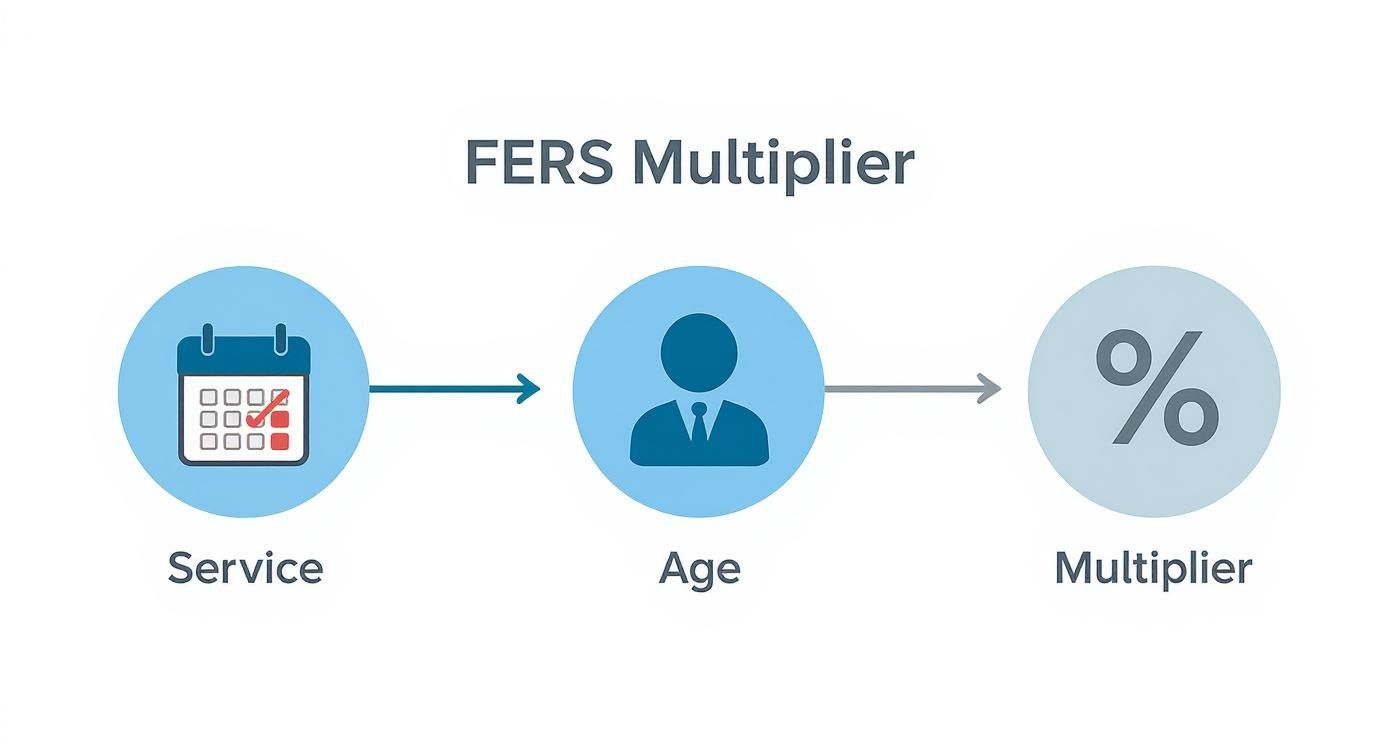
The main thing to notice? Hitting age 62 with at least 20 years of service is the magic combination that unlocks that more valuable 1.1% multiplier.
Scenario 1: The Standard 1% Multiplier
First up is Alex. He's a federal employee who's decided to retire right at his Minimum Retirement Age (MRA) of 57. He's had a good, long career and is ready to move on.
Here are his final numbers:
High-3 Average Salary: $95,000
Creditable Service: 25 years
Age at Retirement: 57
Because Alex is retiring before age 62, his pension will be calculated using the standard 1% multiplier. The math is pretty straightforward from here.
The Calculation:
$95,000 (High-3) x 25 (Years) x 0.01 (Multiplier) = $23,750 per year
This gives Alex a gross annual pension of $23,750. Broken down monthly, that’s about $1,979 before any deductions are taken out for things like survivor benefits or health insurance premiums.
Scenario 2: Unlocking the 1.1% Multiplier
Now let's look at Brenda. She chose to work a few years longer, specifically to maximize her FERS pension. By delaying her retirement until she was 63, she made a huge difference in her final numbers.
Here’s where she landed:
High-3 Average Salary: $110,000
Creditable Service: 31 years
Age at Retirement: 63
Brenda’s decision pays off. Since she retired at 62 or older with more than 20 years of service, she qualifies for that enhanced 1.1% multiplier. This gives her a 10% boost across her entire annuity calculation—a significant advantage.
The Calculation:
$110,000 (High-3) x 31 (Years) x 0.011 (Multiplier) = $37,510 per year
Brenda’s annual pension comes out to $37,510, or roughly $3,126 a month. That extra time on the job, combined with the higher multiplier, resulted in a much more substantial retirement income than what Alex received.
Seeing these numbers in action makes it clear how your retirement timing directly impacts your financial future. A few extra years can significantly increase your lifelong pension.
Scenario 3: The Sick Leave Boost
Finally, we have Carlos. Throughout his career, Carlos was careful about his sick leave, banking as much as possible. When he was ready to retire, he had a balance of 2,087 hours—which, under FERS rules, is equivalent to one full year of creditable service.
Let's break down his situation:
High-3 Average Salary: $100,000
Creditable Service (from working): 29 years
Creditable Service (from sick leave): 1 year
Total Creditable Service: 30 years
Age at Retirement: 60
Carlos retires at age 60, so he'll use the 1% multiplier. The critical step here is to add his converted sick leave to his service time before doing the math.
The Calculation:
$100,000 (High-3) x 30 (Total Years) x 0.01 (Multiplier) = $30,000 per year
If Carlos hadn't saved that sick leave, his pension would have been based on only 29 years, giving him $29,000 annually. That unused leave literally gave him an extra $1,000 per year, every year, for the rest of his life.
For more complex situations or to model your own potential outcomes, our comprehensive retirement calculator for FERS is an excellent planning tool.
Watch Out for These Common FERS Calculation Mistakes
The FERS formula looks simple on paper, but I've seen too many federal employees get a nasty surprise when their first pension check arrives. A few small missteps in your own calculations can create a huge gap between what you think you'll get and what you actually receive. Let's walk through the common traps so you can avoid them.
One of the biggest errors I see is an inflated High-3. People often mistakenly include things like overtime pay, performance awards, or that final lump-sum payment for unused annual leave. None of that counts. Your High-3 is based on basic pay only, so using a number padded with extras will set you up for a major letdown.
Another tricky area is getting your service time right. Just counting the years on a calendar isn't enough, especially if you've had a career with different types of appointments.
Getting Special Service Scenarios Right
Part-time work is a perfect example. The good news is that your High-3 salary is always calculated as if you were working full-time. The catch? Your actual service credit gets prorated. So, if you spent 10 years working a half-time schedule, it only counts as 5 years of creditable service for the pension formula. Forgetting to prorate this is a massive pitfall.
Military service buy-back is another one that needs careful handling. You have to complete the deposit payment, with interest, before you separate from service. If you retire without finalizing that payment, you can't use that military time in your FERS calculation. I've seen people lose out on years of service credit—and a lot of money—because of this simple timing mistake.
The details here are everything. A seemingly small oversight, like not prorating part-time work, can literally change your final pension by thousands of dollars a year.
Your Gross Pension Isn't Your Take-Home Pay
Once you've calculated your gross annual pension, you're not done. That number is just the starting point before deductions. The amount that actually lands in your bank account each month—your net payment—will be lower.
Be sure to account for these reductions in your planning:
Survivor Benefits: Choosing to provide a survivor annuity for your spouse means your pension will be reduced. It’s a 10% reduction for the full benefit or a 5% reduction for the partial one.
Federal Health Insurance (FEHB): Your health insurance premiums don't stop; they'll be deducted from your annuity check.
Federal Taxes: Your FERS pension is taxable income. It's taxed at the federal level and, in most cases, at the state level, too.
Finally, think about how your income will change over time. FERS pensions do get Cost-of-Living Adjustments (COLAs), but for most retirees, those don't kick in until you turn 62. If you retire earlier, your annuity will be a fixed amount for potentially several years. Factoring that flat period into your long-term budget is absolutely critical for building a realistic retirement plan.
Your FERS Annuity and Total Retirement Picture
https://www.youtube.com/embed/npariCz8JpQ
Calculating your FERS pension is a huge step, but it’s really just one piece of your complete retirement puzzle. Now that you have an idea of that guaranteed income stream, it's time to see how it fits with everything else you’ve saved and earned.
I always tell my clients to think of their retirement as a three-legged stool. It’s a classic analogy, but it works perfectly here. Your FERS annuity is that first, incredibly sturdy leg providing a predictable, lifelong payment that you can count on, no matter what the market does.
Of course, a one-legged stool isn't very stable. The other two legs are just as crucial for a balanced retirement:
Social Security: This is your second stream of guaranteed income, another foundational piece of your financial security.
Thrift Savings Plan (TSP): This is your investment portfolio, the part of your plan designed for growth to help you combat inflation and fund your long-term goals.
Integrating Your TSP for a Secure Future
This is where smart planning really comes into play. When you understand how your guaranteed FERS income works alongside your TSP investments, you can make much more confident decisions. With a solid pension covering most (or all) of your essential living expenses, you might feel comfortable taking a bit more risk in your TSP for higher growth potential.
The scale of these benefits is truly massive. Government-defined benefit plans like FERS held a staggering $9.3 trillion in assets as of mid-2025. That's a huge slice of the total $49.9 trillion in U.S. retirement entitlements, a figure highlighted by the Investment Company Institute in their research.
Your FERS annuity gives you the freedom to make smarter decisions about your TSP. It’s not just income; it’s a strategic asset that stabilizes your entire financial picture.
Figuring out the best way to draw money from your TSP is the final piece of this puzzle. To get a handle on all the different strategies, you can dive into our complete guide on Thrift Savings Plan withdrawal options. Taking this kind of holistic view will help you see the incredible value of your federal benefits and build a truly secure future.
Common Questions About FERS Calculations
Even when you know the basic formula, real life always throws a few curveballs into your FERS calculations. Let's walk through some of the most common questions that pop up when federal employees start running their own numbers.
A big one is always about unused sick leave. What happens to all those hours you've saved up? The great news is they don't just disappear. Your entire sick leave balance gets converted into extra time tacked onto your years of service.
The Office of Personnel Management (OPM) has a specific conversion chart based on a 2,087-hour work year. All those sick leave hours translate directly into additional months and days of creditable service, which can give your final pension a surprisingly nice bump.
The FERS Annuity Supplement
The FERS Annuity Supplement often causes a lot of confusion, but it's a critical piece of the puzzle if you plan to retire before age 62. Think of it as a temporary payment designed to bridge the financial gap until you're eligible for Social Security.
You're generally eligible for the supplement if you retire with an immediate, unreduced pension. The two most common scenarios are:
Retiring at your Minimum Retirement Age (MRA) with at least 30 years of service.
Retiring at age 60 with at least 20 years of service.
Just be aware, this supplement isn't guaranteed money. It's subject to an earnings test, so if you go out and get another job, that income could reduce or even eliminate your supplement payment. It also stops cold the day you turn 62, no matter when you actually start taking Social Security. To learn more, check out our complete guide on Social Security benefits for federal employees.
Getting an Official Estimate
While doing your own math is a fantastic way to plan, you don't have to fly blind. Your agency's HR office is there to provide you with an official retirement annuity estimate.
I always recommend requesting this about a year out from your target retirement date. This certified document is the gold standard, giving you the most accurate projection of your gross annuity, what gets taken out for things like insurance or survivor benefits, and what your final net monthly payment will look like.
Getting these details right is the key to a confident retirement. Federal Benefits Sherpa offers free, personalized reviews to help you see exactly where you stand and how to make the most of your benefits. Book your free 15-minute benefit review today.


Dedicated to helping Federal employees nationwide.
“Sherpa” - Someone who guides others through complex challenges, helping them navigate difficult decisions and achieve their goals, much like a trusted advisor in the business world.
Email: [email protected]
Phone: (833) 753-1825
© 2024 Federalbenefitssherpa. All rights reserved