Blogs

Blog title place here
We understand that every federal employee's situation is unique. Our solutions are designed to fit your specific needs.

Blog title place here
We understand that every federal employee's situation is unique. Our solutions are designed to fit your specific needs.

Blog title place here
We understand that every federal employee's situation is unique. Our solutions are designed to fit your specific needs.
Federal Employee Health Insurance in Retirement: A Guide
When you think about retirement planning, your mind probably jumps straight to finances. But just as important is locking down a solid plan for your health and well-being. For federal employees, the key to that security is the Federal Employees Health Benefits (FEHB) program. Knowing how to keep this benefit after you leave service is one of the smartest moves you can make.
Securing Your Federal Health Benefits in Retirement

The transition from a busy federal career to retirement brings a lot of changes, but your access to quality health insurance doesn't have to be one of them. The FEHB program is specifically designed to follow you into your retirement years, providing a vital safety net for both your health and your wallet.
It's helpful to think of it less as an employee perk and more as a long-term investment you've been paying into your whole career. The choices you make in the years leading up to retirement will directly determine whether you can carry this coverage with you. Getting the rules for federal employee health insurance in retirement right means you and your family will be protected when it matters most.
Why FEHB is So Valuable After You Retire
For millions of former government workers, the FEHB program is the bedrock of their retirement security. As the largest employer-sponsored health insurance program in the country, it currently covers over 8.2 million federal employees, retirees, and their families.
One of the biggest advantages is how the cost is shared. As a retiree, you generally pay the same portion of the premium as you did while working—typically around 25% to 28%. The government continues to pay the lion's share, covering the remaining 72% to 75%. This is a massive subsidy that keeps your coverage far more affordable than most private plans. You can find more details on the FEHB cost structure from sources like KFF Health News.
Consider this guide your personal roadmap. We’ll walk through the essential steps and deadlines to protect this incredible asset. We'll break down topics like:
The critical "5-Year Rule" you absolutely must meet.
Smart ways to coordinate your FEHB plan with Medicare.
Strategies for managing rising healthcare costs over time.
How to make the right choices during the yearly Open Season.
By getting a handle on these key pieces, you can turn what seems like a complicated process into a simple, actionable plan. It's the best way to ensure your health is in good hands for all the years ahead.
Meeting the Critical 5-Year Rule for Eligibility

When it comes to your federal retirement benefits, there’s one rule that acts as the ultimate gatekeeper for your health coverage: the 5-Year Rule. Think of it as the final, non-negotiable checkpoint you have to clear to carry your Federal Employees Health Benefits (FEHB) into retirement.
This isn't just a minor detail on a checklist; it's the foundation for securing affordable healthcare for the rest of your life. Getting this wrong means you could lose access to the government-subsidized premiums that make FEHB one of the best benefits of federal service.
So, what is it? Simply put, you must be enrolled in an FEHB plan for the five full years immediately before your retirement date. This isn't about how long you've worked for the government, but specifically about being an active participant in a health plan during that crucial final stretch.
What Continuous Enrollment Actually Means
"Continuous enrollment" sounds simple, but it’s where a lot of people get tripped up. It means you must have FEHB coverage without a single break for the 60 consecutive months leading right up to the day you retire.
Even the smallest gap can be a deal-breaker. For example, if you waived your FEHB coverage for just one pay period within that five-year window, you’ve broken the chain of continuous coverage. That one small decision could jeopardize your eligibility to keep the plan in retirement.
The rules are strict for a reason—they ensure the program remains stable and rewards long-term participants. To keep your FEHB coverage after you retire, you need to have been continuously enrolled for those five years, or since your very first opportunity to enroll if you've served for less than five years. You can find more practical advice on how this impacts retirement timing on sites like STWserve.com.
Key Takeaway: The 5-Year Rule is not flexible. Your agency will meticulously verify your enrollment history. Any gap in the final five years of your career could lead to a denial of post-retirement FEHB coverage.
Common Scenarios and Exceptions to the Rule
While the 5-Year Rule is a hard-and-fast requirement, the Office of Personnel Management (OPM) does recognize that some situations are truly out of an employee's control. As a result, there are a few very specific, narrowly defined exceptions where they might waive the rule.
These waivers aren't granted automatically—they almost always require a formal request and solid documentation. Knowing about them can provide a lifeline for feds in unique circumstances.
Here are a few of the most common scenarios:
Voluntary Early Retirement Authority (VERA): If your agency offers an early retirement "buyout" and you take it, OPM may grant a waiver of the 5-Year Rule. This is a frequent exception when agencies are downsizing or reorganizing.
Postponed or Deferred Retirement: If you leave federal service before you're eligible for an immediate annuity and keep your retirement funds with the government, you typically lose FEHB. However, if you are later re-employed by the federal government, you can often pick your coverage back up and eventually meet the rule.
Involuntary Separation: In cases of a reduction in force (RIF), you might be eligible for a waiver if you were pushed out before you could meet the five-year requirement.
It's crucial to understand that simply forgetting to enroll or choosing to waive coverage for personal financial reasons will not qualify for an exception. The waivers are reserved for specific, agency-driven actions. If you think you might fall into one of these categories, get in touch with your agency's Human Resources office long before you plan to retire. Taking that proactive step can help you understand the process and prevent a devastating surprise down the road.
Choosing the Right FEHB Plan for Your Retirement
Picking your health plan while you're still working is one thing, but choosing the right federal employee health insurance in retirement is a whole new ballgame. Your healthcare needs, your budget, and even your day-to-day lifestyle are about to change in a big way. That means your strategy for selecting a Federal Employees Health Benefits (FEHB) plan has to change, too.
This isn't just about finding the plan with the lowest premium anymore. You need to start thinking like a long-term investor, carefully weighing today's costs against tomorrow’s potential health needs. The choice you make will have a direct impact on your retirement budget and your access to care for years—even decades—to come.
Decoding the Different Plan Types
The FEHB program offers a handful of different plan structures, and each one comes with its own rules, costs, and network of doctors. Getting a handle on these core differences is the first step toward making a smart choice that actually fits your retirement life.
Here are the main flavors you'll come across:
Health Maintenance Organizations (HMOs): Think of these as a self-contained healthcare community. You typically have to use doctors, hospitals, and specialists within their network. You'll also likely need a referral from your primary care doctor to see a specialist, but the trade-off is often lower premiums and more predictable out-of-pocket costs.
Preferred Provider Organizations (PPOs): PPOs are all about flexibility. You have the freedom to see both in-network and out-of-network doctors without a referral. You’ll save a lot of money by staying in-network, but the option to go elsewhere is there if you need it. This freedom usually comes with a slightly higher monthly premium.
High Deductible Health Plans (HDHPs): These plans flip the script. They have lower monthly premiums but require you to pay a higher deductible out of pocket before the insurance really kicks in. The big draw here is that they're almost always paired with a Health Savings Account (HSA), which gives you a powerful, triple-tax-advantaged way to save for medical expenses.
If you want to get into the nitty-gritty of these options, this comprehensive guide to the Federal Employees Health Benefits program FEHB is a great resource that breaks down all the details.
To help you visualize how these plans stack up for a retiree, here's a quick comparison.
Comparing FEHB Plan Types for Retirees
This table breaks down the most common FEHB plan types to help you see which might be the best fit for your healthcare needs and retirement budget.
Plan TypeKey FeatureBest For Retirees Who...Potential DrawbackHMOIn-network care, primary care physician (PCP) coordinates...live in a specific area, want lower premiums, and prefer predictable copays for routine care.Limited choice of doctors; may not cover care when traveling out of the service area.PPOFlexibility to see in-network or out-of-network doctors without a referral...travel frequently (snowbirds!), want direct access to specialists, or have established doctors they want to keep.Higher premiums and potentially higher out-of-pocket costs, especially for out-of-network care.HDHPLow premium, high deductible, often paired with a Health Savings Account (HSA)...are relatively healthy, want to save for future medical costs tax-free, and can afford the high deductible if needed.You are responsible for a large portion of initial healthcare costs until the deductible is met.
Ultimately, there's no single "best" plan—only the one that's best for you.
The Cost Versus Coverage Dilemma
When you’re on a fixed income, it’s incredibly tempting to grab the plan with the lowest monthly premium. A difference of $100 or $200 a month really adds up. But be careful, because this can be a risky gamble if you aren't looking at the whole picture.
It's like buying car insurance. A liability-only policy is dirt cheap, but it won't do you a bit of good if your own car gets totaled. In the same way, a low-premium health plan might save you cash right now, but one bad fall or unexpected diagnosis could leave you facing thousands in bills from high deductibles and coinsurance.
Your real goal is to find that sweet spot—where the premium fits your budget, but the coverage is strong enough to shield you from a financial catastrophe. This becomes even more critical as you get older and the odds of needing significant medical care go up.
To do this right, you have to look past the premium and size up a plan's total potential cost.
A Framework for Making Your Decision
Every Open Season gives you a fresh chance to review your choice. Don't just auto-renew what you've always had! Use this time to do a strategic check-up. Your health needs change over time, and so do the plans on offer.
Here are the key factors to weigh:
Your Health, Now and Later: Be honest with yourself about your current health and any ongoing conditions. Dig into how each plan covers the specific prescription drugs you take and any procedures you might need down the road.
Doctor and Hospital Networks: Do you want the freedom to see any doctor you choose, or are you fine staying within a set network? If you're a "snowbird" or travel a lot, a plan with a nationwide PPO network could be a non-negotiable.
Out-of-Pocket Maximums: For a retiree, this is one of the most important numbers on the page. It's the absolute most you'll have to pay for covered care in a single year. A cheap plan might have a $10,000 maximum, while a plan that costs a bit more per month might cap your total risk at $5,000. Which one lets you sleep better at night?
Prescription Drug Coverage: Drug costs can be a huge part of a retiree's budget. Scrutinize each plan’s formulary (the list of covered drugs) and check the copays for your specific medications. This is especially true if you rely on expensive, brand-name drugs.
By thinking through these elements, you shift your focus from simply saving a few bucks on premiums to truly protecting your financial health and your physical well-being. This proactive approach ensures your federal employee health insurance in retirement is a safety net you can count on.
How FEHB and Medicare Work Together
When you're a federal employee nearing age 65, the healthcare puzzle can feel like it has two giant, confusing pieces: your Federal Employees Health Benefits (FEHB) and Medicare. It’s totally normal to wonder if you need both, which one is better, or if Medicare simply takes over.
For the vast majority of retirees, the answer is surprisingly simple. It’s not an "either/or" choice—it's a partnership.
Think of FEHB and Medicare as a highly coordinated team working together to guard your health and your wallet. When you enroll in both, they don't fight for position; they collaborate. This strategic pairing is the absolute key to creating rock-solid coverage that dramatically cuts down your out-of-pocket medical costs in retirement.
Understanding the Primary and Secondary Payer System
As soon as you enroll in Medicare Parts A and B, the whole game changes. Medicare automatically steps up to the plate as the primary payer. This means that when you go to the doctor or hospital, the bills go to Medicare first. Medicare then pays its share of the approved amount for whatever services you received.
This is where your FEHB plan shifts gears and becomes the secondary payer. After Medicare has paid its part, the remaining bill gets sent over to your FEHB plan. More often than not, your FEHB plan will then pick up many of the costs Medicare didn't cover, like deductibles, copayments, and coinsurance.
This one-two punch is a game-changer for your retirement budget. By having FEHB wrap around Medicare, you can often eliminate nearly all out-of-pocket costs for hospital stays and doctor visits, transforming unpredictable medical bills into manageable, predictable expenses.
This powerful combination is a vital strategy for federal retirees. With Medicare handling the heavy lifting, your FEHB plan essentially acts as premium gap insurance, creating a comprehensive shield that lessens your financial risk.
The diagram below breaks down the three key factors you need to balance when making this decision: your monthly premiums, the depth of your coverage, and what you’ll pay out-of-pocket.
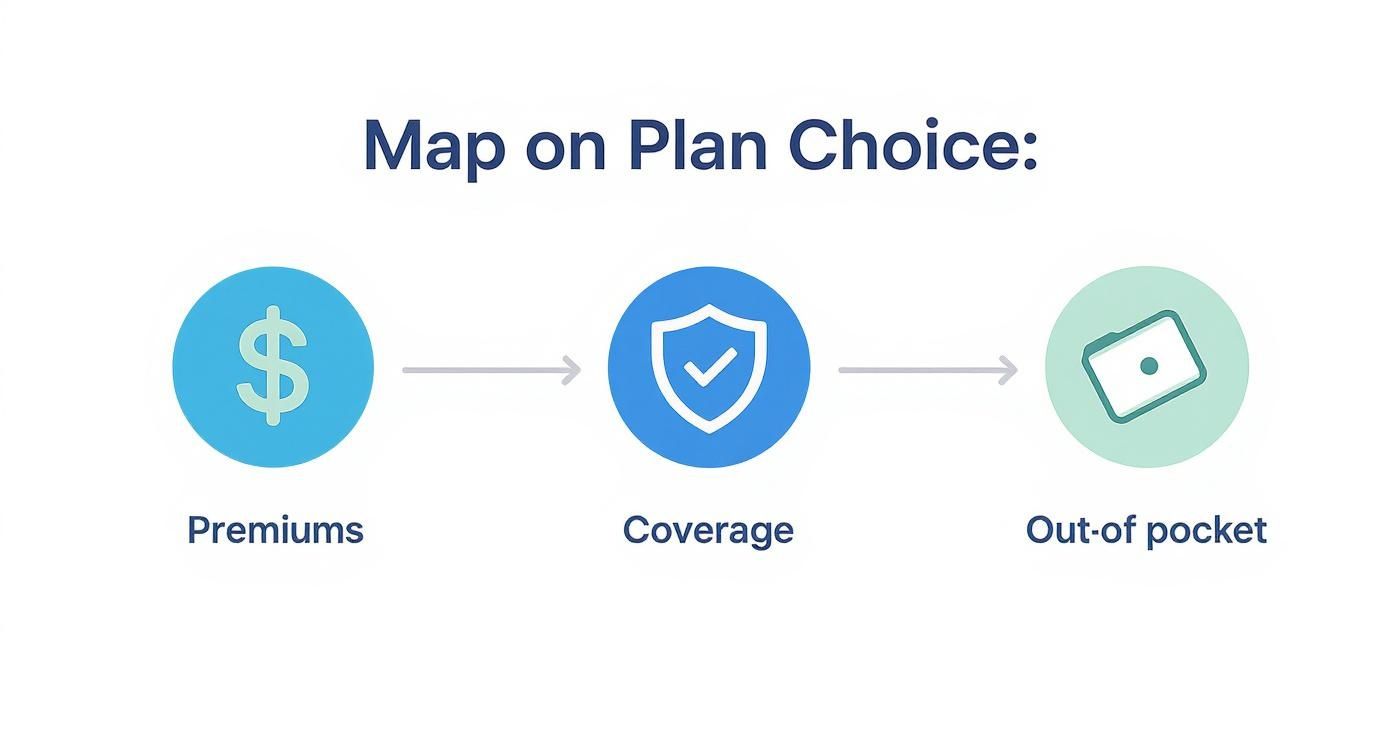
It’s a constant balancing act. Paying a little more upfront in premiums can save you a fortune in unexpected costs down the road.
The Critical Timeline for Enrolling in Medicare Part B
Now for a crucial piece of advice. Most feds get Medicare Part A (Hospital Insurance) for free, but Part B (Medical Insurance) has a monthly premium. It can be tempting to try and save a few bucks by skipping it, but this is one of the costliest financial blunders you can make.
If you delay your Part B enrollment without a valid reason, you get hit with a permanent late enrollment penalty.
This isn't a slap on the wrist. It’s a lifelong surcharge added to your Part B premium. The penalty increases your premium by 10% for each full 12-month period you could have had Part B but didn't sign up. It never goes away.
To avoid this costly mistake, you need to enroll during your Initial Enrollment Period (IEP). This is a seven-month window that opens up around your 65th birthday:
The three months before your 65th birthday month
The month you turn 65
The three months after your 65th birthday month
What if you're still working for the government when you turn 65? Good news. As long as you're covered by FEHB as an active employee, you can delay enrolling in Part B without penalty. You’ll get a Special Enrollment Period (SEP) that starts once you retire. Our in-depth article explaining Federal Employee Health Benefits dives deeper into these rules.
Optimizing Your FEHB Plan with Medicare
Once you have both Medicare Parts A and B in your corner, your FEHB needs a fresh look. Since Medicare is now covering the lion's share of your major medical bills, you probably don't need the most expensive, top-of-the-line FEHB plan anymore. This is a golden opportunity to save some serious money without sacrificing great care.
Many retirees find they can switch to a lower-cost FEHB plan—like a local HMO or another option with a cheaper premium—because its main job is now just to fill in the gaps Medicare leaves behind. Better yet, some FEHB plans will even give you a partial reimbursement for your Medicare Part B premiums if you show them proof of enrollment, putting more money back in your pocket.
When the next Open Season rolls around, take the time to compare plans with your new Medicare coverage in mind. Look for options that play well with Medicare and offer perks like lower premiums or those Part B reimbursements. This simple adjustment ensures your federal employee health insurance in retirement is working as efficiently as possible, giving you maximum protection for the lowest cost.
Making Smart Moves During Open Season
Open Season is more than just an annual administrative drill. For federal retirees, this is the critical moment each year to take a hard look at your healthcare coverage. Think of it as an annual check-up for your financial health, ensuring your plan still fits where you are in life.
This isn't the time to be on autopilot. Simply sticking with the same old plan out of habit—a trap many fall into—can be an incredibly costly mistake. Your health needs change, prescription costs fluctuate, and the plans themselves are tweaked every single year. Making an active, informed decision is the only way to keep your federal employee health insurance in retirement working for you.
Your Annual Open Season Playbook
To get the most out of Open Season, you need a game plan. It’s about more than just glancing at the new premium. You have to dig in and see if your current plan is still giving you the best bang for your buck based on your specific situation.
The goal is to thoughtfully assess three key areas: your personal health, your total costs, and any changes the plan has made for the upcoming year. A structured review like this prevents nasty surprises down the road and lets you choose with confidence, protecting both your health and your wallet.
A common mistake is getting fixated on the monthly premium. The "best" plan isn't always the cheapest one; it's the one that provides the most value and financial protection for your personal health needs.
Your Annual Open Season Review Checklist
Walking through a checklist is a great way to make sure you don't miss anything important when comparing your current plan to other options. Here’s a simple framework to guide your review.
Checklist ItemWhat to Look ForAction to TakeReview Your Health NeedsHave you been diagnosed with a new condition? Are you planning a major surgery or procedure in the coming year?List your expected doctor visits, treatments, and specialists. Confirm they are covered and in-network under any plan you consider.Analyze Prescription CostsCheck each plan's formulary (its list of covered drugs). Have any of your medications been dropped or moved to a more expensive tier?Use the plan comparison tools to enter your exact prescriptions and dosages. This will show you the real out-of-pocket costs for each plan.Check for Benefit ChangesRead the plan brochure's "Summary of Benefits and Coverage." Look for changes in deductibles, copays, out-of-pocket maximums, and network providers.Pay close attention to the out-of-pocket maximum. This number is your ultimate financial safety net in a worst-case health scenario.Evaluate Network AdequacyIs your trusted primary care doctor still in the network? What about the specialists you see or the hospital you prefer?Use the plan's online provider directory to verify that your key doctors and facilities are still participating. This is non-negotiable, especially for HMOs.
Taking the time to go through these steps ensures you’re making a decision based on facts, not just habit.
Using OPM's Tools to Find the Best Value
The Office of Personnel Management (OPM) offers a fantastic online plan comparison tool, and it should be your go-to resource during Open Season. This site lets you put plans side-by-side to compare benefits, rates, and even customer satisfaction scores.
Don't just skim the surface. You can filter plans based on what matters to you, like finding one that coordinates well with Medicare or offers specific wellness programs. Honestly, spending just an hour with this tool can save you thousands of dollars and give you peace of mind. It turns what can feel like an overwhelming process into a clear, data-driven decision.
Protecting Your Family with Survivor Coverage

Your Federal Employees Health Benefits (FEHB) plan isn't just about you—it’s a critical safety net for your entire family. Making sure that protection continues for your loved ones after you’re gone is one of the most important parts of retirement planning.
But this legacy of security doesn't just happen. It all comes down to specific, and often irreversible, decisions you have to make the moment you retire. A mistake here can have permanent and heartbreaking consequences, potentially leaving your surviving spouse without access to affordable healthcare when they need it most.
Let's walk through exactly how survivor benefits work so you can provide lasting peace of mind for your family.
The Irrevocable Choice: Survivor Annuity
The absolute key to unlocking survivor FEHB coverage is electing a survivor annuity for your spouse when you fill out your retirement application. It's that simple, and that serious. If you don't make this election, your spouse's eligibility for FEHB coverage vaporizes the moment you pass away.
Think of the survivor annuity as the master switch for their future health insurance. By choosing to provide a portion of your pension to your spouse after you’re gone, you’re also preserving their right to stay enrolled in an FEHB plan. Of course, they will still be responsible for paying their share of the premiums.
This is a monumental decision. Once you submit your retirement paperwork, your choice is generally locked in for good.
Critical Alert: If you do not elect a survivor benefit for your spouse at retirement, they will lose access to FEHB coverage permanently after your death. This decision cannot be changed later.
How Your Enrollment Type Matters
The type of FEHB plan you have in retirement directly impacts who is covered and how the survivor benefit works. You must have a family plan in place for your spouse to be able to continue coverage.
Here’s the breakdown:
Self Only: This plan covers only you, the retiree. It offers no path for a surviving spouse to continue FEHB coverage.
Self Plus One: This covers you and one eligible family member, which is usually your spouse. It’s a popular and cost-effective option for couples.
Self and Family: This enrollment covers you, your spouse, and any eligible dependent children under 26.
As long as you are enrolled in either a Self Plus One or Self and Family plan when you die, and you've elected a survivor annuity, your eligible family members can keep their FEHB coverage.
While FEHB is all about health coverage, you might also want to explore another layer of financial protection for your family. We cover that in our guide on federal employee life insurance after retirement.
Getting these choices right ensures your commitment to your family’s well-being extends far into the future, creating a lasting legacy of health and security.
Answering Your Top Questions About FEHB in Retirement
Once you start digging into the details of your FEHB, you'll inevitably run into some specific "what if" scenarios. Let's walk through some of the most common questions federal retirees have so you can feel confident about your long-term coverage.
We'll tackle these one by one.
Can I Suspend My FEHB Coverage?
Yes, you can, but only under certain circumstances. You have the option to suspend your FEHB enrollment if you're covered by another qualified plan, like Medicare Advantage, TRICARE, or CHAMPVA.
The key word here is suspend, not cancel. Think of suspending as hitting the pause button. It's a strategic move that saves your spot, letting you re-enroll in FEHB during a future Open Season or if you happen to lose your other insurance. Canceling, on the other hand, is pulling the plug for good—a permanent decision you can't take back.
This can be a smart way to lower your monthly insurance bill, but you have to do your homework. Carefully compare the other plan's network, prescription benefits, and out-of-pocket costs to make sure you aren't unknowingly giving up crucial coverage.
Important Distinction: Suspending FEHB keeps your eligibility intact for the future, while canceling your enrollment means you lose access to the program for good.
What Happens to FEHB if I Divorce After Retiring?
A divorce after you've already retired is a major life event, and it has a direct impact on your health benefits. When a divorce is finalized, your ex-spouse might be able to continue their FEHB coverage under special rules, such as the Spouse Equity Act or through a temporary continuation of coverage (TCC).
The catch is that they will have to pay the full premium cost on their own, including the portion the government used to pay for you. As the retiree, you need to report the divorce to your retirement system right away. This allows you to change your enrollment from a family plan down to "Self Plus One" (if you still have another eligible dependent) or "Self Only."
You can make this change outside of the usual Open Season window, but don't drag your feet—it needs to be done in a timely manner.
Is Medicare Part D Necessary for Prescription Drugs?
For the vast majority of federal retirees who stick with their FEHB plan, the answer is a resounding no. Signing up for a separate Medicare Part D plan for your prescriptions is almost always redundant and a waste of money.
Why? Because every single FEHB plan is required by law to provide "creditable" prescription drug coverage. That's just a technical way of saying that the drug benefits in your FEHB plan are at least as good as, or better than, the standard Medicare Part D plan.
Paying for a Part D plan on top of FEHB means you're paying an extra premium for benefits you already have. It’s like buying two tickets for the same flight—it doesn’t get you there any faster, it just costs you more.
Getting these rules right is a cornerstone of a secure retirement. Federal Benefits Sherpa offers personalized retirement planning and gap analysis to help you understand every detail of your benefits. Book a free 15-minute benefit review to ensure you're making the best choices for your future at https://www.federalbenefitssherpa.com.

Dedicated to helping Federal employees nationwide.
“Sherpa” - Someone who guides others through complex challenges, helping them navigate difficult decisions and achieve their goals, much like a trusted advisor in the business world.
Email: [email protected]
Phone: (833) 753-1825
© 2024 Federalbenefitssherpa. All rights reserved