
Blogs

Blog title place here
We understand that every federal employee's situation is unique. Our solutions are designed to fit your specific needs.

Blog title place here
We understand that every federal employee's situation is unique. Our solutions are designed to fit your specific needs.

Blog title place here
We understand that every federal employee's situation is unique. Our solutions are designed to fit your specific needs.
FEHB and Medicare A Federal Retiree's Guide
When you're a federal employee approaching retirement, figuring out how to handle your FEHB and Medicare is probably the single most important healthcare decision you'll face.
Let's cut to the chase: for most federal retirees, the best move is to keep their FEHB plan and enroll in both Medicare Parts A and B. When you combine them, you create an incredibly strong safety net. Medicare becomes your primary insurance, paying first, and your FEHB plan steps in to cover most of what's left.
Your Guide to Navigating FEHB and Medicare
Retirement planning is full of big decisions, but none hit closer to home than your health insurance. For your entire career, the Federal Employees Health Benefits (FEHB) program has been your go-to. Now, as you near age 65, Medicare comes into play, and it's easy to feel a bit lost in the maze of new options, costs, and rules.

The real question isn't about choosing FEHB or Medicare; it's about figuring out how to make them work together for you. This guide is your roadmap. We’ll cut through the jargon and lay out the essentials so you can build a healthcare strategy that protects both your physical and financial well-being in retirement.
Building Your Healthcare Foundation
Think of it like putting together a puzzle. You have several key pieces: your FEHB plan, Medicare Part A (for hospital stays), and Medicare Part B (for doctor visits and outpatient care). When you connect them the right way, they create a seamless picture of near-total coverage.
This guide will walk you through:
How FEHB and Medicare work in tandem to slash your out-of-pocket medical costs.
The critical enrollment deadlines you absolutely must not miss to avoid lifelong penalties.
Why paying two premiums—one for FEHB and one for Medicare Part B—is often a brilliant financial decision.
By layering these two powerful health plans, many federal retirees discover they have little to no out-of-pocket costs for their medical care. This transforms healthcare from a potential financial storm into a predictable, manageable expense in your retirement budget.
How FEHB and Medicare Work Together
When you retire from federal service and sign up for Medicare, you're not replacing your health insurance. You're creating a powerful healthcare partnership. Figuring out how FEHB and Medicare coordinate is the absolute key to unlocking incredible savings and what I like to call "bulletproof" coverage in retirement.
Think of it like a buddy cop movie. Medicare is the experienced, lead detective who takes charge first. Your FEHB plan is the reliable partner who backs them up and makes sure nothing gets missed. This relationship completely changes how your medical bills are handled.
Primary vs. Secondary Payer: Who Pays First?
Once you're retired and enrolled in both Medicare Part B and an FEHB plan, a switch flips. Medicare automatically steps into the role of your primary insurance for almost all of your medical care.
So, every time you see a doctor, go for outpatient surgery, or get lab work done, the provider sends the bill straight to Medicare first.
Medicare looks at the claim, applies its rules, and pays its share—which is typically 80% of the Medicare-approved amount for services covered by Part B. Whatever is left over, like your Part B deductible and the remaining 20% coinsurance, gets passed along to your FEHB plan.
This is where the magic happens. Your FEHB plan, now acting as the secondary payer, takes that remaining bill and, in most cases, pays it off completely. It's designed to fill in the gaps that Medicare leaves behind.
This coordination is the secret sauce for federal retirees. With Medicare paying the lion's share and FEHB cleaning up the rest, many people find their out-of-pocket costs for doctor's visits and hospital care drop to practically zero.
A Real-World Example of How Your Bills Get Paid
Let's walk through a quick, common scenario to see how this plays out. Imagine you have a medical procedure with a final bill of $5,000.
Bill Goes to Medicare First: The provider submits the $5,000 bill directly to Medicare.
Medicare Pays Its Share: Let's assume the procedure is fully covered and you’ve already paid your small annual Part B deductible. Medicare pays 80% of the approved cost, which is $4,000.
FEHB Gets the Remainder: A $1,000 balance is now left. This is automatically forwarded to your FEHB plan.
FEHB Covers the Rest: Your FEHB plan processes that remaining $1,000 and, because of the way these plans are set up to coordinate, pays it in full.
The result? That $5,000 medical bill costs you nothing out-of-pocket. This seamless handoff eliminates the deductibles, copayments, and coinsurance you're used to paying when you only have an FEHB plan.
Why This System Works So Well
This primary-secondary setup is precisely why so many federal benefits experts and financial planners advise keeping both plans. There's a reason this strategy is the go-to for savvy federal retirees. In fact, around 70% of federal retirees sign up for Original Medicare when they become eligible, and nearly all of them keep their FEHB plan right alongside it. You can explore more data on how federal employees navigate their benefits to see just how common this approach is.
This structure gives you some major advantages:
See Almost Any Doctor: With Medicare as your primary, your network becomes massive. You can see any doctor or go to any hospital in the country that accepts Medicare, even if they aren't in your FEHB plan's little black book.
Slash Your Medical Costs: The combined power of both plans often wipes out your out-of-pocket costs for services that are covered by both.
Keep Your Great Drug Coverage: You get to hang on to your FEHB plan's prescription drug benefits, which are generally far superior and more cost-effective than a standalone Medicare Part D plan.
At the end of the day, coordinating FEHB and Medicare isn't just about carrying two insurance cards. It's about building a financial shield that protects you and your retirement savings from the high and unpredictable cost of healthcare.
Critical Medicare Enrollment Timelines
When it comes to Medicare, timing isn't just important—it's everything. Missing a deadline can trigger permanent financial penalties that will stick with you for the rest of your life. For federal employees, understanding these timelines is absolutely crucial for a smooth, cost-effective transition into retirement healthcare.
The first key date is your 65th birthday. This kicks off your Initial Enrollment Period (IEP), a seven-month window to sign up for Medicare. It starts three months before the month you turn 65 and ends three months after.
But, if you're still an active federal employee with FEHB coverage, you have a major advantage. Your FEHB plan is considered "creditable coverage," which means you can delay enrolling in Medicare Part B without getting hit with any late enrollment penalties. This lets you avoid paying the Part B premium while you're still working and covered by your FEHB plan as your primary insurance.
The Special Enrollment Period: Your One Shot
Once you officially retire or separate from federal service, a new and incredibly important clock starts ticking. This is your Special Enrollment Period (SEP) to sign up for Medicare Part B. It's a one-time, eight-month window to enroll without penalty, and it begins the month after your employment ends.
Once you have both plans working together, your medical bills are processed with Medicare paying its share first, and then your FEHB plan picking up most of what's left.
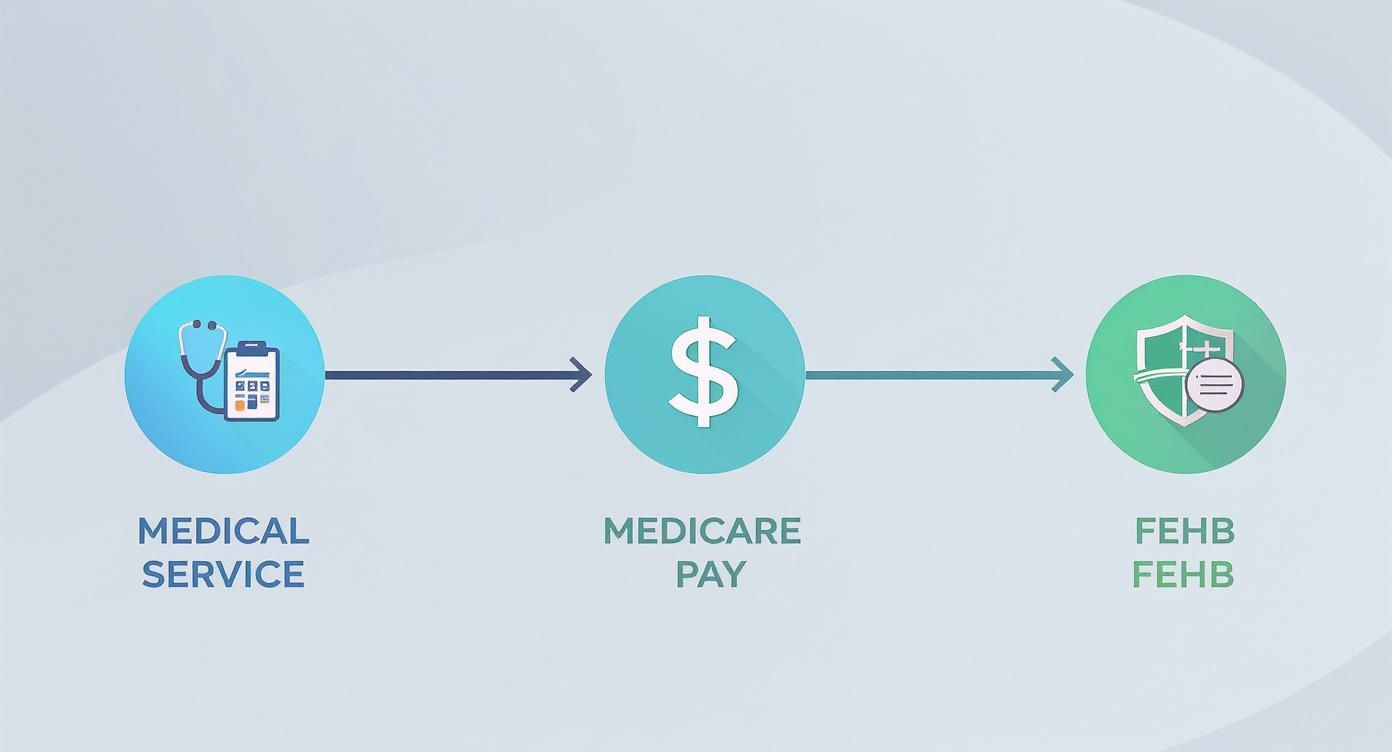
This coordination is why getting enrolled in Part B during your SEP is so vital—it's what makes this powerful cost-saving partnership work.
Think of your SEP as a hard, non-negotiable deadline. If you miss it, you'll likely have to wait for the next General Enrollment Period (which runs from January 1st to March 31st) to sign up, and your coverage won't even start until July 1st. Worse yet, you'll trigger a lifelong penalty.
The High Cost of Missing Your Window
The Medicare Part B late enrollment penalty is both severe and permanent. For every full 12-month period you were eligible for Part B but didn't sign up, your monthly premium increases by 10%. This isn't a one-off fee; it's a surcharge that gets tacked onto your premium every single month for as long as you have Part B.
Let's walk through a real-world example:
Scenario: You retire at age 66 but decide to wait three years before enrolling in Part B, completely missing your eight-month SEP.
Penalty Calculation: That's a 10% penalty for each of those three years, adding up to a permanent 30% surcharge on your premium.
Financial Impact: If the standard Part B premium is $185 per month, your new premium would be $240.50 per month. That's an extra $666 out of your pocket every year, for the rest of your life.
The late enrollment penalty is one of the most expensive and easily avoidable mistakes a federal retiree can make. It really highlights why you have to be proactive and know your specific timeline as retirement gets closer.
Getting your Part B timing right is just as critical as knowing how to maximize Social Security, since both decisions have a huge, lasting impact on your retirement income. To avoid these costly errors, circle your retirement date on the calendar and make sure you get that Medicare Part B application submitted well within your eight-month SEP.
Breaking Down the Costs of FEHB and Medicare
When you first look at keeping FEHB and enrolling in Medicare Part B, the idea of paying two separate premiums can be a little jarring. It's a common reaction, but it’s crucial to look past the monthly payments and see the whole picture of your potential healthcare spending.
The real financial power of combining FEHB and Medicare isn’t found in the premiums you pay, but in the catastrophic out-of-pocket costs you avoid.
Adding Up the Premiums
Let's start with a cost you're already familiar with: your FEHB premium. The thing is, these premiums don't stay flat. In fact, the FEHB program is facing one of its biggest premium hikes in over a decade.
For 2025, federal employees and retirees are looking at an average out-of-pocket premium jump of 13.5%. This isn't a one-off event; it follows several years of significant increases, signaling a trend that directly impacts your retirement budget. You can read more about the 2025 FEHB premium changes and what to consider.
Next, you'll add the Medicare Part B premium to your budget. In 2025, the standard monthly premium for most people just starting is $185. This is usually taken right out of your Social Security check, so it's a predictable, no-fuss expense.
So, let's say your FEHB self-only plan runs you $300 a month. Add the $185 for Part B, and your total monthly premium is $485. That number might raise an eyebrow, but think of it as an investment in a powerful financial shield that offers truly comprehensive coverage.
Think of it less as "paying for two plans" and more as "investing in a system that virtually eliminates unexpected medical bills." This shift in perspective is key to understanding the financial power of this combination.
Where the Real Savings Kick In
This is where the strategy really shines. Even though you’re paying two premiums, the way Medicare and FEHB work together can wipe out nearly all of your other medical costs.
Once you’re retired and Medicare becomes your primary insurance, it pays its 80% share first. Then, your FEHB plan steps up as the secondary payer and, in most cases, cleans up the rest—the deductibles, the copays, and the coinsurance.
This means you can say goodbye to:
Your FEHB plan's high deductible: It’s often completely waived once Medicare takes the lead.
Doctor visit copayments: Most FEHB plans waive these when you have Part B.
Hospital and surgery coinsurance: That remaining 20% that Medicare doesn't cover? Your FEHB plan typically pays it in full.
Here's a look at how this might play out in a real-world scenario.
Sample Annual Healthcare Cost Comparison
This table offers a hypothetical look at the potential out-of-pocket costs for a retiree facing a significant medical event. It compares someone with only an FEHB plan to someone who has coordinated their FEHB with Medicare Part B.
Cost ComponentFEHB Only (Estimate)FEHB + Medicare Part B (Estimate)Annual FEHB Premium$3,600$3,600Annual Medicare B Premium$0$2,220Total Annual Premiums$3,600$5,820Plan Deductible (Medical)$1,500$0 (Waived)Coinsurance for Major Surgery$5,000$0 (Covered)Total Out-of-Pocket$10,100$5,820
As you can see, while the annual premium cost is higher with both plans, the total out-of-pocket expense in a high-cost year is significantly lower and, more importantly, predictable.
The result is a healthcare budget you can actually rely on. Your costs are almost entirely limited to your fixed monthly premiums, which protects you from the financial shock of a major illness or sudden surgery. For more information on how this works, our complete guide on federal employee health insurance after retirement is a great resource.
Ultimately, by paying for both FEHB and Medicare, you are buying peace of mind. You’re building a safety net where a $50,000 medical event is likely to cost you nothing out-of-pocket beyond your premiums. For countless federal retirees, this dual-premium strategy turns out to be one of the smartest financial decisions they make for a secure and worry-free retirement.
Making Your Decision with Real-World Scenarios

Theory is one thing, but seeing how the FEHB and Medicare decision plays out in real life is often the best way to connect the dots. All the talk about enrollment periods and payer rules clicks into place when you see it through the eyes of people who have been there.
To help you see the road ahead more clearly, let's walk through three common scenarios. Each one features a federal employee at a different point in their career, facing the exact same crossroads you are.
Scenario 1: The Proactive Planner
Meet David. He’s 66, still loves his federal job, and has no immediate plans to punch the clock for the last time. But he’s a planner. He knows his FEHB coverage is rock-solid, but he’s also heard the whispers about Medicare deadlines and wants to get ahead of the game.
David's Challenge:
How can he get the ball rolling with Medicare without paying for Part B while he’s still working and covered by his FEHB plan?
David's Smart Steps:
He Enrolls in Part A: The moment he turned 65, David signed up for Medicare Part A during his Initial Enrollment Period. Since he’s worked long enough to have the required 40 quarters, it was completely premium-free. A total no-brainer.
He Delays Part B: Because he’s still an active employee, his FEHB plan is his primary insurance. So, he correctly deferred enrolling in Medicare Part B. This simple move saves him from paying the monthly Part B premium (currently $185 a month) for coverage he doesn't need yet.
He Plans for Retirement: David maps out his retirement for age 68. He marks the date and, more importantly, sets a reminder to enroll in Part B within the first few months of his eight-month Special Enrollment Period (SEP) that will kick off right after he retires.
The Outcome:
By understanding the rules, David completely sidesteps unnecessary premiums. Better yet, he’s perfectly positioned to enroll in Part B later without facing a single dollar in late enrollment penalties. His foresight means his transition into retirement healthcare will be seamless and financially sound.
Scenario 2: The Timely Retiree
Now, let's look at Susan. She just retired from federal service right at age 65. Her goal was to line up her retirement with her Medicare eligibility so her FEHB and Medicare coverage could start working together from day one to crush any potential out-of-pocket costs.
Susan's Challenge:
As a brand-new retiree, how does she get everything set up to create that powerful dual-coverage system we've been talking about?
Susan's Action Plan:
Enrolls in Part B: Susan’s eight-month SEP began the month after she retired, and she used it right away to enroll in Medicare Part B. She filled out the application and sent the Social Security Administration proof of her recent FEHB coverage.
Contacts Her FEHB Plan: As soon as her Medicare card arrived with the Part B effective date, she called her FEHB provider. She let them know she was officially on Medicare Parts A and B, which is the trigger that flips the switch on who pays first.
Reviews Her FEHB Options: When the next FEHB Open Season rolled around, Susan did some comparison shopping. She specifically looked for plans that offered excellent "wraparound" benefits for people on Medicare, like lower co-pays or even a partial reimbursement of her Part B premium.
The Outcome:
Susan did it. She successfully established Medicare as her primary insurer, with FEHB now acting as her secondary. The very next time she had a specialist appointment, she owed nothing. She built the comprehensive safety net that will protect her finances for the rest of her life.
Scenario 3: The Costly Delay
Finally, there’s Frank. He retired from his federal post at 66, but he was skeptical. Why pay for another insurance plan? He decided to "wait and see," figuring he could always just sign up for Medicare Part B later if a health problem popped up.
Frank's Challenge:
He completely missed his eight-month Special Enrollment Period. Now he's 69, and a recent health scare made him realize he desperately needs the broader coverage Medicare offers. What's the damage from his delay?
Missing your one-time Special Enrollment Period is one of the most financially damaging and irreversible mistakes a federal retiree can make. The resulting penalties are permanent.
The Painful Consequences:
A Lifelong Penalty: Frank now has to wait for the General Enrollment Period (January 1 to March 31) just to apply. Because he waited three full years after his SEP closed, he’s facing a 30% late enrollment penalty (10% for each 12-month period he delayed). This isn't a one-time fee; it's tacked onto his Part B premium every single month for the rest of his life.
A Dangerous Coverage Gap: Even after he enrolls, his Medicare coverage won’t kick in until July 1st. He’s left exposed without primary insurance for several more months.
The Lifetime Cost: If the standard Part B premium is $185, Frank’s penalty means he'll pay an extra $55.50 every month. That’s an extra $666 per year. Over a 20-year retirement, that one decision to "wait and see" will cost him over $13,000.
The Outcome:
Frank's procrastination led to significant and permanent financial harm. His story is a stark warning that when it comes to coordinating FEHB and Medicare, timing isn't just important—it's everything.
Exploring Alternatives to Original Medicare
While pairing your FEHB plan with Original Medicare is the path most federal retirees take, it's not the only route. You'll definitely come across another option: Medicare Advantage plans. These plans, also known as Part C, can look very tempting on the surface with their low (or even zero-dollar) premiums and all-in-one benefits.
But you have to understand, they work in a completely different way.
Think of Original Medicare as a nationwide "hall pass" that lets you see any doctor who accepts Medicare, no questions asked. A Medicare Advantage (MA) plan, on the other hand, is more like a membership to a specific health club. It’s run by a private insurance company that bundles Parts A, B, and usually D (prescriptions) together. The catch? You're often restricted to a local network of doctors and hospitals.
Medicare Advantage vs. FEHB Coordination
Here’s the most important difference you need to know: you cannot use FEHB to supplement a Medicare Advantage plan like you can with Original Medicare. It just doesn't work that way. To join a Medicare Advantage plan, you are required to suspend your FEHB coverage.
This is a major decision with some serious risks attached. You can suspend FEHB, but you have to follow the Office of Personnel Management's (OPM) rules to the letter. If you decide later that you want your FEHB plan back—maybe your MA plan's network shrinks or the costs go up—you can generally do it during the annual Open Season.
CRITICAL WARNING: Suspending FEHB to join a Medicare Advantage plan is a high-stakes move. If you don't follow the exact re-enrollment procedures down the road, you could permanently and irrevocably lose your FEHB eligibility for life.
The Question of Prescription Drug Plans
Another alternative you might see are standalone Medicare Part D plans for prescriptions. For nearly every federal employee and retiree, this is an unnecessary expense.
Why? Because your FEHB plan’s drug coverage is considered "creditable coverage" by Medicare. That’s just a fancy way of saying it's as good as, or better than, what a standard Part D plan offers. Since you already have great coverage, there's no reason to pay for a separate Part D plan. You also won't ever face a late enrollment penalty if you need to sign up for Part D later for some reason.
The market for these plans is also changing. We’ve seen a slowdown in Medicare Advantage and Part D enrollment growth, which only increased by about 4% in 2025. At the same time, the number of standalone drug plans offered was cut by 26%, which suggests the market is stabilizing. These shifts could affect the options available to all retirees. You can discover more insights about these 2025 enrollment trends.
When it comes down to it, alternatives like Medicare Advantage introduce complexities and risks that simply don't exist when you stick with the tried-and-true combination of FEHB and Original Medicare. For the vast majority of feds, keeping your FEHB plan for drug coverage is the most reliable and sensible strategy.
Common Questions About FEHB and Medicare
It's completely normal to have questions when you're trying to figure out how FEHB and Medicare fit together. Let's tackle some of the most common ones we hear from federal employees and retirees.
Do I Have to Pay for Both FEHB and Medicare Part B?
This is a big one. The short answer is no, it's not mandatory. However, most federal retirees find that keeping both and paying both premiums is the smartest financial move for their retirement healthcare.
When you have both, Medicare steps up to become your primary coverage, and your FEHB plan shifts into a secondary role. This one-two punch is incredibly powerful. It often means you’ll have very few out-of-pocket costs because your FEHB plan picks up what Medicare doesn't cover, like deductibles and copays. The result? Predictable, minimal healthcare spending when you need it most.
Should I Sign Up for Medicare If I Work Past Age 65?
If you're still working for the federal government when you turn 65, the strategy is pretty straightforward. You should definitely sign up for Medicare Part A—it’s premium-free for most people, so it costs you nothing. Think of it as laying the groundwork for your future coverage.
You can, however, safely hold off on enrolling in Medicare Part B without facing any late-enrollment penalties. As long as you are an active employee, your FEHB plan remains your primary insurance. When you eventually retire, you’ll get a special eight-month window to sign up for Part B.
The key takeaway is that active employment protects you from late enrollment penalties, giving you the flexibility to time your Part B enrollment with your retirement date.
Can I Suspend My FEHB to Use a Medicare Advantage Plan?
Technically, yes, you can suspend your FEHB to enroll in a Medicare Advantage (MA) plan. But—and this is a big but—it's a high-stakes decision that you should approach with extreme caution.
While you can re-enroll in FEHB during a future Open Season if you leave the MA plan, the process is wrapped in very strict OPM rules. If you don't follow the procedures perfectly, you could permanently and irreversibly lose your FEHB benefits for life. For many retirees, that's a gamble they're just not willing to take.
Understanding how these critical benefits coordinate is the key to a secure retirement. The decisions you make can impact your finances for decades. At Federal Benefits Sherpa, we specialize in helping federal employees create a clear and confident path forward. Schedule your free 15-minute benefits review today to ensure your strategy is built for success at https://www.federalbenefitssherpa.com.


Dedicated to helping Federal employees nationwide.
“Sherpa” - Someone who guides others through complex challenges, helping them navigate difficult decisions and achieve their goals, much like a trusted advisor in the business world.
Email: [email protected]
Phone: (833) 753-1825
© 2024 Federalbenefitssherpa. All rights reserved